


Free Speech vs. “Censorship By Proxy”: Parler’s Amy Peikoff vs. Facebook’s Mark Zuckerberg
Parler’s chief policy officer, the thoughtful Amy Peikoff, has an enlightening interview on Spiked Online on the app’s cancellation by Big Tech. According to Ms. Peikoff, "Parler’s mission has always been to allow people to express themselves freely to the maximum extent possible consistent with the law and with our own business purposes...." and that the answer to so-called "hate speech" is " more speech."In regards to Parler differentiating itself from Twitter and Facebook, Peikoff states that Parler "want[s] to respect the privacy of users. Unlike with Twitter and Facebook, there’s no data mining, profiling, and targeting of ads based on profiles." She adds: "The people on Parler are not the commodity."Peikoff also finds it "scary" that,"Politicians are hauling tech CEOs before Congress and urging them to remove more and more content, even when the particular category of speech in question would be protected by the First Amendment or similar laws around the world."It’s a scary prospect, because we get to a stage where we are not in a completely free country.In regards, to Facebook CEO Mark Zuckerberg's call for what some describe as "censorship by proxy":
"Moreover, Mark Zuckerberg supports new regulations under which platforms would be required to issue so-called transparency reports. These are reports in which firms describe what they have done to deal with ‘objectionable content’, including speech that is protected by the First Amendment."He has gone further to suggest platforms should be required to prove their effectiveness at dealing with that content. If that ends up being put into law, it would represent the government trying to achieve, via regulation of social-media companies, what it could not achieve by directly censoring."Read the full Spiked Online interview here.In an article on her personal website, Don't Let It Go (named after a brilliant article by philosopher Ayn Rand), Peikoff writes on Zuckerberg's proposals:
"Now recall that Mark Zuckerberg, in the most recent Big-Tech-CEO-Hearanguing before Congress, suggested amending Section 230 as follows:Peikoff notes that though Parler was singled out by Amazon, Google, and others, the left-leaning Salon "blame[s] Facebook for playing a much larger role in facilitating the planning that led up to the 6th.Writes Peikoff:"Perhaps you think “transparency” at least, is good. But imagine what information ends up being collected and retained as 'ordinary business records' when complying with this sort of law, and read on.
- “Transparency” – each company enjoying Section 230 immunity would be required to issue periodic reports detailing how it dealt with certain types of “objectionable” content.
- “Accountability” –platforms enjoying immunity could also be held to some minimum level of “effectiveness” with respect to dealing with that “objectionable” content. (Recall he also bragged about how effective Facebook’s “hate speech” algorithms are.)
"....What does Salon hope to gain by blaming Facebook and showing sympathy to Parler? I argue that placing responsibility for user-generated content on platforms plays right into the totalitarians’ hands."With all the platforms now being blamed for user-generated content containing threats or incitement, the new Congress needs only to accept Mark Zuckerberg’s engraved invitation to amend Section 230 along the above lines. But, as we’ve learned in the last week, no system of guidelines enforcement is perfect. If Facebook, with all its algorithms and other resources could not 'adequately' deal with this content, then what company could?"If it’s not actually possible to be good at this, to the standard that everyone seems to expect, and Zuckerberg is calling for all of us to be regulated according to that standard, then what exactly is he calling for (whether he realizes it or not)? For government to take over, to have arbitrary control. For all online platforms to operate only by permission of government, according to whatever standards politicians (or the Twitter mobs pulling their strings) deem fit—and this will be true with respect to both free speech and privacy."I would love to see a debate between Facebook's CEO Mark Zuckerberg and Parler's CPO Amy Peikoff on this vital issue.For context, below is a video interview with Tucker Carlson on the targeting of Parler by Google, Apple, and Amazon:Top Photo: FoxNews Tucker Carlson Show Related:

What a Billion Dollars Can Buy: Elon Musk’s SpaceX Compared with NASA’s Orion
NASA has spent over 23 billion dollars on the Orion spacecraft - that has yet to be able to take a person into space. Writes Eric Berger in "The Orion spacecraft is now 15 years old and has flown into space just once":The Orion spacecraft dates back to 2005, when NASA issued a "request for proposals" to industry with the goal of "developing a new Crew Exploration Vehicle by 2014 that is capable of carrying astronauts beyond low Earth orbit." NASA sought Orion as a building block to land humans on the Moon as part of what became known as the Constellation program. This program was later canceled, but Orion survived. Since that time, according to The Planetary Society's Casey Dreier, NASA has spent $23.7 billion developing the Orion spacecraft. This does not include primary costs for the vehicle's Service Module, which provides power and propulsion, as it is being provided by the European Space Agency.For this money, NASA has gotten a bare-bones version of Orion that flew [without a crew] during the Exploration Flight Test-1 mission in 2014. The agency has also gotten the construction of an Orion capsule—which also does not have a full life support system—that will be used during the uncrewed Artemis I mission due to be flown in 12 to 24 months. So over its lifetime, and for $23.7 billion, the Orion program has produced:How does that compare to Elon Musk's privately run space initiative, SpaceX?
- Development of Orion spacecraft
- Exploration Flight Test-1 basic vehicle
- The Orion capsule to be used for another test flight
- Work on capsules for subsequent missions
SpaceX is generally considered one of the most efficient space companies. Founded in 2002, the company has received funding from NASA, the Department of Defense, and private investors. Over its history, we can reliably estimate that SpaceX has expended a total of $16 billion to $20 billion on all of its spaceflight endeavors. Consider what that money has bought:The author calls this an "extreme" comparison. Far from it, when comparing the economics of capitalism and socialism it is the norm.
- Development of Falcon 1, Falcon 9, and Falcon Heavy rockets
- Development of Cargo Dragon, Crew Dragon, and Cargo Dragon 2 spacecraft
- Development of Merlin, Kestrel, and Raptor rocket engines
- Build-out of launch sites at Vandenberg (twice), Kwajalein Atoll, Cape Canaveral, and Kennedy Space Center
- 105 successful launches to orbit
- 20 missions to supply International Space Station, two crewed flights
- Development of vertical take off, vertical landing, rapid reuse for first stages
- Starship and Super Heavy rocket development program
- Starlink Internet program (with 955 satellites on orbit, SpaceX is largest satellite operator in the world)

Federal Death Agency: COVID Vaccine Created in January 2020 was Blocked By The FDA Until December 2020
Writes David Wallace-Wells in New York Magazine, "We Had the Vaccine the Whole Time":You may be surprised to learn that of the trio of long-awaited coronavirus vaccines, the most promising, Moderna’s mRNA-1273, which reported a 94.5 percent efficacy rate on November 16, had been designed by January 13. This was just two days after the genetic sequence had been made public in an act of scientific and humanitarian generosity that resulted in China’s Yong-Zhen Zhang’s being temporarily forced out of his lab. In Massachusetts, the Moderna vaccine design took all of one weekend. It was completed before China had even acknowledged that the disease could be transmitted from human to human, more than a week before the first confirmed coronavirus case in the United States. By the time the first American death was announced a month later, the vaccine had already been manufactured and shipped to the National Institutes of Health for the beginning of its Phase I clinical trial. This is — as the country and the world are rightly celebrating — the fastest timeline of development in the history of vaccines. It also means that for the entire span of the pandemic in this country, which has already killed more than 250,000 Americans, we had the tools we needed to prevent it .
The author then goes on to regurgitate "the FDA has to approve it" excuse for not banning the sale of the vaccine until the end of 2020:
To be clear, I don’t want to suggest that Moderna should have been allowed to roll out its vaccine in February or even in May, when interim results from its Phase I trial demonstrated its basic safety.
Well, why the hell not?
Shouldn't that judgment on the efficacy of the vaccine be up to each individual? If you have a high probability of dying from COVID-19 if you get it, the vaccine in February 2020 might be worth the risk.
And why not release it in May 2020 when it was proven "safe" by FDA standards (but not yet proven as "efficacious").
Observe that for 41% of voters; the pandemic was the "most important issue facing the country":

What was the FDA waiting for? For Trump to lose the 2020 Presidential election? I seriously hope not. More likely, it is something worse: bureaucratic inertia with a central planning anti-free-market mindset.
Continues the author on the "reasoning" of the experts:
An unsafe vaccine, like the one for polio that killed ten and paralyzed 200 in 1955, could cause medical disaster and public-health backlash — though, as Balloux points out, since none of the new coronavirus vaccines use real viral material, that kind of accident, which affected one in a thousand recipients, would be impossible. (These days, one adverse impact in a million is the rule-of-thumb threshold of acceptability.) An ineffective vaccine could also give false security to those receiving it, thereby helping spread the disease by providing population-scale license to irresponsible behavior (indoor parties, say, or masklessness). But on other matters of population-level guidance, our messaging about risk has been erratic all year, too. In February and March, we were warned against the use of masks, in part on the grounds that a false sense of security would lead to irresponsible behavior — on balance, perhaps the most consequential public-health mistake in the whole horrid pandemic. In April, with schools already shut, we closed playgrounds. In May, beaches — unable or unwilling to live with even the very-close-to-zero risk of socializing outside (often shaming those who gathered there anyway). But in September, we opened bars and restaurants and gyms, inviting pandemic spread even as we knew the seasonality of the disease would make everything much riskier in the fall. The whole time, we also knew that the Moderna vaccine was essentially safe. We were just waiting to know for sure that it worked, too.None of the scientists I spoke to for this story were at all surprised by either outcome — all said they expected the vaccines were safe and effective all along. Which has made a number of them wonder whether, in the future, at least, we might find a way to do things differently — without even thinking in terms of trade-offs.The problem is that "scientists" cannot determine the "trade-offs" for any given individual. Those decisions should be up to the individual, with "experts" providing the facts, allowing each person to decide based on their particular situation and personal priorities, with the government's job to get-out-of-the-way.
Given that the FDA blocked the sale and distribution of a vaccine that could have prevented the death of over a quarter a million Americans, we think the name suggested by Harry Binswanger to be a far more accurate description: Federal Death Agency.
Recommended Reading:
- How a Laissez-faire Capitalist Society Deals with a Vaccine by Harry Binswanger
40% of U.S. COVID-19 Deaths Occur in Long-Term Care (LTC) Facilities
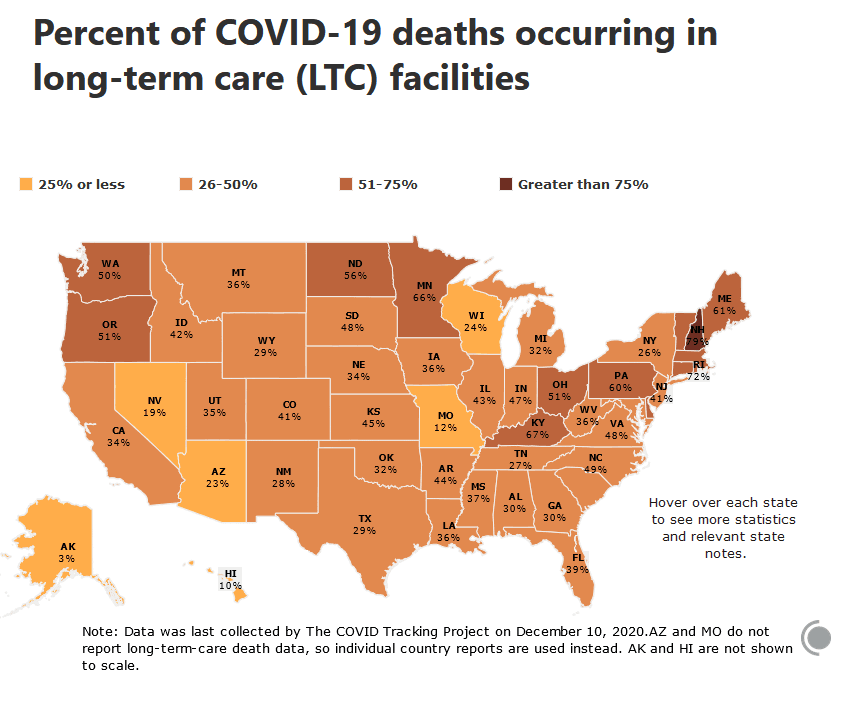 Note: In NY if a person contracted COVID-19 in LTC facility and dies in the hospital, NY counts it as a hospital death and does not attribute it the LTC.
"...the Long-Term Care COVID Tracker is the most comprehensive dataset about COVID-19 in US long-term care facilities. It compiles crucial data about the effects of the pandemic on a population with extraordinary vulnerabilities to the virus due to age, underlying health conditions, or proximity to large outbreaks.The dataset compiles all currently available information of COVID-19 cases and related deaths in long-term care facilities—nursing homes, skilled nursing facilities, assisted living facilities, and other care homes—and tracks both residents and staff.One solution is to "bubble" the home and have staff live full-time on-site during the pandemic:
Currently, most senior homes rely on checkpoints to screen staff as they arrive to work, mainly by asking them questions and taking their temperatures. But these checkpoints can easily fail, because people without symptoms can carry and transmit the coronavirus. Moreover, many staff members work at multiple homes or have family members who work at other facilities. Many senior homes also have been preparing for the pandemic by hiring extra staffers. So it is hardly surprising that the contagion has spread like a chain reaction in senior care homes.[...]A better approach is to pay front line aides and nurses to live on-site through the period when the disease is surging — meaning right now. This is hardship work, requiring staff to work 60 to 80 hours a week without seeing family members. But it could be the best way to protect our elderly. Lowering the number of infections at our senior homes would also allow us to conserve protective equipment, reduce the need for hospital beds and prevent the spread of the disease into communities where staff members live.[...]The result?At homes overwhelmed by Covid-19, having caregivers live on-site would prevent them from bringing the virus home to their families or spreading it through communities, particularly when they commute.
Looking ahead, Covid may recede for much of the country this summer, but I fear that senior homes will remain vulnerable to a new wave of infection. We can prepare for that by having our staff live in our homes.
The result has been promising; we have yet to have a confirmed case of Covid-19 among our residents or staff.Unfortunately, it is more expensive:
But I cannot afford it for much longer, and many other senior care centers could not afford to even start such a program.Hat Tip: Phil Magness