The Bear Fire

From "I cry for the mountains and the legacy lost: The Bear Fire" By Dave Daley, Butte County Rancher & CCA Immediate Past President:
I cry for the forest, the trees and streams, and the horrible deaths suffered by the wildlife and our cattle. The suffering was unimaginable. When you find groups of cows and their baby calves tumbled in a ravine trying to escape, burned almost beyond recognition, you try not to wretch. You only pray death was swift. A fawn and small calf side by side as if hoping to protect one another. Worse, in searing memory, cows with their hooves, udder and even legs burned off who had to be euthanized.[...]I grew up hearing the stories from my Dad and Grandad of the “last man out” lighting the forest floor to burn the low undergrowth. Their generations knew to reduce the ladder fuels that spread the fire to the canopy, to open it up for the wildlife. It was a pact between our friends the Native Americans who had managed it this way for 13,000 years, the loggers, miners and ranchers. They knew ecology and botany and wildlife. They worked together because they loved and knew the land.It was the early 1960s and snow was already on the ground in December on our foothill ranch. I would have been about four and holding my Grandfather’s hand as he lit some piles of brush on fire to open the landscape. It was the practice he had learned from generations before. And the CDF (now Cal Fire) crew showed up, put out the fire, and lectured him for burning. My Grandad was the kindest, gentlest and funniest man I have ever known. And he was mad. It was the beginning of the end for our forest home. And it has proceeded at an unprecedented rate.[...]Look at the mega-fires California has experienced in recent years. If you study them closely, almost all of them start on State or Federally owned land. Fifty percent of California is owned by the feds or state, land that has unmanaged fuel loads because of the restrictions to do anything on the land. Right now, the only buffer to these disasters are private, well managed, grazed landscapes. They may still burn, but the fires are not as catastrophic and can be controlled.[...]Even with the dead cattle on Hartman Ridge that we found, why did we find over half alive here and nowhere else? If anything, I assumed this steep ridge gave them no chance at all. And I realized that there had been a much smaller fire here about five years ago. The country was more open and the fire moved quickly. Less fuel and more things lived. Trees, wildlife, and cows.I observed the same phenomenon in the remnants of the town of Feather Falls—where only a school and cemetery remain. The school had over 80 students less than 50 years ago, until the lumber mill closed and the village died. The school was destroyed by fire. The cemetery, however, still stands with green stately pines respecting the graves of mostly Native American veterans with flags at each grave. The cemetery was maintained free of deadfall and litter by family members. All the trees lived.[...]This is devastating emotionally and financially. And I am not sure of the next steps. I do know this: We must change our land management practices if we expect the West to survive. It is best done locally, not from DC or Sacramento, but I have tilted at windmills before.

California Fires: How 120 Years of Active Fire Suppression Created a Tinderbox in California

From EPA.gov:
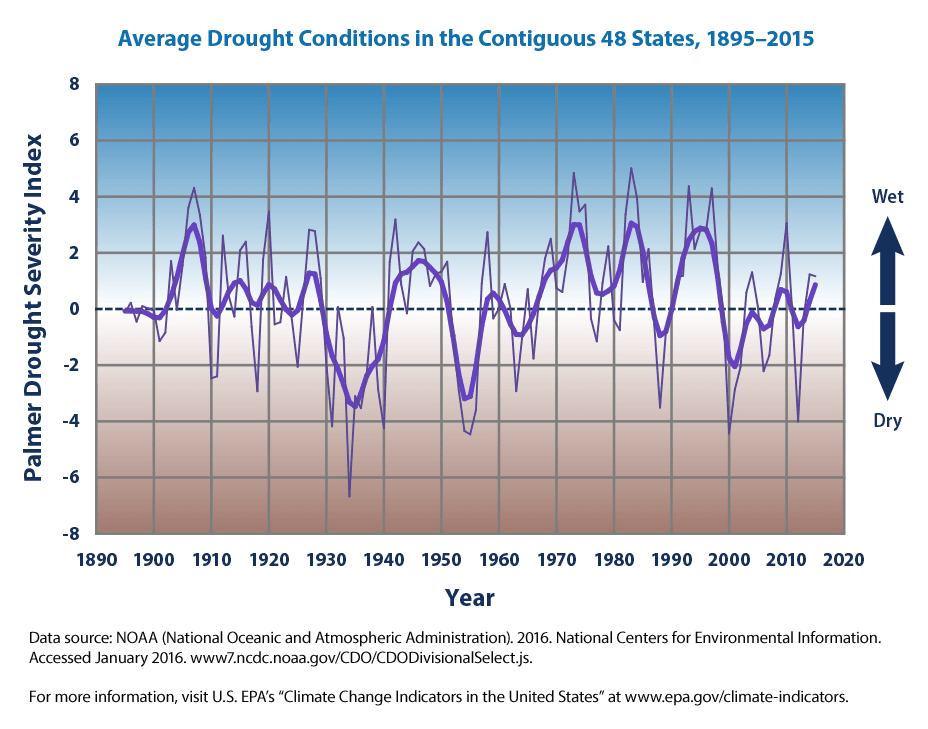
Average drought conditions across the nation have varied since records began in 1895. The 1930s and 1950s saw the most widespread droughts, while the last 50 years have generally been wetter than average (see Figure 1).
"This chart shows annual values of the Palmer Drought Severity Index, averaged over the entire area of the contiguous 48 states. Positive values represent wetter-than-average conditions, while negative values represent drier-than-average conditions. A value between -2 and -3 indicates moderate drought, -3 to -4 is severe drought, and -4 or below indicates extreme drought. The thicker line is a nine-year weighted average."
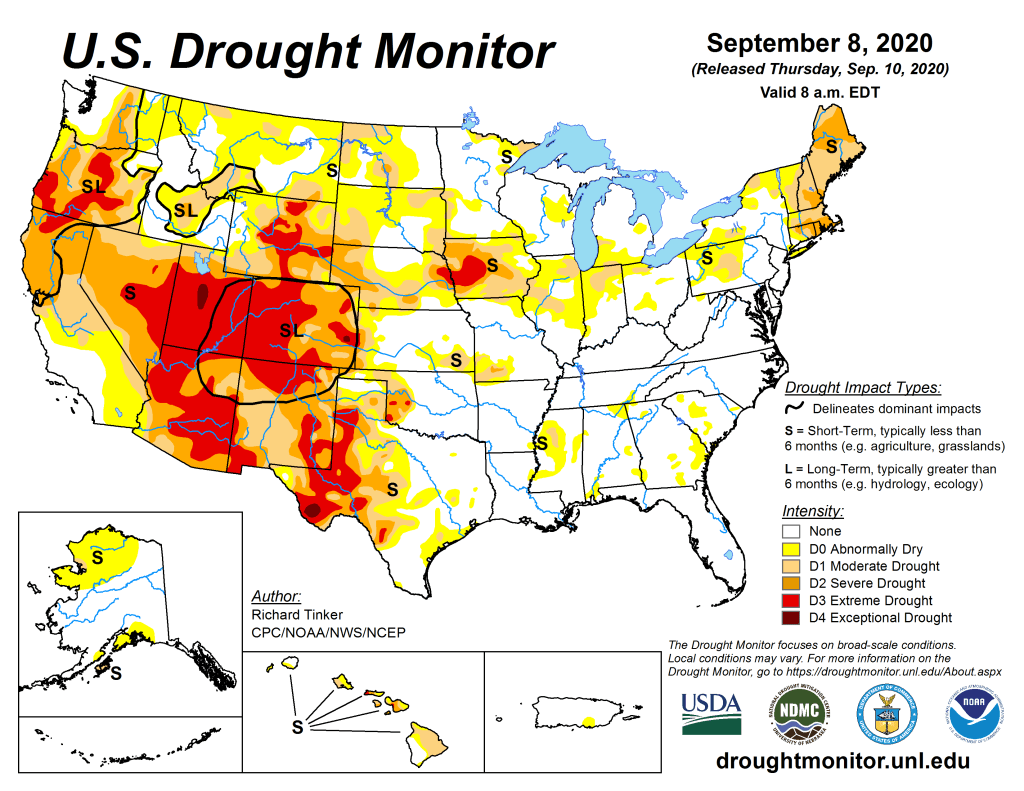
From the U.S. Drought Monitor:From: https://firerestorationgroup.org/
In the West, fires are burning today at higher intensities and larger spatial scales than in the recent past. With the attempted removal of Native Americans and their cultures of extensive burning, coupled with roughly 120 years of active fire suppression, we are experiencing an unraveling of ecosystem stability. This comes at a time when climate change is exacerbating drought and extending fire seasons. […]Scientists are clear that we are in a severe deficit of “good fire.” Prior to 1800 approximately 4.5 million acres were burning in California annually, half of which were from tribal burning. Today our forests are two to three times more dense than they were historically. While we are not returning to the 1800s, we need to extensively restore fire on the California landscape as a pathway to resilience.
From an MSN article:
“I don’t want to be alarmist. But I think the conditions are there,” said Scott Stephens, a UC Berkeley professor of fire science and lead author of a 2018 paper that raised the specter of future mass forest fires as intense as the Dresden, Germany, and Tokyo firebombings.“As those [trees] continue to fall, the physics of it are unchanged. If you have dead and downed logs … the fires described in warfare are possible.”One of hundreds of major blazes to erupt in this record-breaking fire season in California, the Creek fire has underscored the urgency of reducing that monster fuel load.The only way to do that on the broad, landscape level needed, many experts say, is with fire of a different sort.“All of us on the paper were suggesting that if you are going to try to reduce that mass fire problem in the future, you really need to start putting prescribed fire into these stands to start whittling away at those bigger fuels,” said Forest Service research ecologist Malcolm North, one of Stephens’ eight co-authors.[…]Some areas have 500 to 800 trees per acre, compared with 60 to 100 pre-settlement. As North puts it, there were too many straws in the dry ground competing for water. The beetle toll was the greatest in the densest stands. There dead fuel will keep piling up for years to come.Climate change, which accentuated drought severity and is promoting record-breaking heat waves this summer, “is like the frosting on the cake,” said conservationist Craig Thomas.
Here is a video with Scott Stephens at the UC Berkely Fire Science Lab which has some interesting photos of how California forests have changed over the century.https://youtu.be/2r7JI6zVwf0
James Stock: Government Must End Ban of Cheap Rapid Response COVID-19 Antigen Tests

James Stock: Government Must End Ban of Cheap Rapid Response COVID-19 Antigen Tests

Writing in the FInanical Post, James H. Stock on why Lockdowns are too blunt a weapon against Covid makes three key points:

1. "[E]conomic lockdowns are neither necessary nor sufficient to suppress Covid-19"

[E]conomic lockdowns are neither necessary nor sufficient to suppress Covid-19. But the concerted use of largely non-economic interventions can suppress the virus and set the stage for the recovery of demand and employment in restaurants, travel and other high-contact sectors. ...economic lockdowns alone are a blunt, costly and only partially effective instrument of public health.

2. Less expensive measures though individually not effective, when combined together become highly effective

There are many less expensive measures that, when deployed together, can be highly effective. These include working from home and setting rules to make the workplace safe. Taking special steps to protect the elderly, reopening the lowest-contact economic sectors first, banning the highest-risk activities such as bars and large social gatherings, wearing masks, social distancing and enhanced testing, quarantine, and contact tracing are already familiar. If they are seriously adopted, together they can suppress the virus without resorting to a new round of economic lockdowns.

2. The most important measure is wide use of frequent, cheap, rapid screening tests

Most important, testing for the virus remains grossly inadequate....Rapid screening tests need to be widely available...My colleague Michael Mina argues persuasively that the government should fast-track approval and production of cheap paper-strip antigen tests that would alert the newly infected of the need to isolate.Screening tests need not detect every infection. Mathematically, rapid testing and isolation acts like herd immunity: by reducing the chance that a susceptible individual comes into contact with an infected one it can drive the basic reproduction or “R” number below one. Even if a testing regime pulls only a fraction of the infected out of circulation, that — along with other measures such as widespread mask usage and targeted bans of potential superspreader events — can suppress the virus, bring down deaths to very low levels and set the stage for a strong recovery.

Fauci: No Reason People Cannot Vote in Person

The science "experts" tell us that those who break curfews, do not socially distance, and do not wear masks, are responsible for COVID-19 deaths, which is why the economy, churches, and schools should remain closed. (For a proper approach to handling pandemics click here.)These same priests of "science" also tell us that if one carries BLM Inc. signs, harasses policeman, and blocks traffic, one is exempted.Now in a similar vein, the political talking heads, continue that these same "protestors" are unable to vote in polling booths in person because of the dangers of COVID-19, and therefore an untested new system designed by the DNC of nationwide mail-in voting must be implemented at the last minute, that goes beyond the present system of absentee ballotting (where a potential voter is verified before they cast a mail-in ballot).Is their concern really over COVID-19 or to enable election fraud on a nationwide scale?As for the dangers of in-person voting Dr. Fauci sets the record straight:The

Jason Hill: Nihilistic Attempts to Abolish History and Grammar

https://youtu.be/9dmc1db5KeUProfessor Jason Hill, author of We Have Overcome, mostly channeling Ayn Rand, made this important statement:
"What we’re seeing in the educational system is systemic nihilism. So let us go back a step further. A couple weeks ago Rutgers University declared that grammar was racist. Now grammar is the science that deals with the proper method of oral and written communication. When you attack grammar you attack language, which is the method of cognition. You attack man’s mind, you attack his ability to reason. So you attack man’s mind, which means you leave us on the level of grunting farm animals, so you leave us incapacitated to reason, to think. And then you take away his history, you take away human history, our Constitutional rights, our Bill of Rights, our Second Amendment, our First Amendment, or time-worn principles that we use to defend our way of life. Our Judeo-Christianity. Your looking at sysemtic nihilism. You are looking at the Anti-Christ as far as I am concerned. You’re looking at a bunch of nihilists and anarchists that want to destroy the system and replace it with nothing – nothing at all. They want to destroy the good for the sake of it being the good. I have been warning about these post-modern nihilists that started back in the 1960s, when we had these fake disciplines attacking reason, valorizing feelings as the only criterion for adjudicating disputes – one’s feelings and one’s feeling of being offended as the only criteria for adjudicating disputes – and dispensing with reason, objective reality, and logic as the construct of imperialist, racist, white men. That’s what we’re seeing today, and so you dispense with history altogether."

Voice of Capitalism

Capitalism news delivered every Monday to your email inbox.

Subscribed. Check your email box for confirmation.

Pin It on Pinterest