Say Yes To Data Centers

Say Yes To Data Centers

Data centers, in a capitalist economy, is an issue of property rights. So long as a data center (or for that matter farm) does not affect the property rights of other property owners (say by pollution) the proper policy is laissez-faire.

Data centers are where your email is stored, where your Amazon purchases are handled, and where the computers that the military uses to defend the US are located. The quantity and the quality of human life on Earth depends on them.

The energy issue is one of supply and demand. Until recently, the United States has more or less pursued an anti-energy economic policy (most notably with clean nuclear energy) which is the reason why energy prices rise as a supply cannot meet demand.

Farmland versus data centers is a false alternative. Politically, both can coexist in an objective rule of law system where the rights of the owners of both are equally respected.

Economically, the computer power from data centers will help increase the quantity and improve the quality of produce in the future.

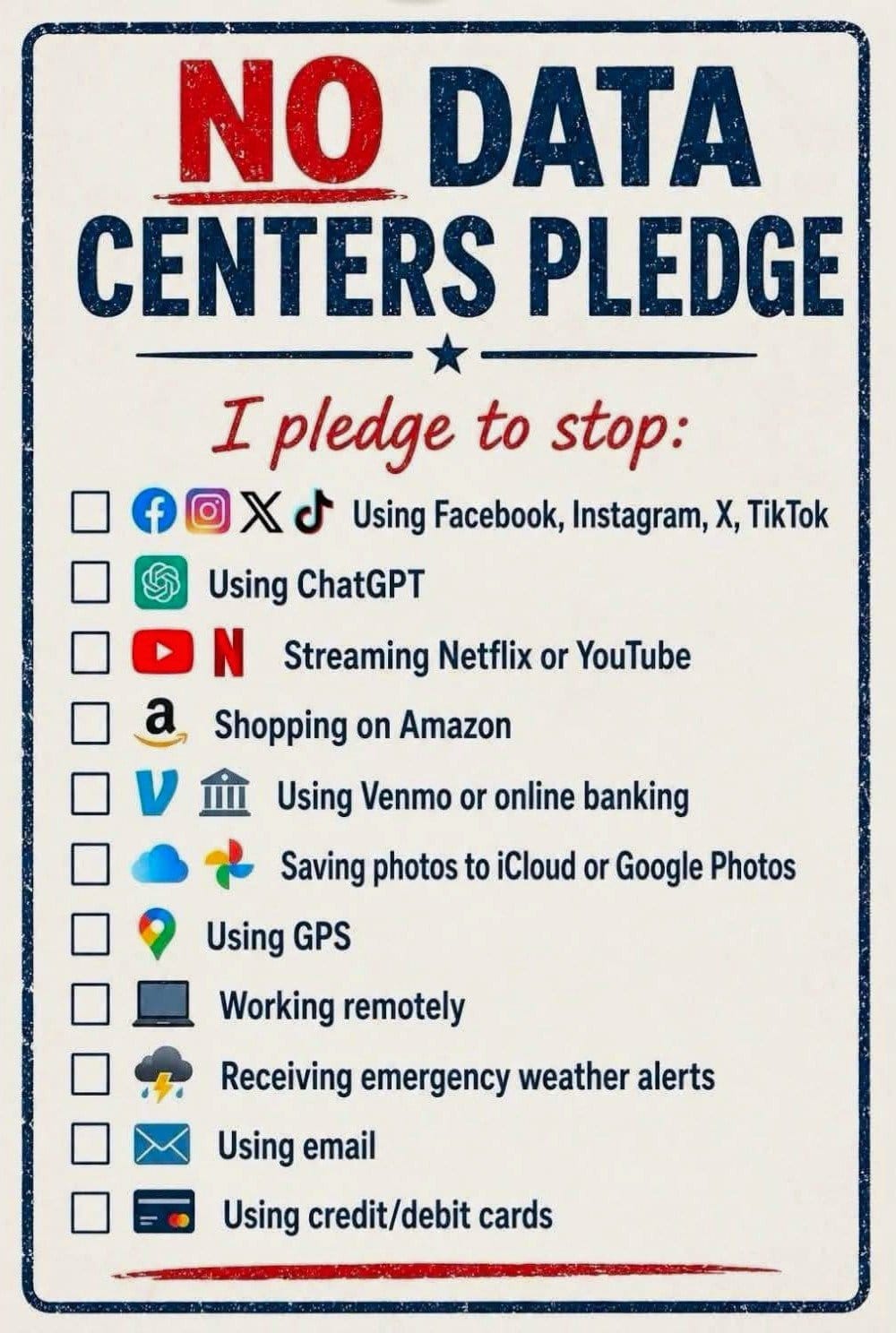
Those modern-day anti-progress advocates of statism that propose to ban data centers should take the no data centers pledge—they have nothing to lose but the benefits of the internet in the 21st century.

For those who oppose Data Centers they should take the NO DATA CENTERS PLEDGE:

data centers


America Last: Fuentes’s Prime Supporters are Foreign Bots That Boost His Influence

America Last: Fuentes’s Prime Supporters are Foreign Bots That Boost His Influence

From America Last: How Fuentes’s Coordinated Raids and Foreign Fake-Speech Networks Inflate His Influence:

Nick Fuentes’s surge into national visibility did not originate from a broad or sudden shift in American political sentiment. It emerged from a pattern of online amplification that was unusually fast, unusually concentrated, and unusually foreign in origin. This report examines the
structure of that amplification, the signals it produced inside the information environment, and the ways mainstream, legacy institutions interpreted those signals as indicators of emerging relevance. The goal is not to explain Fuentes’s ideology or his existing audience, but to assess
how synthetic engagement, real-world events, and media incentives converged to elevate a fringe figure into a central subject of national attention.

– Algorithmic Amplification Far Exceeds Legitimate Reach: Fuentes received dramatically higher early retweet velocity than any comparator, including Elon Musk (the platform’s most-followed user). Within the critical first 30 minutes, Fuentes routinely outperformed
accounts with 10-100× more followers.

– Early Engagement is Dominated by Repeat Actors: In a sample of 20 recent posts, 61% of Fuentes’s first-30-minute retweets came from accounts that retweeted multiple of these 20 posts within that same ultra-short window – behavior highly suggestive of coordination or automation.

– The Amplification Network is Overwhelmingly Anonymous & Ideologically Dedicated: 92% of repeat early-retweeters were fully anonymous (no real name, no real photo, no location, no contact info) and the majority are openly or functionally single-purpose “Groyper” / “AmericaFirst” accounts whose primary activity is boosting Nick Fuentes and related fringextremist messaging.

– Foreign-Origin Amplification Dominated Fuentes’s Viral Posts: In the months before Charlie Kirk’s death, roughly half of the retweets on Fuentes’s most-viral posts came from foreign accounts, heavily concentrated in India, Pakistan, Nigeria, Malaysia, and Indonesia.
These regions have no organic link to Fuentes’s politics but do match the known geographic footprint of low-cost engagement farms, making the pattern consistent with bot-farm amplification rather than genuine foreign audiences.

– Mainstream Media Reinforcement: Since September 2025, mainstream media coverage increased more than threefold and high-status descriptions of Fuentes increased by 59.6%. Outlets also adopted markedly more polished visual treatments, including studio-grade portraits,
controlled lighting, shallow depth of field, and editorial framing that visually positioned Fuentes as a consequential political figure.

– Fuentes Himself is Involved in Coordination: His manipulated reach is not accidental; full show transcripts reveal hundreds of real-time commands to “retweet this” and “retweet me,” establishing raid-style amplification as a core operating method. These directed raids built the
behavioral infrastructure of his account and laid the groundwork for consistent X policy violations by the anonymous and foreign network now amplifying him.

 

Mossoff: Anti-IP “Advancing America’s Interests Act” is Anti-American

Mossoff: Anti-IP “Advancing America’s Interests Act” is Anti-American

Adam Mossoff, a patent law expert and professor at George Mason University’s Antonin Scalia Law School, who is chair of the Forum for IP at the Hudson Institute and a visiting intellectual property fellow at the Heritage Foundation, writes in The Hill, on "Big Tech’s ‘patent troll’ attacks are a smokescreen — don’t let them fool you":
...Big Tech companies with their legions of DC lobbyists have been on a crusade to weaken the International Trade Commission (ITC), a little-known, independent, nonpartisan federal agency tasked with protecting the United States from imports that violate U.S. laws, including U.S. patent laws. These companies are now at it again, lobbying for a bill that was recently re-introduced in Congress: the Advancing America’s Interests Act (AAIA).The AAIA would severely restrict the ITC’s ability to block imports manufactured in China that violate U.S. patents. The bill’s title, of course, is classic Washington Orwellian double-speak —this legislation would significantly undermine American innovators and U.S. interests.A dirty little secret about Big Tech companies is that they profit handsomely from taking the patented ideas of other American innovators. They incorporate these inventions into their products and then they refuse to pay the innovators who created them. It’s called “predatory infringement.” Two recent lawsuits by American startups, Sonos v. Google and Masimo v. Apple, highlight this practice and reveal the tip of the massive IP piracy iceberg by Big Tech companies.[...]If we allow patent-infringing products to be imported, we undermine the legal engine that has driven the U.S. innovation economy for over two centuries: the patent system. American inventors and the venture capitalists and investors who fund them need to know that their patents will be enforced, even when infringed by a large, powerful tech company.In their campaign to close the doors at the ITC to American innovators, Big Tech companies and their backers have promoted arguments again and again that so-called “patent trolls” are using the ITC to hurt U.S. companies. It’s self-serving, false rhetoric that aids their predatory infringement.In fact, there is no evidence that the ITC is over-run by “patent trolls.”
Read the entire article.
 
Gupta: Masking Children is Illogical and Irrational

Gupta: Masking Children is Illogical and Irrational

This article is over two years old, but in case you forgot, or like Anthony Fauci just didn't know, "Masking children is illogical and irrational." Sunetra Gupta, a professor of epidemiology at the University of Oxford, and co-author of the pro-science, pro-freedom Great Barrington Declaration explains:
The argument for masking children, or obliging them to be vaccinated against a pathogen that is less likely to kill them than many others in normal circulation, should have stopped at the level of logic rather than continuing into a debate over its ethical and political implications. Neither masks nor vaccines can reliably prevent children from passing Sars-CoV-2 onto others, and I worry for the unvaccinated grandparent in a multi-generational household who believes themselves to be protected because their grandchild is attending school with an unpleasant (and environmentally unfriendly) piece of material on their face. I remain convinced that many people (including my cousins in India) have lost their lives labouring under this misapprehension.There is now ample observational data to suggest that mask mandates do not work, and the few formal trials that have been conducted show no credible effect.
Read the rest.
Apollo 11: What Philosophy Has To Say About a Man Walking on the Moon

Apollo 11: What Philosophy Has To Say About a Man Walking on the Moon

July 20, 1969, marks the day Apollo 11 landed on the moon. The importance of the event is best described by philosopher Ayn Rand who writes:
The most inspiring aspect of Apollo 11’s flight was that it made such abstractions as rationality, knowledge, science perceivable in direct, immediate experience. That it involved a landing on another celestial body was like a dramatist’s emphasis on the dimensions of reason’s power: it is not of enormous importance to most people that man lands on the moon, but that man can do it, is.
You can read Ayn Rand's full essay, Apollo 11. 

Voice of Capitalism

Capitalism news delivered every Monday to your email inbox.

Subscribed. Check your email box for confirmation.

Pin It on Pinterest