Apr 11, 2003 | Dollars & Crosses
Bob Getman, whom I know by acquaintance, has a nice letter in the Sun today:
The New York Sun has done a great job of alerting New Yorkers to the political skirmishes concerning the coming post-war period ["The British Worth," Andrew Sullivan, Opinion, April 9, 2003]. It would be moral treason for America to allow the United Nations or anti-war countries any role whatever, directly or indirectly, in the post-war liberation of Iraq. The anti-war nations, some of whose citizens now defile the graves of American war dead from earlier wars, opposed the ends of the war and are unworthy (let alone untrustworthy) of carrying them out. The United Nations is full of countries with tyrannical governments similar to Saddam's and opposite to what we aim to establish in Iraq.
What our men and women die for in a war is what comes after victory; the end of a war must bring the ends for which it was fought: freedom and man's rights. [New York Sun, 4/10/03]
Apr 11, 2003 | Dollars & Crosses
Writes Washington Post columnist Richard Cohen in "Hollywood's Darling, Liberals' Blind Spot":Just recently the government of Fidel Castro arrested about 80 dissidents and almost instantly brought them to trial -- if it can be called that. Foreign journalists and diplomats were excluded from the proceedings, in which 12 of the accused face life sentences. All of them are undoubtedly guilty of seeking greater freedom and on occasion meeting with visiting human rights activists. In Cuba, those are crimes...[Castro] can rely also on the unswerving naivete and obtuseness of the American left, which consistently has managed to overlook what a goon he is. Instead, [the Left] concentrates on his willingness to meet with American intellectuals and chatter long into the night...I'd like to see anyone interrupt one of Fidel's marathon soliloquies to ask about human rights violations...[Washington Post, April 8, 2003]
Perhaps this is because to Leftists, freedom of speech is not a mean and ends toward freedom, but only useful as a means to establishing the opposite: socialism--or some variant thereof, i.e., fascism, communism, etc. Once the socialist state is a reality, as in Cuba, freedom of speech becomes a liability that can only undermine the Leftist's totalitarian dream.
***
Update: Or perhaps it is because they are too busy gushing over Castro...
Barbara Walters on Why Cuba is the Freest Nation on Earth: "For Castro, freedom starts with education. And if literacy alone were the yardstick, Cuba would rank as one of the freest nations on Earth. The literacy rate is 96 percent." -- [ABC's 20/20, October 11, 2002]
Of course, given that it is illegal to disagree with Cuban government statistics in Cuba and illegal to lend books which makes makes the ability to read fairly useless in practice. Here is Dan Rather being "controversial" by speaking his mind on the morning of the Elian raid:
Dan Rather's Very Small Mind: ". . . there is no question that Castro feels a very deep and abiding connection to those Cubans who are still in Cuba. And, I recognize this might be controversial, but there's little doubt in my mind that Fidel Castro was sincere when he said, 'listen, we really want this child back here.'"
Where is my bucket?The Multicultural Approach to Totalitarianism: "What is deprogramming? What is reeducation? The young man [Elian] will go back into the, into the school system in Cuba. The school system inCuba teaches that Communism is the way to succeed in life and it is the best system. Is that deprogramming or is that national heritage? That's certainly what he'll be learning. He'll also be living in a different kind of society, a society that many people here in Cuba like. The CIA, in fact, says that if the borders were open that most, 90 percent of the population here in Cuba would stay in Cuba because they like it."-- NBC News reporter Jim Avila from Cuba
Yeah and 100% of them would vote for Castro...
Why Elian's Mom Died for Nothing: "To be a poor child in Cuba may in many instances be better than being a poor child in Miami and I'm not going to condemn their lifestyle so gratuitously."- Newsweek's Eleanor Clift
It is a shame Elian's mother, Elizabet Broton, did not read Eleanor's column at Newsweek, perhaps she would not have risked her life to bring her son to the U.S.
By the way, these are all actual quotes (Hat Tip: MRC). I am not making this stuff up.
Apr 10, 2003 | Dollars & Crosses
The New York Sun's Seth Lipsky today reviews Fareed Zakaria's book The Future of Freedom: Illiberal Democracy at Home and Abroad. Zakaria is editor of the international edition of Newsweek, and former managing editor of Foreign Affairs; I have it from good sources that he's a source of excellent commentary about the Middle East. Lipsky writes:
It is not an argument against democracy. "Overwhelmingly it has had wonderful consequences," he writes, but he is concerned with democracy's "dark sides," with the fact that democracy doesn't automatically equate with freedom or sensible government...Mr. Zakaria is nervous about democracy in the Middle East in general. He opens his chapter called "The Islamic Exception" with a vignette of how President Mubarak of Egypt rebuffs America's entreaties to be more democratic. "If I were to do what you ask, Islamic fundamentalists will take over Egypt," Mr. Mubarak likes to say. "Is that what you want?" Mr. Zakaria doesn't seem inclined to challenge the Egyptian martinet. He does manage to avoid other common mistakes...That said, I finished the book admiring Mr. Zakaria's reprise nonetheless. What its author is making is essentially a plea for republicanism, for constitutionalism, for checks on majority rule, and for moderation--all things that the best of conservatives and liberals favor. [New York Sun, 4/9/03]
But you can't argue for any of these things unless you define freedom--and particularly, decisively refute the misconception that democracy is freedom. And you can't do that properly unless you have a concept of individual rights, and understand its foundation in reality. Does Zakaria do these things? If he does, Lipsky doesn't mention it--which argues that Lipsky, at least, does not appreciate their significance.
A report in Lipsky's own paper today (picked up from the Daily Telegraph) wonders how it will be possible to return to the rule of law in Iraq when for so long literal gangsters have been running the country. It's a good question. There is no avoiding the fact that freedom and self-government require a commitment to objectivity. If the law can't be enforced impartially, it becomes just another tool of tribal warfare. Then it's anarchy followed by another dictatorship when the strongest thugs win.
In this regard, Iraqi Kanan Makiya has an interesting entry in his war diary concerning federalism:
The Transition to Democracy report produced for the London conference of the Iraqi opposition in December 2002 proposed that federalism in Iraq be understood as an extension of the principle of the separation of powers--only this time power is being divided instead of separated. Federalism is from this point of view the thin end of the wedge of Iraqi democracy. It is the first step towards a state system resting on the principle that the rights of the part, or the minority, should never be sacrificed to the will of the majority--be that part defined as a single individual or a whole collectivity of individuals who speak another language and have their own culture. Yet this redefinition alone will not redress the mistake of Michel Aflaq, which led to Saddam Hussein's butchery. If the constituent parts of the new Iraqi federation are defined ethnically, we will revert back to the deadly logic of "nationalism is [ethnic] love before anything else." ...The idea must be to have complete freedom of movement, of people and capital, and of property rights, regardless of the region in which one chooses to settle. [New Republic Online, 4/7/03]
He even thinks the idea of Iraq as an Arab state should be reconsidered. One can only applaud this rejection of nationalism and hope that it catches on across the Arab world.Apr 10, 2003 | Dollars & Crosses
Dr. Yaron Brook, executive director of the Ayn Rand Institute, will appear on Fox News Channel's continuing war coverage at 12 midnight, Pacific time, Thursday/Friday April 10/11. Dr. Brook will discuss why Iran should be our next target in the war against Muslim fundamentalists. Check your local listing for times in your area.
Related Reading: Iran, Not So Far AwayApr 10, 2003 | Dollars & Crosses
Here's Chip Joyce at About the War:
Ten days ago to the day I wrote,
I will guess that the regime will collapse within ten days from today by assassinations prior to a ground invasion of Baghdad. Before that we will see escalated missile and air attacks of sites within Baghdad; Iraqi forces will assault coalition forces on the outskirts of the city, in a desperate last effort; there will be limited chemical attacks that will be mainly futile; coalition troops' response will be stupefying; and eventually, a few high-ranking military officers within Baghdad will acknowledge imminent defeat and turn coat. They will assist our special forces, who are already in Baghdad, in terminating the regime.
There wasn't any chemical attack to date, but the rest of my prediction was pretty accurate. So far my April 9th prediction looks amazingly accurate: Saddam and sons might be dead, the cities are in coalition control, the army is disunited at best, and the Iraqi people are celebrating. Time will tell, of course. How about that?! Remember that I called the starting date of the war almost perfectly--just two days off. [About the War, 4/9/03]
Apr 10, 2003 | Dollars & Crosses
Iraqi Kanan Makiya spoke at the American Enterprise Institute yesterday, telling how the CIA is apparently continuing to undermine the Iraqi opposition:
At the same American Enterprise Institute event yesterday, a former CIA officer, Reuel Marc Gerecht,referred to efforts by the CIA and the State Department to "derail" the leader of the Iraqi National Congress, Ahmad Chalabi. He said the State Department and the CIA have an inclination toward Sunni Muslims. Mr. Chalabi is a Shiite Muslim, as is the Iraqi fighter involved in the incident at Amara. [New York Sun, 4/9/03]
You can read the story of this interesting fighter, Abu Hattam, in the Sun article. Reuters describes the latest CIA efforts to derail Chalabi, and what he's up to as well:
The opposition Iraqi National Congress said on Tuesday leaders from across southern Iraq flocked to the town of Nassiriya to greet its leader Ahmad Chalabi, but a CIA report said he and other returning exiles would find little support among Iraqis...Francis Brooke, a close adviser to the opposition leader, said local Iraqi leaders had brought requests for Chalabi to mediate with the U.S. military authorities on matters such as power supplies and people held as prisoners of war. "We have been receiving delegation upon delegation. We don't have time to meet them all. We are inundated," Brooke told Reuters in a telephone interview from Nassiriya. [Reuters, 4/8/03]
Robert Kagan makes the same line sound more reasonable:
[S]ome Bush officials may want to support the political fortunes of people they have known and trusted for many years, such as Ahmed Chalabi. It's understandable, but it's a mistake. Chalabi is undoubtedly a good man. While in exile, he labored long and hard against Saddam Hussein. If he can now muster genuine support in Iraq, through his own exertions, then the world should wish him well. But the United States must not give him a leg up over other potential leaders, and especially those who may now begin emerging from within Iraq. As Paul Wolfowitz put it last Sunday, "You can't talk about democracy and then turn around and say we're going to pick the leaders of this democratic country." Exactly right, so the United States shouldn't help Chalabi or anyone else position himself as Iraq's Charles de Gaulle in the waning days of the war. If it ever starts to look as if the United States fought a war in Iraq in order to put Chalabi in power, President Bush's great success will be measurably discredited. [Washington Post, 4/8/03]
Now this, to put it bluntly, is rubbish. It springs from the premise that we're not allowed to have any selfish interests in this war, that we're doing it "for the Iraqi people." If Bush really wants to win this war, it's this premise he has to reject. If we have an interest in Iraq's postwar government, it's that it be a free country, not a "democratic" one. The idea that we should leave Iraq alone to vote itself into Islamic fundamentalism is absurd. And the idea that we should care what other people or other countries think is equally absurd. As the New Republic puts it (while agreeing with Kagan):
[I]t seems like a Chalabi government might pose a public relations problem for the United States even if he manages to win the job by his own accord. After all, given Chalabi's long association with several American policymakers, and the fact that we basically airlifted him and other top INC officials into Southern Iraq during the closing days of the war, isn't it going to be nearly impossible to avoid the perception that we helped install him atop the Iraqi government, even if we make no effort to do that from here on out? ON THE OTHER HAND... Given that the United States almost single-handedly liberated the country, and that it's the U.S. which will be the major force behind its reconstruction, it's probably inevitable that whoever ends up leading postwar Iraq will face the perception that they were installed by the United States. [New Republic Online, 4/9/03]
All this nonsense comes from seeking legitimacy in some mystical, indefinable "will of the people" whose purity will somehow be besmirched if we have any influence on the outcome. The "will of the people" be damned--the people have no right to vote away other people's rights, and Iraq has no right to be governed by a government that allows that to happen. Any other considerations of "who rules" are secondary to that.Apr 9, 2003 | Dollars & Crosses
A top US military officer said hundreds of so-called Islamic fighters, including many non-Iraqis, were putting up a stronger fight for Baghdad than Iraq's Republican Guard or regular army. "They stand, they fight, sometimes they run when we engage them," said Brigadier-General John Kelly. "But often they run into our machine-guns and we shoot them down like the morons they are." General Kelly, assistant commander of the 1st Marine Division, told The Age that US intelligence indicated there might be anywhere between 500 and 5000 of the fighters, whom he described as terrorists. "They seem to have come to Iraq for their summer vacation to kill American, British and Australian soldiers," he said. "They appear willing to die. We are trying our best to help them out in that endeavour." [April 9, 2003, The Age]
Apr 9, 2003 | Dollars & Crosses
Baghdad--With help from a U.S. M88 tank recovery vehicle, citizens of Baghdad this morning ripped down a 20-foot high statue of Saddam Hussein that stood in the heart of the city.
The jubilant crowds threw various objects at the broken symbol and beat it with their shoes as a show of distain for the fallen tyrant. After decapitating the statue, some citizens rode atop the head as fellow Iraqis dragged it through the city streets in celebration.
So far, no demonstrators have gathered in San Francisco to celebrate the liberation of the oppressed Iraqi people for whom they cared so deeply just weeks ago.
Apr 9, 2003 | Dollars & Crosses
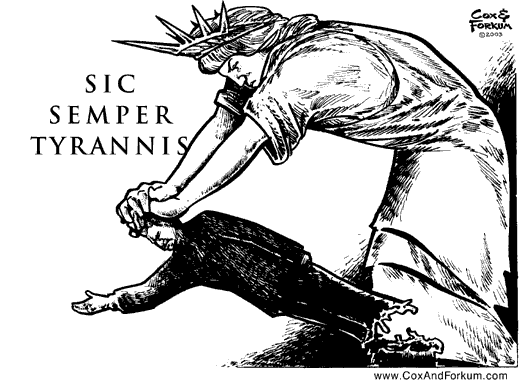
From the political cartoon geniuses at Cox and Forkum:
Comments
Forkum:
Fox News reports that in Baghdad small bands of youths tore down portraits of Saddam and chanted,"Bush! Bush! Thank you!". Excerpt: "Emboldened by the sight of U.S. troops taking control of the capital, they dared not only to loot but also to rejoice over Saddam's fall, to vandalize his image and to call him a criminal -- offenses that just days or weeks ago could have brought arrest, imprisonment, torture, even death at the hands of the secret police. They danced in the streets, waving rifles, palm fronds and flags, thrusting their arms in the air and flashing the V-for-victory sign. ... On a Baghdad street, a white-haired man held up a poster of Saddam and beat it with his shoe. A younger man spat on the portrait, and several others launched kicks at the face of the Iraqi president."
Meanwhile, completely blinded by ideological hatred, the Communistic "anti-war" group International ANSWER has announced a March on Washington. Excerpt: "Baghdad has been bombed relentlessly, terrorizing the occupants of that city and of the entire country. ... This horrific unprovoked attack on Iraq must be understood as one of the extreme terrorist acts of modern times. ... The Bush Administration is hell bent on world domination. The war on Iraq was meant to signal that the U.S. use of raw military power will be the means to create a new era of Empire."
Apr 9, 2003 | Dollars & Crosses
Antispam company Habeas is suing bulk e-mailers, accusing them of using its poetry without permission in an unusual use of trademark law to clamp down on spammers. Habeas, headed by lawyer and antispam activist Anne P. Mitchell, puts a new twist on spam prevention by inserting some trademarked haiku lines into the header of an e-mail. The haiku is supposed to indicate to spam filters that the accompanying message is not spam in an effort to make sure that legitimate messages get through to recipients. Habeas' haikus are recognized by the antispam filters and technology of companies including Spam Assassin, AOL and Juno..."The only reason to put our mark in the e-mail is to make sure it gets past spam filters," Mitchell said. "If someone uses our trademark without permission, we are required to go after them." [CNet News, 4/4/03]
Apr 9, 2003 | Dollars & Crosses
Previously I mentioned Leonard Peikoff's position that we shouldn't be in Iraq to liberate it--he mentioned that those people had never been through the Enlightenment and if given a democracy would just vote themselves into Islamic fundamentalism. I mentioned I was not entirely convinced, though I have read elsewhere that Iraq's literacy rate is 58%. Then yesterday came this message from Sylvia Bokor, who gave me her permission to post it:
On "60 Minutes" last night I listened to part of a discussion on rebuilding Iraq after the war. It was mentioned that a new kind of government would be set up. It was not said what kind of government. How much will rebuilding cost? Billions.
I do not like the idea of our spending huge sums of taxpayer money on rebuilding other countries. If we were going to install a constitutional, representative republic that protected and enforced individual rights, that promoted and ensured laissez-faire capitalism, that would be great. It would be a step toward Pax Americana.
But given what's been said and done already in the conduct of this war, I shudder to think what a lot of that hard-earned money will go for--even though the world's two best countries will run the show. There will be rake-offs, graft and corruption. Less, surely, than if the UN runs the rebuilding. But still there will be a tremendous waste of money. Plus, the kind of government installed will be based on a moral code as collectivist as its past--no matter whether it's run by Muslims or Christians, no matter what its form.
It does not make sense to spend money and manpower rebuilding a country that never reached a level of civilization that leads toward the possibilities indicated by Ancient Greece. I can see rebuilding Germany and Japan. Culturally, both of those nations had a good understanding of the importance of productivity if not of the individual, despite each country's descent into fascism. But the Iraqis? The ones who really care about creating values and making money have emigrated.
If any such are still in Iraq, then they can rebuild what they want, and pay for it themselves. They have oil fields and there are many men who want to become involved in the country's politics. Some opine that terrorism will return if we just walk away. It will anyway so long as collectivism is operative. It's far better to use our money on us. Reduce taxes, raise military pay and have a strong defense policy. Stomp down hard and swiftly on terrorism the minute it appears. This approach would maintain our peace and security. Present plans will not.
Fair enough. And Blair and Bush are even going all wobbly on the United Nations:
George W. Bush and Tony Blair on Tuesday endorsed a "vital role" for the United Nations when fighting ends, but their plans may fall short of European desires...[Bush] added: "Rebuilding of Iraq will require the support and expertise of the international community. We are committed to working with international institutions, including the United Nations, which will have a vital role to play in this task." Pressed on what precisely the U.N. role would be, however, Bush mentioned only humanitarian work, "suggesting" people to staff the interim authority and helping Iraq "progress." He did not spell out how much power the United Nations would have...In a joint written statement, Bush and Blair pledged to seek U.N. Security Council resolutions to affirm Iraq's territorial integrity, ensure aid delivery and endorse an appropriate post- conflict administration for Iraq. [Reuters, 4/8/03]
Given that the US provides a quarter of the UN budget, it's still largely our money going to these "humanitarian" projects. If there's one thing Americans should be absolutely militant about, it's keeping the UN out of Iraq and getting America out of the UN.Apr 9, 2003 | Dollars & Crosses
Yahoo! News reports that hundreds of Iraqi children were released from prison:Around 150 children spilled out of the jail after the gates were opened as a US military Humvee vehicle approached, Lieutenant Colonel Fred Padilla told an AFP correspondent travelling with the Marines 5th Regiment. "Hundreds of kids were swarming us and kissing us," Padilla said. "There were parents running up, so happy to have their kids back." "The children had been imprisoned because they had not joined the youth branch of the Baath party," he alleged. "Some of these kids had been in there for five years." The children, who were wearing threadbare clothes and looked under-nourished, walked on the streets crossing their hands as if to mimic handcuffs, before giving the thumbs up sign and shouting their thanks.
[Read this story about a similar incident in Castro's Cuba.]
Apr 8, 2003 | Dollars & Crosses
It appears that Arnett is no longer only working for Saddam...DUBAI, United Arab Emirates - Peter Arnett, fired by NBC earlier this week for giving an interview to state-run Iraqi television, is reporting for pan-Arab satellite channel Al-Arabiya, the station said Saturday. "He (Arnett) is an able reporter who has covered wars before and who knows Iraq well," the Dubai-based station's editor-in-chief Salah Nejm told The Associated Press. "I think he is unbiased and has a lot of experience," Nejm said. [April 5, 2003, AP]
What next? Arnett acting as Gollum in the Lord of Rings too! At least he won't need makeup--and, like Gollum, the weasel Arnett has the traitor part down too!
Related: Is Peter Arnett guilty of treason?" and Peter Arnett: Saddam's Useful Idiot.
Apr 8, 2003 | Dollars & Crosses
From Cox and Forkum:

Apr 8, 2003 | Dollars & Crosses
[Cuban] human rights activists confirmed that at least 75 members of the opposition had been prosecuted on state security charges in summary trials lasting no more than one day each. The known sentences for about half of them ranged from 15 to 27 years..."We are witnessing the harshest political trials of the past decade," said [veteran activist Elizardo] Sanchez, among the few leading government opponents not arrested last month. Some of the longest sentences were reserved for independent journalists, including 27 years for reporter and photographer Omar Rodriguez Saludes; and 20 years each for poet and writer Raul Rivero, magazine editor Ricardo Gonzalez, and economics writer Oscar Espinosa Chepe. The Cuban government accused them--along with pro-democracy activists, opposition party leaders and other dissidents--of collaborating with U.S. diplomats to undermine the socialist state. [Associated Press, 4/8/03]
Notably absent from the trials: Castro's "useful idiots" at CNN. (Hat Tip: Paul Blair)
Apr 8, 2003 | Dollars & Crosses
Brunswick, GA--After much debate over the issue of whether passenger airline pilots can be trusted to carry firearms into the cockpit, the first group of pilots will begin training at FLETC next week. The pilot training program allows volunteers who meet federal "screening" requirements and pass arbitrary psychological evaluations to carry .40 caliber semiautomatic weapons during flight. Why revolvers or other calibers aren't allowed is anybody's guess.
"Not every plane is going to have a pilot who is armed," Airline Pilots Association spokesman John Mazor explained, "but you won't know if your pilot is armed or not, and that's the deterrent."
Hmmm. I wonder if firearm possession only works as a criminal deterrent when you're above 10,000 feet...
Apr 7, 2003 | Dollars & Crosses
Dr. Leonard Peikoff's lecture yesterday, "America versus Americans" at the Ford Hall Forum was incredibly provocative (Links: Audio Only, Video Modem, Video Broadband). I had felt myself getting complacent recently with my nice neoconservative New York Sun--I was even beginning to feel downright mainstream. Sure enough, Dr. Peikoff showed once again how radical Objectivism is compared to anything else out there, even on a subject like the war.
I didn't take notes, but here's a brief--and I hope accurate--summary: We're fighting the wrong wars, for the wrong reasons, in the wrong way. While Dr. Peikoff supports the troops, and believes that attacking Iraq was better than sitting on our hands and doing nothing, he argued that we've taken on Iraq because George W. Bush lacks the moral courage to identify and go after the true enemy, Islam. (He did at one point say "Islamic militancy," but he also maintained that the militants were the consistent practitioners of Islam, so I believe I've got his intention correct here.) If we had done so, we'd be attacking Iran.
Dr. Peikoff maintained that in war our only concern should be victory and the destruction of the threat--and that we should then leave Iraq and the Iraqis to their own devices rather than being concerned with forming their next government. Our ultimate goal should be simply to create an overwhelming fear in that part of the world--a fear of what would happen if any terrorist act were ever tried again. This goal warrants an utter lack of concern for civilian casualties, including the deliberate targeting of civilians if necessary. (He illustrated the point with a description of the Allied firebombing of Tokyo--and in general contrasted our conduct of the current war with our actions in WWII.) Needless to say, he believes the groveling before the UN, the humanitarian aid to the enemy, the concern with civilian casualties, and the desire to be seen as liberators all reflect a fear of being seen as conducting a war for our own selfish reasons. (In the question period, when asked about the "No Blood for Oil" slogan, he answered: "If we are going to conduct a war, oil would be a pretty damn good reason..."--though he went on to say that this isn't Bush's reason.)
The overarching theme of the talk, however, was that the American people have compliantly followed along behind George Bush in all this because altruism has completely swamped the remnants of the original American sense of life. It isn't just the intellectuals any more; it's everybody.
The talk prompted one indignant outburst--when Dr. Peikoff came out in favor of deliberately targeting civilians, a man in front shouted "That's disgusting!" and then angrily left the auditorium. Other than that, the audience was civil.
I wish I had the text of the talk in front of me--I'm still not sure if I agree with it entirely, or if my uneasiness is just a lack of nerve. I certainly don't believe civilians should be spared if doing so endangers American lives, and I agree that the battle orders have put American lives needlessly at risk. But is fear the only motivator we need, or should want? All other things being equal, wouldn't it be in our long-term interest to have a free Iraq at the end of the war, if it's possible? Wouldn't that make it less likely that we'd have to go in again in the future? And so wouldn't it be preferable to refrain from destroying people and things we don't need to destroy?