What Record Industry Slump?

I don't believe the major music labels deserve to have their music stolen by downloads from the Internet. That said, to my knowledge the record industry is not a business that has conducted itself with much integrity. So it's good to see that profits are being made by those who refuse to pander to the lowest common denominator:

While executives at [the five mega-majors: Sony Music Entertainment Inc., Universal Music Group, BMG Entertainment, EMI Group, and Warner Music Group] wail about the industry's imminent collapse, indie labels and artists are singing a much happier tune. Profits are up--in some cases by 50 to 100 percent. That's in contrast to overall album sales, which dropped about 11 percent in 2002. You won't hear many of these labels' artists on pop radio--and ironically, that's one of the secrets to their success. By avoiding the major expenses associated with getting a tune on the air--which can cost upwards of $400,000 or $500,000 per song--independent labels are able to turn a profit far more quickly, and share more of those profits with their artists. Another secret of their success is that the labels target consumers--namely, adults--who are still willing to pay for their music, rather than download it for free...At a major label, most artists are unlikely to earn anything unless they sell at least 1 million albums, and even then, they could wind up in debt. Everything from studio time to limo rides are charged against their royalties, which might be only $1 per disc sold. That compares with an indie artist, who can sell a disc for $15 at a concert. If they make $5 profit a disc on 5,000 discs, they pocket $25,000. [Christian Science Monitor, 4/11/03]

FNC Panel Castigates CNN Chief News Executive for Dishonesty

Reports the MRC, that on the April 11th edition of Special Report with Brit Hume on FNC

..citing a NPR interview Jordan did last October, Roll Call's Morton Kondracke recalled that Jordan insisted "that CNN never made journalistic compromises to gain access, specifically about covering this war, but he made that general statement, which is a flat lie, to National Public radio at the time." ...Columnist Charles Krauthammer observed: "It's a classic example of selling your soul for the story. He clearly gave up truth for access. Well he could have taken the translator out and told that story about Uday or other stories, but he would have lost the bureau in Baghdad and that's why he did it."

Later that week on the April 13th edition of Fox News Sunday, NPR's Juan Williams commented on the CNN dishonesty issue:

"Well, to me, this is an outrage. It doesn't, I don't understand how you can make a judgment about what seems, appears to me, on the surface it -- going soft, not telling people about the depth of the tyranny of Saddam Hussein, when, in fact, now, Eason Jordan says, you know, he thought the American people knew about it, no one was hiding it. But he wanted access for CNN, and I think that's what he made the predominant issue in his mind. The consequence being that, to the way I look at it, he wasn't being forthcoming with CNN's viewers. That CNN's viewers should have known exactly, exactly how tyrannical, how awful, how despotic Saddam Hussein was. And here's the other point, Tony. CNN's continued reporting lent some credibility, made it seem to the American people as if, 'Well, this is an ordered society. CNN, other news networks can go in there, operate freely and with some sort of, you know, First Amendment protections and freedoms.' That was never the case."

Bill Kristol observed: "Well, what it means is that any tyranny threatens to kill someone who works for any news network, and the news network doesn't tell the truth about the tyranny. It's totally unacceptable. If this man was in danger, they should have flown him out of Baghdad, they should have flown his family out of Baghdad. They should have gone to the U.S. government and tried to get the president of the United States to say, 'If you start killing people who are cooperating with American media, that's in effect an act of war against, virtually, against American citizens or American employees.' This is just craven."

Brit Hume pointed out: "It is clear that reporters who wanted to stay in Baghdad had to be very careful what they said. That doesn't apply to people who have left Baghdad, which is what's so striking to me about this." NPR White House reporter Mara Liasson also expressed concern: "I think that raises some crucial questions about how media organizations behave in totalitarian governments."

What your child can learn for $40,000 at Columbia University

"The idea that Iraq's population would have welcomed American forces entering the country after a terrifying aerial bombardment was always utterly implausible. That this became one of the lynchpins of US policy is evidence of the rubbish fed to the Administration (many of whose members were out of touch with their country as well as keen on promoting their postwar careers by persuading the Americans of how easy an invasion would be.)"--Edward Said, tenured professor at Columbia University

CNN’s Sordid History of Dishonest Reporting on Iraq

Writes Eason Jordan, chief news executive at CNN, in today's New York Times in an article titled, "The News We Kept to Ourselves":

Over the last dozen years I made 13 trips to Baghdad to lobby the government to keep CNN's Baghdad bureau open and to arrange interviews with Iraqi leaders. Each time I visited, I became more distressed by what I saw and heard -- awful things that could not be reported because doing so would have jeopardized the lives of Iraqis, particularly those on our Baghdad staff. For example, in the mid-1990's one of our Iraqi cameramen was abducted. For weeks he was beaten and subjected to electroshock torture in the basement of a secret police headquarters because he refused to confirm the government's ludicrous suspicion that I was the Central Intelligence Agency's Iraq station chief. CNN had been in Baghdad long enough to know that telling the world about the torture of one of its employees would almost certainly have gotten him killed and put his family and co-workers at grave risk.

Jordan goes on to recount some of the horrid stories that he "could not be reported" and then concludes:

I felt awful having these stories bottled up inside me. Now that Saddam Hussein's regime is gone, I suspect we will hear many, many more gut-wrenching tales from Iraqis about the decades of torment. At last, these stories can be told freely.

The truth is these stories could have always been reported, but CNN chose not to do so. CNN could have chosen to close down their Iraqi office. They did not. Was this "not an option," because CNN was more concerned with "media access" than the truth? (For the record CNN follows this same policy today in Cuba by failing to objectively report on the torture imposed by the Castro Regime).

If CNN could not report honestly on Iraq, why spend all the time, money, and effort to support the pretense that it was doing so? Such actions merely sanctioned the Hussein Regime in Iraq and mislead millions of people who think they are receiving the facts. By CNN's near decade long of dishonesty by lying by omission they morally propped up the Saddam regime (as they still do Castro's regime), thus allowing it to enslave, torture, and kill even more people then if they had only told the truth. CNN has no moral right to call itself a news agency--they are merely "useful idiots" running an PR agency for the thugs and savages of the world.

Old Europe Moves Backwards As US Moves Forward

As US-led coalition forces liberate Iraq and Old Europe desperately tries to claim a piece of the post-war action through the United Nations, this news today from the legislatures of Germany and the United States.

This morning the US House of Representatives voted to cut taxes (the Senate is expected to follow suit shortly). And today the German parliament voted to raise taxes.

Liberation, and the willingness to take risks to invest in the future, isn't just about war and peace.

Sean Penn: actor, pacifist, assailant…gun owner?

Berkeley, CA--Sean Penn left the Venus restaurant in Berkeley after having lunch on Tuesday to discover that his 1987 Buick Grand National had been stolen.  Even more surprising, however, was that the vocal pacifist had left a loaded 9mm Glock semi-automatic handgun and a.38 Smith and Wesson revolver in the car. 


Now there's some responsible gun ownership!
 
While most law-abiding Californians are denied their right to carry a handgun for personal protection, Penn (who served jail time in 1987 on an assault conviction) holds one of only 38 coveted Marin county permits to carry a concealed weapon.


Neither Hollywood nor Berkeley residents appear bothered by the actor's casual possession of "killing sticks."


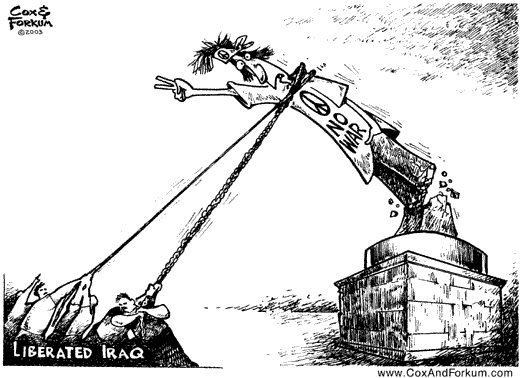
From Cox and Forkum:

No U.N. Kangaroo Court for Iraqis who Commit War Crimes

Reports MSNBC:

The Bush administration has ruled out any role for international courts in trying Iraqi President Saddam Hussein and other Iraqis for war crimes, U.S. officials say, and plan instead to rely on reconstituted Iraqi courts and U.S. military tribunals. Officials at the State and Justice departments now say that two separate tracks will likely be used for war crimes trials, one for violations during the current war and another for past abuses.


... As for calls that the United Nations set up an international tribunal to try Saddam, Iraqi exile groups strongly oppose such an arrangement. "It's about 20 years too late," said Sermid al-Sarraf, the California lawyer. "The U.N...had an opportunity to do that on many occasions previously but did nothing," he said. [April 7, 2003]

Old Europe must not be pleased.

Arianna Huffington vs. The Pursuit of Happiness

American companies that move their headquarters offshore to avoid paying taxes will be the target of a new television advertisement that questions their patriotism during a time when U.S. soldiers are fighting in Iraq..."The message is about shared sacrifice," said columnist and author Arianna Huffington, one of the founders of The Bermuda Project. "They're really cheating America, and they're cheating every American taxpayer who plays by the rules." [Associated Press, 4/9/03]
Or is it America--and particularly those like Huffington who seek unearned benefits from unwilling victims--that is cheating them? America is not about "shared sacrifice"--it is about the repudiation of sacrifice, and of those who demand sacrifices. In its founding principles, America spits on Arianna Huffington and all she stands for.

No, That Makes Him Very Qualified

Arab and Muslim leaders say retired Lt. Gen. Jay Garner's involvement with the Jewish Institute for National Security Affairs--including the document he signed and a trip he took to Israel--raises questions about whether he is the right person to oversee Iraq's reconstruction. Garner was one of more than 40 retired U.S. military leaders to sign his name to a letter 2 1/2 years ago amid renewed Mideast violence. The letter strongly supported Israel for exercising "remarkable restraint" and blamed the crisis on Palestinian leaders. A Palestinian tactic to "use civilians as soldiers in a war is a perversion of military ethics," the statement said. Palestinian leaders taught children the mechanics of war while "filling their heads with hate," and Palestinian police and military commanders were "betting their children's lives on the capabilities and restraint" of Israeli defense forces, the statement added....Sarah Eltantawi, spokeswoman for the Muslim Public Affairs Council, called the choice of Garner "very unwise--it will not reinforce among the Iraqis the sentiment that their leadership is representative." [Associated Press, 4/8/03]
Taranto: "Given the Palestinians' open sympathy for the Iraqis' oppressor, we'd be surprised if the Iraqis have any sympathy at all for the Palestinians."

But let's suppose that's what the Iraqis think--if so, then their leadership shouldn't be representative. We are conducting this war to forcibly prevent Iraq from conducting and supporting terrorism. If the Iraqis are really going to insist on supporting terrorism, that will merely prove to us that we haven't killed enough of them. Such an outcome would put me squarely behind everything Leonard Peikoff said the other night: Target as many of them as it takes--including civilians--until they are terrified of twitching a single muscle that even looks like supporting terrorism. There is no such thing as a right to assist the use of force against a free state--and no right means no protection: No principle forbids using as much force as it takes to suppress your action.

A “Vital” Role for the United Nations?

President Bush and British prime minister Tony Blair are proposing a "vital" role for the United Nations in delivering "humanitarian" assistance to the Iraqis. Big mistake. The United Nations, which opposed the war, should not be invited to participate now that the war is over and thus be granted a legitimacy it does not deserve.

The United Nations, let's not forget, is the playpen of Russia, China, France and a host of other countries that actively oppose the United States at every turn. The United Nations opposition to the war against the brutal dictatorship of Saddam Hussein showed it is not a "humanitarian" organization, and the United States should not let it pretend otherwise by letting it deliver food packages--paid for mostly by American money--to hungry Iraqis. Just as we didn't need the United Nations to prosecute this war we don't need it to deliver assistance. Let FedEx do the job.

Who’s Celebrating–and Who Isn’t

Iranian Amir Taheri looks to be another commentator worth reading on the Middle East. Here's from his London Times article titled "Don't listen to the Arab elites, the Iraqis didn't and they're the ones cheering today":
The Arab masses... as yesterday's scenes of jubilation showed in Baghdad, are happy to see at least one of their oppressors kicked into the dustbin of history. The so-called "Arab street" did not explode in countries outside Iraq, thus disappointing the "Don't-Touch-Saddam" lobby in the West...Much of the Arab media went hysterical about imaginary battles in which resisting Iraqis supposedly inflicted massive losses on "the invaders". They forecast a war that would last "for years", if not "until the end of time"...These days the Arab media are full of articles about how the Arabs feel humiliated by what has happened in Iraq, how they are frustrated, how they hate America for having liberated the people of Iraq from their oppressor, and how they hope that the Europeans, presumably led by Jacques Chirac, will ride to the rescue to preserve a little bit of Saddam's legacy with the help of the United Nations. Thank God, the peoples of Iraq, not deceived by Arab hyperbole, are ignoring such nonsense. [Times (London), 4/10/03]
Hear! Hear!
Freedom and Man’s Rights

Bob Getman, whom I know by acquaintance, has a nice letter in the Sun today:
The New York Sun has done a great job of alerting New Yorkers to the political skirmishes concerning the coming post-war period ["The British Worth," Andrew Sullivan, Opinion, April 9, 2003]. It would be moral treason for America to allow the United Nations or anti-war countries any role whatever, directly or indirectly, in the post-war liberation of Iraq. The anti-war nations, some of whose citizens now defile the graves of American war dead from earlier wars, opposed the ends of the war and are unworthy (let alone untrustworthy) of carrying them out. The United Nations is full of countries with tyrannical governments similar to Saddam's and opposite to what we aim to establish in Iraq.

What our men and women die for in a war is what comes after victory; the end of a war must bring the ends for which it was fought: freedom and man's rights. [New York Sun, 4/10/03]

Castro Imprisons Journalists for Being Objective: Where is the Uproar?

Writes Washington Post columnist Richard Cohen in "Hollywood's Darling, Liberals' Blind Spot":

Just recently the government of Fidel Castro arrested about 80 dissidents and almost instantly brought them to trial -- if it can be called that. Foreign journalists and diplomats were excluded from the proceedings, in which 12 of the accused face life sentences. All of them are undoubtedly guilty of seeking greater freedom and on occasion meeting with visiting human rights activists. In Cuba, those are crimes...[Castro] can rely also on the unswerving naivete and obtuseness of the American left, which consistently has managed to overlook what a goon he is. Instead, [the Left] concentrates on his willingness to meet with American intellectuals and chatter long into the night...I'd like to see anyone interrupt one of Fidel's marathon soliloquies to ask about human rights violations...[Washington Post, April 8, 2003]

Perhaps this is because to Leftists, freedom of speech is not a mean and ends toward freedom, but only useful as a means to establishing the opposite: socialism--or some variant thereof, i.e., fascism, communism, etc. Once the socialist state is a reality, as in Cuba, freedom of speech becomes a liability that can only undermine the Leftist's totalitarian dream.

***

Update: Or perhaps it is because they are too busy gushing over Castro...

Barbara Walters on Why Cuba is the Freest Nation on Earth: "For Castro, freedom starts with education. And if literacy alone were the yardstick, Cuba would rank as one of the freest nations on Earth. The literacy rate is 96 percent." -- [ABC's 20/20, October 11, 2002]

Of course, given that it is illegal to disagree with Cuban government statistics in Cuba and illegal to lend books which makes makes the ability to read fairly useless in practice. Here is Dan Rather being "controversial" by speaking his mind on the morning of the Elian raid:

Dan Rather's Very Small Mind: ". . . there is no question that Castro feels a very deep and abiding connection to those Cubans who are still in Cuba. And, I recognize this might be controversial, but there's little doubt in my mind that Fidel Castro was sincere when he said, 'listen, we really want this child back here.'"

Where is my bucket?

The Multicultural Approach to Totalitarianism: "What is deprogramming? What is reeducation? The young man [Elian] will go back into the, into the school system in Cuba. The school system inCuba teaches that Communism is the way to succeed in life and it is the best system. Is that deprogramming or is that national heritage? That's certainly what he'll be learning. He'll also be living in a different kind of society, a society that many people here in Cuba like. The CIA, in fact, says that if the borders were open that most, 90 percent of the population here in Cuba would stay in Cuba because they like it."-- NBC News reporter Jim Avila from Cuba

Yeah and 100% of them would vote for Castro...

Why Elian's Mom Died for Nothing: "To be a poor child in Cuba may in many instances be better than being a poor child in Miami and I'm not going to condemn their lifestyle so gratuitously."- Newsweek's Eleanor Clift

It is a shame Elian's mother, Elizabet Broton, did not read Eleanor's column at Newsweek, perhaps she would not have risked her life to bring her son to the U.S.

By the way, these are all actual quotes (Hat Tip: MRC). I am not making this stuff up.

Against Democracy in Favor of Republicanism

The New York Sun's Seth Lipsky today reviews Fareed Zakaria's book The Future of Freedom: Illiberal Democracy at Home and Abroad. Zakaria is editor of the international edition of Newsweek, and former managing editor of Foreign Affairs; I have it from good sources that he's a source of excellent commentary about the Middle East. Lipsky writes:
It is not an argument against democracy. "Overwhelmingly it has had wonderful consequences," he writes, but he is concerned with democracy's "dark sides," with the fact that democracy doesn't automatically equate with freedom or sensible government...Mr. Zakaria is nervous about democracy in the Middle East in general. He opens his chapter called "The Islamic Exception" with a vignette of how President Mubarak of Egypt rebuffs America's entreaties to be more democratic. "If I were to do what you ask, Islamic fundamentalists will take over Egypt," Mr. Mubarak likes to say. "Is that what you want?" Mr. Zakaria doesn't seem inclined to challenge the Egyptian martinet. He does manage to avoid other common mistakes...That said, I finished the book admiring Mr. Zakaria's reprise nonetheless. What its author is making is essentially a plea for republicanism, for constitutionalism, for checks on majority rule, and for moderation--all things that the best of conservatives and liberals favor. [New York Sun, 4/9/03]
But you can't argue for any of these things unless you define freedom--and particularly, decisively refute the misconception that democracy is freedom. And you can't do that properly unless you have a concept of individual rights, and understand its foundation in reality. Does Zakaria do these things? If he does, Lipsky doesn't mention it--which argues that Lipsky, at least, does not appreciate their significance.

A report in Lipsky's own paper today (picked up from the Daily Telegraph) wonders how it will be possible to return to the rule of law in Iraq when for so long literal gangsters have been running the country. It's a good question. There is no avoiding the fact that freedom and self-government require a commitment to objectivity. If the law can't be enforced impartially, it becomes just another tool of tribal warfare. Then it's anarchy followed by another dictatorship when the strongest thugs win.

In this regard, Iraqi Kanan Makiya has an interesting entry in his war diary concerning federalism:
The Transition to Democracy report produced for the London conference of the Iraqi opposition in December 2002 proposed that federalism in Iraq be understood as an extension of the principle of the separation of powers--only this time power is being divided instead of separated. Federalism is from this point of view the thin end of the wedge of Iraqi democracy. It is the first step towards a state system resting on the principle that the rights of the part, or the minority, should never be sacrificed to the will of the majority--be that part defined as a single individual or a whole collectivity of individuals who speak another language and have their own culture. Yet this redefinition alone will not redress the mistake of Michel Aflaq, which led to Saddam Hussein's butchery. If the constituent parts of the new Iraqi federation are defined ethnically, we will revert back to the deadly logic of "nationalism is [ethnic] love before anything else." ...The idea must be to have complete freedom of movement, of people and capital, and of property rights, regardless of the region in which one chooses to settle. [New Republic Online, 4/7/03]
He even thinks the idea of Iraq as an Arab state should be reconsidered. One can only applaud this rejection of nationalism and hope that it catches on across the Arab world.

He’s Good

Here's Chip Joyce at About the War:

Ten days ago to the day I wrote,

I will guess that the regime will collapse within ten days from today by assassinations prior to a ground invasion of Baghdad. Before that we will see escalated missile and air attacks of sites within Baghdad; Iraqi forces will assault coalition forces on the outskirts of the city, in a desperate last effort; there will be limited chemical attacks that will be mainly futile; coalition troops' response will be stupefying; and eventually, a few high-ranking military officers within Baghdad will acknowledge imminent defeat and turn coat. They will assist our special forces, who are already in Baghdad, in terminating the regime.

There wasn't any chemical attack to date, but the rest of my prediction was pretty accurate. So far my April 9th prediction looks amazingly accurate: Saddam and sons might be dead, the cities are in coalition control, the army is disunited at best, and the Iraqi people are celebrating. Time will tell, of course. How about that?! Remember that I called the starting date of the war almost perfectly--just two days off. [About the War, 4/9/03]

CIA Busy Derailing Free Iraqis

Iraqi Kanan Makiya spoke at the American Enterprise Institute yesterday, telling how the CIA is apparently continuing to undermine the Iraqi opposition:
At the same American Enterprise Institute event yesterday, a former CIA officer, Reuel Marc Gerecht,referred to efforts by the CIA and the State Department to "derail" the leader of the Iraqi National Congress, Ahmad Chalabi. He said the State Department and the CIA have an inclination toward Sunni Muslims. Mr. Chalabi is a Shiite Muslim, as is the Iraqi fighter involved in the incident at Amara. [New York Sun, 4/9/03]
You can read the story of this interesting fighter, Abu Hattam, in the Sun article. Reuters describes the latest CIA efforts to derail Chalabi, and what he's up to as well:
The opposition Iraqi National Congress said on Tuesday leaders from across southern Iraq flocked to the town of Nassiriya to greet its leader Ahmad Chalabi, but a CIA report said he and other returning exiles would find little support among Iraqis...Francis Brooke, a close adviser to the opposition leader, said local Iraqi leaders had brought requests for Chalabi to mediate with the U.S. military authorities on matters such as power supplies and people held as prisoners of war. "We have been receiving delegation upon delegation. We don't have time to meet them all. We are inundated," Brooke told Reuters in a telephone interview from Nassiriya. [Reuters, 4/8/03]
Robert Kagan makes the same line sound more reasonable:
[S]ome Bush officials may want to support the political fortunes of people they have known and trusted for many years, such as Ahmed Chalabi. It's understandable, but it's a mistake. Chalabi is undoubtedly a good man. While in exile, he labored long and hard against Saddam Hussein. If he can now muster genuine support in Iraq, through his own exertions, then the world should wish him well. But the United States must not give him a leg up over other potential leaders, and especially those who may now begin emerging from within Iraq. As Paul Wolfowitz put it last Sunday, "You can't talk about democracy and then turn around and say we're going to pick the leaders of this democratic country." Exactly right, so the United States shouldn't help Chalabi or anyone else position himself as Iraq's Charles de Gaulle in the waning days of the war. If it ever starts to look as if the United States fought a war in Iraq in order to put Chalabi in power, President Bush's great success will be measurably discredited. [Washington Post, 4/8/03]
Now this, to put it bluntly, is rubbish. It springs from the premise that we're not allowed to have any selfish interests in this war, that we're doing it "for the Iraqi people." If Bush really wants to win this war, it's this premise he has to reject. If we have an interest in Iraq's postwar government, it's that it be a free country, not a "democratic" one. The idea that we should leave Iraq alone to vote itself into Islamic fundamentalism is absurd. And the idea that we should care what other people or other countries think is equally absurd. As the New Republic puts it (while agreeing with Kagan):
[I]t seems like a Chalabi government might pose a public relations problem for the United States even if he manages to win the job by his own accord. After all, given Chalabi's long association with several American policymakers, and the fact that we basically airlifted him and other top INC officials into Southern Iraq during the closing days of the war, isn't it going to be nearly impossible to avoid the perception that we helped install him atop the Iraqi government, even if we make no effort to do that from here on out? ON THE OTHER HAND... Given that the United States almost single-handedly liberated the country, and that it's the U.S. which will be the major force behind its reconstruction, it's probably inevitable that whoever ends up leading postwar Iraq will face the perception that they were installed by the United States. [New Republic Online, 4/9/03]
All this nonsense comes from seeking legitimacy in some mystical, indefinable "will of the people" whose purity will somehow be besmirched if we have any influence on the outcome. The "will of the people" be damned--the people have no right to vote away other people's rights, and Iraq has no right to be governed by a government that allows that to happen. Any other considerations of "who rules" are secondary to that.

Voice of Capitalism

Capitalism news delivered every Monday to your email inbox.

Subscribed. Check your email box for confirmation.

Pin It on Pinterest