
Generous with Other People’s Paycheck
I had this letter published in today's New York Sun:J. P. Avlon, in his column "How Giuliani Cut Government," [Opinion, April 24, 2003] writes that "had Mr. Giuliani proposed deeper personnel cuts at a time of historic surpluses during the late 1990s, he would have been accused of racism and hardheartedness." But this is hardly an excuse--Mr. Giuliani was accused of racism and hard-heartedness anyway.
While I doubt Mr. Giuliani is the coward that he could be taken to be from Mr. Avlon's characterization, an elected official who gives away the store when faced with such cheap attempts at moral intimidation isn't fit to be in office. It's easy to be generous when you're helping yourself to other people's money. We need less of such irresponsible "kindness" in City Hall.
Growth = Sprawl?
Thomas Bray exhibits the rare virtue of requiring that terms be defined--in this case, "sprawl": "At what point does development cease being growth and become sprawl? And what is the aim of growth/sprawl restrictions: preserving farms, protecting the environment, saving existing cities and older suburbs, creating more efficient patterns of growth?"Madonna: Material Girl Blasts Materialism
Take it from Madonna:"We as Americans are completely obsessed and wrapped up in a lot of the wrong values--looking good, having cash in the bank, being perceived as rich, famous and successful or just being famous... It's the most superficial part of the American dream and who would know better than me? The only thing that's going to bring you happiness is love and how you treat your fellow man and having compassion for one another." [Reuters, 4/24/03]
So why should anyone think she's any less shallow now that she's "sincere" than she was when she was cynical?
“Social Conscience” for Terrorism
The New York Times reports that the CUNY Law School, after decades of trying "to produce lawyers with a social conscience and a left-wing sense of the public interest," is now dismayed that its students are "seeking to honor the only American lawyer ever charged with providing material support to a terrorist organization." [New York Times, 4/26/03]It must be really egregious if even the Times can't whitewash it.
France and Saddam
Dump Colin Powell
Secretary of State Colin L. Powell, while far from endorsing an Iranian-style theocracy, has avoided ruling out an Islamic government. "Why cannot an Islamic form of government that has as its basis the faith of Islam not also be democratic?" he asked in an interview with the Dubai-based station al-Arabiya on Thursday. "Just because one is in an Arab country or one is practicing the Muslim faith, to suggest that, therefore, you are denied the benefits of democracy, I think is a false choice. Democracy can coexist with any faith," Mr. Powell said in a separate interview with the U.S.-funded Radio Sawa. [Washington Times, 4/26/03]Separation of church and state? "That's just our culture; other cultures can make other choices."
But why then insist on democracy? That's just our culture too; why not let other cultures make other choices?
But not having democracy is tyrannical, Powell might say. Well, not having a separation of church and state is tyrannical too. If you're not willing to pass moral judgments on other people's cultures, then don't--but then you have nothing to say. If we're going to insist on democracy in the name of preventing tyranny, then we should at least be honest about the fact that we are passing a moral judgment on what kind of government we're willing to tolerate in that society--and then we should be consistent in doing so.
Freedom cannot coexist with any faith--most faiths to one extent or another oppose essential elements of freedom, and all faiths oppose the basis of freedom: the absolutism of reason. Powell seems to think that as long as there is "democracy" then the government can choose to do whatever it wants. But this is not freedom; it is the tyranny of the majority. If he believes that, he is not fit to be serving as a government official in a free country.
Rumsfeld is much better on this:
"This much is certain," Mr. Rumsfeld told reporters at the Pentagon. "A vocal minority clamoring to transform Iraq in Iran's image will not be permitted to do so. We will not allow the Iraqi people's democratic transition to be hijacked by those who might wish to install another form of dictatorship."Let's remember, too, that George Bush the elder is the one who first brought us Colin Powell--and both of them are the ones who stopped short of taking out Saddam Hussein the first time. I completely agree with Chip Joyce on this:
What the first George Bush did in 1991--stop short of taking out the Iraqi government and inciting a Shi'ite revolution and then betraying it--was hideous. His foreign policy was as bad as, and I think arguably worse than, President Clinton's. He made Saddam Hussein a hero who inspired jihad against the West. ... [He] had the CIA tell these terrified people: revolt and we'll back you up. They revolted and no one backed them up. Thousands were massacred and thousands more were tortured and imprisoned as a direct result of this betrayal. [About the War, 4/23/03]
And for the sake of what? In order to preserve an international coalition for the purpose of contriving "peace" between the Israelis and the Palestinians. And we know how well that worked out.
For further reading: Bush Should Fire Colin Powell
“Humanitarian” Aid from Turkey
In the days after U.S. forces captured Saddam's powerbase in Tikrit, a dozen Turkish Special Forces troops were dispatched south from Turkey. Their target: the northern oil city of Kirkuk, now controlled by the U.S. 173rd Airborne Division's 3rd Brigade. Using the pretext of accompanying humanitarian aid the elite soldiers passed through the northern city of Arbil on Tuesday. They wore civilian clothes, their vehicles lagging behind a legitimate aid convoy. They'd hoped to pass unnoticed. But at a checkpoint on the outskirts of Kirkuk they ran into trouble. "We were waiting for them," says a U.S. paratroop officer. The Turkish Special Forces team put up no resistance though a mean arsenal was discovered in their cars, including a variety of AK-47s, M4s, grenades, body armor and night vision goggles. "They did not come here with a pure heart," says U.S. brigade commander Col. Bill Mayville. "Their objective is to create an environment that can be used by Turkey to send a large peacekeeping force into Kirkuk." [Time, 4/24/03]
Kinsley vs. Road Congestion
Michael Kinsley, in his typically vacillating fashion, comes out (or seems to come out) in favor of charging for the use of roads:When I worked for the Economist magazine 14 years ago, congestion charges were a hobbyhorse of that free-market publication. They were considered the epitome of hard-nosed business thinking about public problems. But the London plan was put in place by Mayor Ken Livingstone, a hate-figure known as "Red Ken" among British conservatives. As a consequence, the congestion charge is often attacked by conservative politicians and publications as Big Government at its worst....The main objection is that charging for something that used to be free is unfair to those who can't afford it or who find it a burden. [Michael Kinsley, Slate.com, 4/24/03]You call this an argument? Who gives anybody the right to demand that their wants be fulfilled free of charge?
This is the government charging money for the very purpose of making an activity cost more than most people are willing to spend. You can see it as making people buy something--the right to drive in the middle of town--that used to be free. Or you can see it as allowing citizens to buy something--an easy commute--that formerly was unobtainable at any price....You can decide for yourself if you'd rather have $8 or an easy commute. You cannot decide that you'd rather give up your share of the congestion charge revenue and have your old crowded commute back. That option has been closed off. Democracy is good for decisions that must be made collectively. But it is not as good as letting each of us decide for ourselves, where possible....This deal is collective or not at all. It still strikes most citizens as a bad deal. But with a bit of marketing, that could change.The absurdity of the discussion results from the premise that roads are and should be public property and subject to collective decision-making. In a proper society, roads would belong to private owners, who would have the right to set the terms for the use of their property, and society as a whole would have no say.
(Incidentally, Kinsley in the same article also favors--or seems to favor--allowing for compensation of transplant donors: "We think it's terrible that he has to make that choice, but we're not offering a third alternative. We're just forcing him to take what he thinks is the worst of the current two." Hey, Michael, isn't there a principle under here?)
Conservatives’ Morally Empty Majoritarianism
From the Sun's lead editorial yesterday:Lower taxes, however, don't have to mean a lower quality of life in the city or the state. First of all, there is plenty of waste to be cut, no matter what the politicians say. And second, cutting taxes--especially in an overtaxed state like New York, which loses business and residents to nearby, lower-tax states--can spark growth, increasing government revenues in the medium term. [New York Sun, 4/25/03]How about the much more fundamental issue that it's not the government's role to be doing all the things that it's doing, that the ones that provide value should be privatized and the rest abolished? It's not a matter of "waste," it's a matter of understanding and insisting on the proper role of government. But that would require defending one's proposals in terms of principles--which apparently even the Sun has become reluctant to do. Here's another one:
Robert L. Bartley, editor emeritus of the Wall Street Journal, reassesses the Scopes trial of 1925 and its legacy. In an evening of "Documentary, Dessert & Discussion," Mr. Bartley will discuss "Fundamentalists and Other Bogey Men." ..."Bryan had a point," said Mr. Bartley, a Minnesota native, outlining various aspects of the case. "And I don't think it's inappropriate for a legislature to decide how public moneys are spent. That includes the right to make mistakes." [New York Sun, 4/25/03]What Bartley is saying is that the legislature has the authority to fund false teachings based on religion, and that the courts have no right to say anything about it. (Apparently the legislature's illegitimate power to fund education at all is never called into question.) Here once again is the conservatives' morally empty majoritarianism. And another:
Sir John Templeton will be honored by the William E. Simon Foundation as the third recipient of its annual Prize in Philanthropic Leadership. Sir John is a pioneering businessman who founded some of the world's most successful international investment funds....Through the Radnor, Pa.-based John Templeton Foundation, Sir John created the world's richest award, The Templeton Prize for Progress Toward Research and Discoveries about Spiritual Realities, believing an award should be given on par at least with Nobel Prizes. Mother Teresa received the first prize; other laureates have included Reverend Billy Graham, Russian Alexander Solzhenitsyn, author of "Gulag Archipelago," and Freeman Dyson, professor emeritus at the Institute for Advanced Study at Princeton. The 2003 year Templeton Prize went to Holmes Rolston III, a professor of philosophy at Colorado State University who helped establish the field of environmental ethics.... [New York Sun, 4/25/03]But then, it's really not a surprise to learn that conservatives are mystics and altruists, is it?
France’s Struggle With Islam
The Agence France Presse reports that scarf partisans [who advocate the wearing of headscarves by Muslim girls] ... appeal in public to the doctrine of universal human rights, which are observed only in states such as France; on the other, in private, they use the traditional male dominance of their culture--including the threat of violence--to impose their views on others in the name of Holy Writ. ...in some giant housing projects surrounding Paris and other French cities, young Muslim women who dress in western clothing are deemed to be fair game, inviting--indeed, asking for--rape by gangs of Muslim youths. ...it is impossible to know whether the adoption of Islamic dress by women in western society is ever truly voluntary, and so long as such behavior persists, the presumption must be against it being so.Here once again is an example of conservatives' intellectually bankrupt approach to social problems. How is "the study of social realities" supposed to lead to a policy in the absence of principles? On what basis is one to judge whose claims have merit and whose claims don't? But "there are good arguments on both sides," and the conservative is too intellectually lazy or cowardly to weigh the arguments and decide which side (if either) is right. The implicit premise is: Anything can be proved on the basis of principles; principles will justify both sides of a contradiction. In such a case a rational person would conclude that his principles are incorrect--but the contemporary pragmatist simply chucks out principles altogether.
...Islamic extremists use secularism to impose theocracy: a tactic that calls to mind that of the communists of old, who appealed to freedom of speech with the long-term aim of extinguishing it altogether. The parallel is all the more exact, because just as Moscow financed the communists, the Saudis finance many of the Muslim extremists. France's headscarf problem illustrates the limited ability of abstract principle to decide practical political questions. There are good abstract arguments, appealing to human rights on both sides, for allowing and disallowing the wearing of the headscarf. But the question can only be decided sensibly based on the study of social realities. [Theodore Dalrymple, "France's Headscarf Problem," City Journal, 4/23/03]
What's more, in this particular case it isn't all that hard to grasp the relevant principles--assuming one grasps the principle that the role of the state is to protect its citizens from the initiation of force. If schools were all private, as they should be, the government would clearly have no legitimate power to ban the wearing of headscarves at school. Even in public schools, whose rights are violated by this practice? If there's a disciplinary problem, shouldn't the instigators be punished? There is nothing inherently disruptive about wearing headscarves, any more than crosses or yarmulkes.
The issue around wearing headscarves in the exercise of a public function comes down to this: Public officials have a responsibility to uphold the law objectively. The state legitimately prohibits public officials from using the government to enforce or promote their religious beliefs, or from otherwise putting their own religious beliefs above the law. But it does not prohibit public officials from having religious beliefs: the law governs behavior, not ideas. In the case of headscarves (or crosses, or yarmulkes) there may be a legitimate legal issue as to where the display of one's own personal religious beliefs is inappropriate, but the principles themselves are clear.
Keeping the Threat in Perspective
Protests against the US presence in Iraq have been staged by Shias in the central city of Karbala at the climax of a pilgrimage that has attracted up to one million people....However the BBC's Damien Grammaticas in Karbala says the anti-US demonstrations were small-scale, involving only a few hundred people. [BBC News, 4/23/03]Needless to say, the second sentence is buried deep in the article, whose headline is "Shias stage anti-US protest." And here's from the bottom of another article:
The Doctors Without Borders (MSF) group said that Baghdad hospitals are in dire straits, but that there was no large-scale health crisis in the country. "MSF has not found any reason to justify a major humanitarian medical programme in Iraq," said MSF international president Morten Rostrup. [Agence France Presse, 4/24/03]This admission is all the more remarkable as, according to a mail I received from someone recently in southern Iraq, the more the aid agencies create stories of humanitarian crises, the more money they get--and the media often goes along unquestioningly.
Dixie Twits: Talk About Non Sequiturs
I've seen public displays of airheadedness before, but this pretty much takes the cake:The three women of country music band the Dixie Chicks posed nude for the cover of a weekly showbiz magazine in a defiant response to the backlash over their opposition to the war in Iraq. [Reuters, 4/24/03]
There's defiance for you. The headline reads "Dixie Chicks Pose Nude in Answer to Critics"--a particularly intellectual sort of response, dealing decisively with the issues, wouldn't you say?
"We don't want people to think that we are trying to be provocative...."
I guess they don't want people to think they're particularly intelligent, either--or honest, given that last comment.
"It's not about the nakedness," band member Martie Maguire said in an accompanying interview with the magazine. "It's about clothes getting in the way of labels."
Oh. I see. Now it all makes sense. (Or maybe was it about labels getting in the way of clothes? ...or something.) To top it all off, they're just not all that attractive, even with their clothes off.
Related articles: Country Fried Dixie Chicks.--Ed
Regime Change in Iraq
From Cox and Forkum: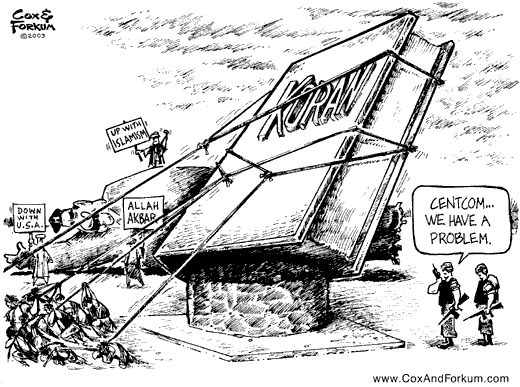
Comments Allen Forkum:
Fox News reports: Iraqi Shiite Pilgrims Criticize U.S. and White House Eyeing Iranian Influence Among Iraqi Shiites. Excerpt from latter article: [White House Press Secretary Ari Fleischer] said Bush doesn't have a problem with Iraq being an Islamic state as long as it is a democratic and tolerant one. Officials point to the model of Turkey, a democratic nation run by an elected Islamic party that allows religious freedom. The United States opposes an Islamic dictatorship in Iraq, similar to that seen in Tehran, Fleischer said.
But a "democratic" state is not necessarily a "tolerant" one. Here are two good editorials about the type of government that should be established in Iraq:
The first is by Robert Tracinski of the Ayn Rand Institute: 'Iraqi Freedom' Requires Individual Rights. Excerpt: "The greatest threat to good government in Iraq is precisely that each tribal and religious faction will demand special favors, that the Shiites in the south will want a Khomeini-style theocracy, or that the Kurds will make a grab for control of the northern oil fields. This kind of political gang warfare between opposing factions is inevitable--so long as the government has the power to dispense such privileges. That is why it is crucial, for example, that the new Iraqi government enforce, not a balance of power between Sunnis and Shiites, but a separation of church and state."
The second editorial is from InterMarket Forecasting's Richard Salsman: Turning Iraq Into Another Iran. Excerpt: "The problem [of democracy] in Iraq is that 60% of the population consists of Shiite Muslims. They are more religious and more anti-American than the other two tribes (Kurd and Sunni) that comprise the population. The Shiites in Iraq are similar to those who run the dictatorial, terror-sponsoring theocracy in Iran. By deposing the Shah of Iran in 1979, the U.S. helped terrorist Shiites take hold of Iran. Will the U.S. now do the same thing in Iraq? It certainly will if it concedes to 'one-man, one-vote' in that country -- with no constitution protecting individual rights. If that is the result, the U.S. will have wasted its war effort, by allowing an Iran-style government to develop next to Iran."
Pragmatism–as usual–from the Conservatives
Today's my day to be exasperated with conservatives. The New York Sun today takes on Martin Indyk's plan, mentioned yesterday, to have an American-led trusteeship rule parts of the West Bank and Gaza:The first [problem]... is that "Egypt, Saudi Arabia, and Jordan" would provide "training of the Palestinian security services." This, according to Mr. Indyk, "would ensure that Western methods were effectively adapted to Arab culture." There, in one chilling clause, is encapsulated the entire patronizing, condescending attitude of American peace processors. As if "Arab culture" somehow had a special need to be policed by security forces with the Egyptian or Saudi government's disregard for human rights, democracy, freedom, and rule of law....
The other problem we see with the Indyk plan is perhaps even graver. It is that final-status negotiations between Israel and the Palestinian Arabs would go forward even while the trusteeship... was in charge of rooting out terrorism and eliminating anti-Israel incitement from the Palestinian public schools and controlled press. Queried on which Palestinian Arabs would be doing the negotiating, Mr. Indyk mentioned the same PLO henchmen who have been doing the negotiating for Yasser Arafat for a decade. In other words, people with no true democratic mandate and no proven track record of fighting terrorism, delivering security to Israel, or providing freedom or honest, representative government to the Palestinian Arabs. There may be an argument for America and its allies invading the West Bank and Gaza to root out terrorism and help build a free democracy there. But asking Israel to simultaneously negotiate a deal to give a state to the same gang of terrorists who America and its allies are invading to kick out strikes us as befogged. [New York Sun, 4/23/03]
Now these are good points as far as they go. But nowhere does the article mention the fundamental issue: that this plan requires that America sacrifice its own interests for the sake of "peace" in the Middle East. It's sophisticated pragmatism, but it's still pragmatism--as usual conservatives know what our interests are, but are unwilling to defend our moral right to pursue them, as a matter of principle.
BBC vs. Objectivity
It's nice to see a defense of objectivity in reporting, even if it's only in passing:As the American forces quickly advanced on Baghdad, the BBC offered viewers live feeds of the briefings given by Iraq's information minister. As those sessions began to look more and more like "Saturday Night Live" skits, the BBC continued to treat them at face value and continued to give them equal billing to briefings from the Americans in Qatar.
Even more troubling, the network rarely chose to make any effort to establish the objective facts. When the two sides disagreed about who controlled the Baghdad Airport, the BBC could have noted that American journalists, embedded with American troops, were standing on the runways, but it did not. That kind of credulous evenhandedness is not a service to viewers; it is an abdication of journalistic responsibility. [Joshua Gerstein, New York Sun, 4/23/03]
Several paragraphs later, however, Gerstein (a reporter for ABC News) completely undercuts his defense of objectivity. With full knowledge of the CNN scandal, he defends the BBC for staying in Baghdad: "Imagine the journalists and news outlets we would have had to rely on had the BBC pulled out of Baghdad as most American television outlets did. But Iraqi censorship is no excuse for the network's failure to have its correspondents outside Iraq, who were not under the thumb of Saddam's goons, report on the true nature of the Iraqi power structure." The utter failure to think in principle is exasperating. Isn't it clear by now how little value there was in reports from Baghdad?
From Cox and Forkum:

New York: Government As Thief
An excellent editorial in today's New York Sun details the government's unconstitutional seizures of private property in New York:The [New York] Times worked out a deal under which the Empire State Development Corporation would condemn an entire city block, razing 10 properties and a parking lot. A number of residences... and more than 30 thriving businesses... will be swept away to accommodate the Times. The Times will be paying about $62 per square foot for its acquisition, according to the report, as opposed to $130 per square foot paid in a comparable private transaction for a nearby parcel....
The New York Stock Exchange, in lower Manhattan, wanted a location to build a new headquarters. It decided on a site across the street from its current location. Unfortunately for the NYSE, however, the location was occupied by residential and commercial properties. Instead of letting that get it down, however, the NYSE decided to threaten the city with leaving Manhattan altogether if it didn't help in the acquisition of the properties. The New York City Economic Development Corporation complied and began the process of condemning the apartment building at 45 Wall Street.The tenants' association fought the move, but a state appeals court sided with the city. The court cited that the project would have a public benefit, would increase tax revenues, and would aid economic development. Judged by such criteria, it's hard to see why a government use of eminent domain would ever be denied... [New York Sun, 4/23/03]
The rest of the editorial is worth reading too; these examples come from a report by the Castle Coalition, a project of the Institute for Justice. The Constitution says that private property shall not be taken for public use without just compensation; in these cases "public use" is stretched to benefit private individuals in the name of "economic development" and the compensation is anything but just. This is to say nothing of the fact that in justice, no private property should ever be taken for public use, barring emergencies.
Conservatives Are Hopeless
If you really believe that all sexual activity between consenting adults should be legally permitted, you ought to object to laws against incest (when no child is involved) and polygamy too. (The adultery example doesn't really fit, since adultery involves a usually nonconsenting third party, the betrayed spouse.)
The real point here is that except for a few radical libertarians, hardly anyone actually accepts the principle that the government must never regulate private, consensual sexual behavior. What regulations one finds acceptable or desirable is a matter of custom and tradition as much as principle. And custom and tradition are subject to change. [James Taranto, "Best of the Web Today," 4/23/03]
See? There's no principle at all here; it's all abject second handedness. What's actually right or wrong, or what the facts are, is not important; just follow custom and tradition--i.e., what other people think. (The ad hominem shows only that he has no case of his own: as if sneering about "radical libertarians" or their alleged small numbers is at all relevant to the truth or falsity of the position he's criticizing.)
We have the Founding Fathers to thank for the fact that America was founded on the rejection of custom and tradition, and that it protected individuals' ownership of their own lives from the kind of morally empty majoritarianism Taranto is espousing here.