
Supply-Side Self-Delusion
Michael Kinsley writes like a typical rationalist: his focus is typically on others' contradictions, not on the truth--and even when he has something positive to say he has to do it dialectically. Nevertheless, he has a point here:Republicans do give reasons for wanting to make big projected deficits even bigger. They say that tax cuts spur the economy and eventually will generate revenue to wipe out the deficits. They say that big deficits will force the government to cut spending. These arguments are contradictory and bogus. If the deficit will eliminate itself, it will not create pressure to cut spending. If tax cuts always spur so much growth that they pay for themselves, can we cut taxes to zero and still break even on revenue? If the trick stops working at some point higher than zero, how can we assume it will work for us? And if the purpose of tax cuts is to force spending cuts, why doesn't the governing party at least propose enough spending cuts to cover the cost? "I'm eating all this pie so I'll get fat and be forced to diet." Do you buy that one? [Michael Kinsley, Slate.com, 5/1/03]Or another way to put it: The typical supply-side Republicans think that cutting taxes will allow them to avoid the moral battle over cutting spending--because they are fundamentally unwilling to challenge the altruistic premise behind the welfare state. But it's nothing but self-delusion.--Paul Blair
["I'm eating all this pie so I'll get fat and be forced to diet" is a poor analogy--a much better one is "I will be expropriating less pie, so I will be forced to diet." The only problem is that reduced taxation combined with no spending cuts will force the government into either increasing the deficit or inflation to pay for its prodigality.--Mark Da Cunha]
Welfare’s Effects
Whether poor families stay married shouldn't be a matter of public policy; those who act destructively should bear the cost of their own behavior. In today's world, welfare supports these families; public policy is concerned with whether or not welfare encourages irresponsible behavior that the taxpayer is expected to subsidize.The Associated Press reports that the portion of black families headed by single women dropped by four points since welfare reform passed in 1996, contrary to the predictions of the naysayers. The article claims that "the surging economy of the late 1990's probably had more to do with the gains for black families than did welfare reform," but adds that "The increase came despite a recent drop in blacks' income." (Note that the number of black families headed by married couples is still only 47.9 percent.)
According to Mickey Kaus, "the economy has boomed and busted before--and before the mid-1990s the family trends for blacks moved relentlessly downhill for decades ... I doubt that honest liberals... think that welfare reform wasn't also a major part of the cause."
Duplomacy II
From Cox and Forkum:
Comments Allen Forkum:
As the anniversary of Mr. Carter's Castro coddling approaches, he is again confronted with harsh realities that contradict his socialist sympathies.
In May 2002, Carter condemned the Bush Administration for suggesting that Cuba is pursuing biological weapons, which dictator Castro called a "lie." Carter praised the Castro regime for allowing him speak freely to the Cuban people, who are not allowed such freedom. The former U.S. president encouraged dissidents by publicly airing their calls for reforms. The BBC News reported at the time that Carter left Cuba on friendly terms. Excerpt: Organisers of the so-called Project Varela have handed in a petition bearing 11,020 signatures to the Cuban National Assembly asking for a referendum on civil liberties. Mr Carter said he believed the Cuban Government had not yet decided how it would respond to the proposals. "I think it's accurate to say the decision to deal with it -- or not -- has not been decided," he said.
A year later, we now know what Castro "decided": 75 political dissidents and independent journalists were recently rounded up and sent to jail for 28 years, and three men who tried to hijack a ferry to escape to America were executed.
In an Atlanta Journal-Constitution article by Moni Basu (Castro's crackdown strains budding ties), Mr. Carter stated: "Needless to say, I have been very disappointed by what has occurred in Cuba," Carter said. "The dissident movement has been severely crippled, and I would presume Draconian measures adopted by Castro will be maintained."
We would presume Carter was also "very disappointed" when the Draconian North Korea dictatorship broke the agreement he helped broker and started developing nuclear weapons. (The cartoon above is an allusion to this cartoon.)
For more on Cuba visit Liberty for Cuba.
Where’s the shame?
Last December more than 1000 "academics and intellectuals" signed a letter warning that Israel would use the cover of war in Iraq to expel the Palestinians. Never happened.The New York Sun notes "this letter made drastic accusations about the Israeli government, condemning it for something it had not done and that there was no evidence it ever intended to do. Israel's haters, however, are seldom swayed by history or fact."
Terrorist acts were down last year
The State Department has released its Patterns of Global Terrorism report for 2002, which shows a gain: terrorist acts were down last year.According to the report the seven designated state sponsors of terror are Cuba, Iran, Iraq, Libya, North Korea, Syria, and Sudan: "Iran remained the most active state sponsor of terrorism in 2002" and "Iraq planned and sponsored international terrorism in 2002. Throughout the year, the Iraqi Intelligence Services (IIS) laid the groundwork for possible attacks against civilian and military targets in the United States and other Western countries. The IIS reportedly instructed its agents in early 2001 that their main mission was to obtain information about US and Israeli targets."
Self-Imposed Blindness
What better example of conservatives' stubborn unwillingness even to consider thinking in principles--and the disastrous results in practice:Is it realistic for any political leader to make policy today based on assumptions about what the world will look like nearly six decades hence?
As it happens, 58 years ago it was 1945, the year of the United Nations' founding. Whatever one might think of the U.N., one certainly cannot fault the men who started it for having failed to foresee how it would become a threat to world peace and an obstacle to American action today. [James Taranto, "Best of the Web Today," 5/1/03]
Yes one can fault them, James--that's what principles are for; anyone who had grasped the proper principles would have foreseen it, and Ayn Rand did foresee it.
Suburbia vs. Vouchers
While vouchers are routinely supported by 65% of urban residents, support levels are barely half that amount in the suburbs. Voucher proponents have grown increasingly frustrated with this resistance, and have yet to acknowledge that suburban resistance to choice is entirely reasonable and unlikely to be nagged away.Well, maybe; the whole argument is on the premise that people are entitled to an education at someone else's expense. Vouchers are a mechanism for public funding of private schools. This effectively subjects them to all the strings that are tied to institutions that receive public money--vouchers will eventually bring private education down to the level of public education. Nor do vouchers address the fundamental moral issue that individuals have no right to demand that someone else pay for educating their children. Having children is a choice. If a couple can't afford to support children, then they shouldn't go having children; they have no right to make that choice and then force someone else to bear the costs.
Families that purchase homes in good suburban school districts typically do so, in large part, because of the "seat license" it confers in the local schools. Choice-based reforms, on the other hand, allow students to attend schools where their family hasn't "bought" a seat....
Those who own homes in districts with good schools risk losing tens or even hundreds of thousands of dollars in home equity, may no longer be able to assure their children services they had purchased, and will find that local schools may no longer enjoy first crack at quality teachers or provide as uniformly desirable a peer group. [Frederick Hess, New York Sun, 4/30/03]
Real education reform would institute tuition tax credits, whereby individuals spend their own money on education and their taxes are decreased by that amount. Of course, such a plan doesn't have the "altruistic" justification of sacrificing some members of society for the sake of the poor--but the notion that the poor are entitled to an education at public expense is a big reason why we're in this mess to begin with.
“Shut up and listen to us!” –Hollywood
Americans are already used to socialist celebrities prancing about the country lamenting the fact that "regular people" don't care about the inane viewpoints of someone who once played a smart person on television. But now, they're telling those "regular people" to shut-up, and they're threatening to petition Uncle Sam (the guy with all of those banned "assault weapons") if America doesn't comply.In a letter dated 28 April 2003, the William Morris Agency sent a "cease-and-desist" letter to the "Boycott Hollywood" website. Apparently, some of William Morris' clients don't like what those regular folk have to say about them.Rumors that Susan Sarandon is petitioning to modify the first amendment to read "the famous people" are entirely unsubstantiated, but I don't mind spreading them anyway.[Because the Boycott Hollywood website may soon go offline, a copy of the William Morris letter can be found here. And yes, the server is slow. Just deal.]
Mask Hysteria
From Cox and Forkum:

Recommended: If you have enjoyed Cox and Forkum's work displayed at Capitalism Magazine don't forget to get their paperback collection of their cartoons available at the Cox and Forkum website.
Free Speech Primer
From Rachel Lucas:To all the people who've e-mailed me to say that I'm wrong for criticizing Janeane Garofalo and other celebrities: let me try to explain it to you like you're four years old, mmkay?
The Dixie Chicks have every right to say they're ashamed of President Bush.
Tim Robbins has every right to say he's against the war.
Susan Sarandon has every right to say Bush is an idiot.
Michael Moore has every right to say guns are bad.
Janeane Garofalo has every right to say some Americans are Nazis.
And I have every right to say that all of those celebrities are ignorant.
That simple.
North Korea: Rumsfeld’s Pentagon is Not Very Diplomatic
Negotiations have apparently resulted in an offer from North Korea to end its nuclear program in exchange for "something considerable." How can we trust these people--and how can we verify anything in a country like that?! The Pentagon is apparently skeptical as well:Mr. Rumsfeld acknowledged that for now "the president's on a diplomatic path." But the Department of Defense did not deny two news reports last week that must have sent shivers into Mr. Kim's circle. [An] Australian newspaper cited Pentagon plans to bomb the nuclear site at Yongbyon if Mr. Kim reprocessed spent fuel rods to make bombs. One Pentagon official responded that there are many contingency plans. He told The New York Sun, "That's what we do, we plan."
Another report, in the New York Times, quoted a Defense Department memo which recommended that together with China, America should topple the regime in North Korea. The Pentagon official tried to play it down as just one more of Mr.Rumsfeld's ideas. "His style is to throw things out and inspire debate," the official said.
According to a Reuters report, administration hard liners were upset they were not informed back in March that North Korean diplomats told their American counterparts Korea had begun reprocessing the fuel rods. [New York Sun, 4/29/03]
BBC: The Bagdahd Bob Corporation?
Saudi Arabia is home to some of Islam's holiest sites and the deployment of US forces there was seen as a historic betrayal by many Islamists, notably Osama Bin Laden. It is one of the main reasons given by the Saudi-born dissident --blamed by Washington for the 11 September attacks--to justify violence against the United States and its allies. [BBC News, 4/29/03]
"Dissident"?
Bear in mind those US forces were deployed in the Middle East to stop this:
A 31-year-old Kuwaiti woman, Asrar Qabandi, was captured by Iraqi secret police occupying her country in 1990 for "crimes," one of which included speaking with CNN on the phone. They beat her daily for two months, forcing her father to watch. In January 1991, on the eve of the American-led offensive, they smashed her skull and tore her body apart limb by limb. A plastic bag containing her body parts was left on the doorstep of her family's home. [New York Times]
So the "justification" is the the U.S. should have allowed Saddam to stay in Kuwait.
***
Tony Blair contrasts BBC objectivity to the "Iraqi information Minister":
"Tony Blair blitzed the BBC on Friday over its twisted coverage of the Iraq war. The PM was furious after a newsman claimed terror in Baghdad is worse than under Saddam. War reporter Andrew Gilligan said on Radio 4's Today programme: 'Baghdad's people are passing their first days of liberty in a greater fear than they've ever before known. The old fear of the regime was habitual, low-level. This fear is sharp and immediate.' Mr Blair was furious at a War Cabinet meeting on Friday. He gave his official spokesman his blessing to say: 'Try telling that to people whose relatives have been dropped head-first into shredders. I doubt if the Iraqi information minister would try to justify this report.' " [Sun]
OK, maybe Bagdahd Bob isn't dishonest enough to work for the BBC. My apologies to the "Iraqi information Minister."
Conservatives’ Tyrannical Premises
Here's from James Taranto's column today--comments that Andrew Sullivan has called "sane":Echoing Santorum, Kurtz raises the possibility of a "slippery slope" leading from same-sex marriage to polygamy. But one can easily draw a distinction. The widespread practice of polygamy would have great social costs. It would distort the sexual marketplace by creating an undersupply of marriageable women. (Polyandry, the practice of women having multiple husbands, is too rare to be worth discussing.) The result is the creation of what Jonathan Rauch calls a "sexual underclass" of "low-status men" whose prospects for marriage are virtually nil... By contrast, it's hard to imagine any great social harm arising from official recognition of same-sex unions. Just about anyone who would consider "marrying" someone of the same sex is outside the ordinary marriage pool anyway... [James Taranto, "Best of the Web Today," 4/29/03]Is Taranto completely oblivious to the philosophical implications of his argument? What business is it of the government whether or not someone "reduces the marriage pool"? Suppose Catholicism differentially encouraged women to become nuns--would that mean society should proscribe women from doing so? If it became fashionable for women to refrain from marrying, would that justify society's forcing them into marriage?
The premise from which Taranto is arguing sounds like a feminist caricature: People are breeding animals for society, who, if they can't find a mate, deserve to have one provided by the state. This is completely antithetical to any notion of individual rights, let alone human decency. This is yet another example of conservatives' willingness to dispense with rational principles.
State Department’s Destructive Foreign Policy
This was sent to CM:Dear Editor:
Newt Gingrich's harsh criticism of Colin Powell's policy of "appeasing dictators and propping up corrupt regimes" is entirely justified--and long overdue.
However, the State Department's misguided policy precedes Powell's leadership, and is caused by the bankrupt doctrines of moral relativism and appeasement.
Moral relativism is the belief that there is no absolute right and wrong, no absolute good and evil, and leads to the belief that free countries are morally equivalent to dictatorships. Thus the sad spectacle of the United States, the greatest force for good on earth, befriending and enriching Saudi Arabia and China, two of the greatest forces for evil today.
Appeasement is the strategy of dealing with enemies not by confronting them but by sacrificing to them. Thus the United States' shameful handouts of goods and money to North Korea, the Palestinian Authority, and the former Taliban.
In order to fix the State Department's self-destructive foreign policy nothing less than a change of its underlying philosophy will do. Moral relativism and appeasement must be rejected and replaced by a willingness to differentiate between good and evil, between friends and enemies--and to act accordingly. Thus the United States must confront its enemies, condemn them morally, isolate them diplomatically, sanction them economically, and if necessary, destroy them militarily.
Only then will the United States gain the respect of its friends and command the fear of its enemies. Only then will the United States be safe.
Sincerely,
David Holcberg
Ayn Rand Institute
For the record Capitalism Magazine is not affiliated with the Ayn Rand Institute.
Labour MP George Galloway’s Charity
The Daily Telegraph finds that Labour MP George Galloway's Mariam Appeal for three months hasn't even given the leukemia patient it was founded to support her monthly £65 allowance for food and travel expenses--while the charity spent more than £800,000 on political campaigns and expenses, including £18,000 to Galloway's Palestinian wife.North Korea and Nukes
From Cox and Forkum: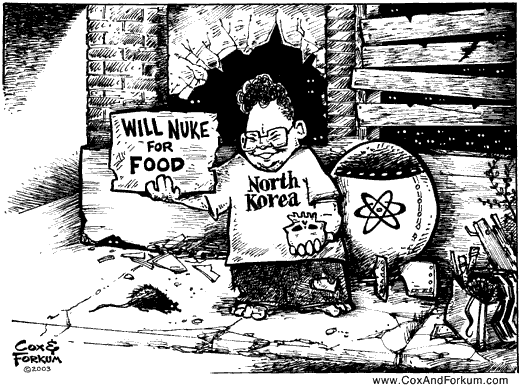
Related Reading: Baby Kim Jong's Secret Weapon Against America
CNN: Nonobjective Nonjudgmentalism at Work
The New York Sun has an even better than normal editorial today defending Ahmad Chalabi in the context of CNN's lack of objectivity with respect to Arab leaders. CNN interviewed King Abdullah of Jordan, who as much as accused Ahmad Chalabi of being a crook. Writes the Sun, "one can only wonder what were the reasons that the network yesterday failed to challenge the Hashemite ruler with the obvious follow-up questions." Here are a few--but I very much recommend reading the whole editorial:2. About that alleged embezzlement. The Jordanian charges against Petra Bank, which you refer to, were made in a special "security court" established under martial law--an emergency measure adopted following the war in 1967. If the charges were so strong, why weren't they made in an ordinary Jordanian court?The one I like best, though, is where the reporter would demand if the King is a stooge of the CIA.
3. This special Jordanian security court was established on April 1, 1992. It had its first hearing on April 8, 1992. The following day, April 9, 1992, the court handed down a 223-page decision against Mr. Chalabi. How was it possible for this court to thoroughly and fairly examine matters involving a complex international banking empire and issue a 223-page ruling all in the space of 24 hours? Is this the way the rule of law works in Jordan?
4. Did the timing of the Jordanian security court's attack on Mr. Chalabi and his bank have anything to do with Mr. Chalabi's appearance in a "60 Minutes" segment in early 1992, in which he showed documents detailing the links of your father, King Hussein, to arms purchases by Saddam Hussein's Iraq?
5. After Mr. Chalabi was convicted, he apparently met twice with your father. If these Jordanian banking abuses of which Mr. Chalabi was supposedly guilty of were so severe, why did the king not arrest him? [New York Sun, 4/28/03]