Feb 6, 2004 | Dollars & Crosses
A New York Sun lead editorial says about all that needs to be said about John Kerry:
[I]f Tuesday night was an indicator of where the Kerry campaign is headed, we predict the senator from Massachusetts is in for a rocky ride. And not only because the message is weak, in a country where lots of us enjoy miracle cures and cheap gasoline because of "the drug companies" and "big oil," and where a lot of middle-class workers have retirement accounts or union pension funds swelled with stock in energy and drug companies. But because the messenger is, well, hampered by his own circumstances.
How John Forbes Kerry can credibly campaign against "the economy of privilege" is beyond us. He was in Skull and Bones at Yale. He lives in a $10 million townhouse on Louisburg Square in Boston's Beacon Hill. He summers in Nantucket. Forbes estimated his net worth at $550 million, more than Jay Rockefeller.
Maybe between the guilty rich and the angry poor Mr. Kerry can cobble together a coalition to defeat Mr. Bush in November.Our guess is that there are far more of a third category of people--optimists who are happy that America is a place where hard workers with some luck can build vast fortunes. [January 29, 2004]
Feb 6, 2004 | Dollars & Crosses
Brooklyn middle-school teachers told city lawmakers yesterday they were ordered not to expel students no matter how severe the crime under the Education Department's school safety plan....
The directive came from a principal during a September staff meeting, he told admittedly "shocked" City Council members in a hearing on school safety. Students have choked each other, stabbed each other with pencils, and shot off bottle rockets in the cafeteria, but weren't punished, teachers at J.H.S. 258 testified. In some cases, there were under-the-table suspensions where a troublemaker was walked home and kept out of school for five days, but there's no record of a suspension, according to another J.H.S. 258 teacher, Dorian Hunter Jr. [NYSun, January 29, 2004]
An article the following day reports that "Whistle-blowers who share tales of woe about school safety, micromanagement, and other education issues with Chancellor Joel Klein have suffered a backlash from their superiors..."
Feb 5, 2004 | Dollars & Crosses
You've probably heard that former weapons inspector David Kay doesn't think Iraq had weapons of mass destruction. But here's what else he thinks:
"We were almost all wrong, and I certainly include myself here," he said. "My view was that the best evidence I had seen was that Iraq indeed had weapons of mass destruction." ... Mr. Kay said he doesn't think members of the administration pressured analysts to shape evidence to make the case for war. "I deeply think that is the wrong explanation," Mr. Kay said, adding that numerous analysts had come to him in recent months to apologize about incorrect estimates. [NYSun, Jan 29, 2004]
Kay testified before the Senate Armed Services committee:
In the course of doing that, I had innumerable [intelligence] analysts who came to me in apology that the world that we were finding was not the world that they had thought existed and that they had estimated. Reality on the ground differed in advance. And never--not in a single case--was the explanation, "I was pressured to do this." The explanation was very often, "The limited data we had led one to reasonably conclude this. I now see that there's another explanation for it." [CNN, Jan 28, 2004]
James Taranto adds:
Earlier in the week a New York Times editor "sexed up" the paper's coverage of Kay, leading the paper to publish this embarrassing correction Tuesday:
Because of an editing error, a front-page article yesterday about David A. Kay, the C.I.A.'s former weapons inspector, misstated his view of whether the agency's analysts had been pressured by the Bush administration to tailor their prewar intelligence reports about Iraq's weapons programs to conform to a White House political agenda. Mr. Kay said he believed that there was no such pressure, not that there was. (His view was correctly reflected in a quotation that followed the error.)
Feb 5, 2004 | Dollars & Crosses
How's this for cynical whitewashing of tyranny and amoral stability-worship:
Commerzbank, Germany's third largest bank... seemed particularly eager to curry favor with Tehran. At a session on "fiscal framework, regulations and contracts," Commerzbank's representative at the conference, Richard Greer said, "Since that moment in 1908 when oil was found in Iran, great benefits have passed on to the people of that country, despite great difficulties and foreign aggression." He later said, "At Commerzbank we see Iran as an island of stability."
Mr. Greer later recounted a story from his recent trip to Iran. As he was discussing the current turmoil in the Middle East with his hosts, one Iranian official remarked, "We have already had our revolution." Mr. Greer then remarked, "That stability we see in Iran is a product of that revolution."
The 1979 revolution that brought the Ayatollah Khomeini to power was followed the following year by the outbreak of war with Iraq and the beginning of Iran's relationship with Hezbollah and campaign to assassinate former high ranking officials from the Shah's government living abroad.
When asked whether he believed the demonstration of July 9, 2003, to commemorate the five year anniversary of the state's crackdowns on student protesters, was a possible sign of instability, Mr. Greer was dismissive. "The July 9 demonstrations is a sign of letting off steam. Half the population is very young and there is high unemployment." [NYSun, Jan 29, 2004]
Feb 4, 2004 | Dollars & Crosses
Andrew Sullivan observes:
I'm beginning to worry that the president has lost his political touch. He's still under 50% on the re-elect question in most polls.
And the base is very restless. The domestic spending explosion and the immigrant temporary-worker program have hardly helped him cement his core supporters. However, if I were to come up with one single idea to enrage the base--after all the spending criticism--I'd come up with doubling spending on the one federal agency the right loathes the most. And sure enough, the president is now pouring more money into the NEA. Does he think National Public Radio listeners are going to rally to him over this? Has he lost his mind?
Feb 3, 2004 | Dollars & Crosses
Bet the environmentalists are in a tizzy about this:
Mayor Bloomberg said it came as no surprise to him that an analysis by the New York City Independent Budget Office released yesterday found recycling metal, plastic, paper, and glass to be more expense than simply throwing them out. The budget office study concluded that recycling cost the city about $35 million more in 2002 than had conventional disposal methods of landfills and incinerators been employed. "The numbers have been out there for a long time. If you've listened, I've been saying it again and again and again," Mr. Bloomberg said. "Anybody that thinks it saves money is just wrong." The study was released to coincide with the city's plan to restart weekly recycling and glass recycling this spring, after a year-long hiatus to save money. "You've got to drive two trucks with two crews down the same streets," Mr. Bloomberg said. "It's going to cost you more than if you do it once."
Feb 3, 2004 | Dollars & Crosses
From a column by Marquis Harris in the Atlanta Journal-Constitution, (by way of James Taranto and Joanne Jacobs):
Recently, I interviewed with a school in one of the metro Atlanta counties, only to receive an e-mail from the principal stating, "Though your qualifications are quite impressive, I regret to inform you that we have selected another candidate. It was felt that your demeanor and therefore presence in the classroom would serve as an unrealistic expectation as to what high school students could strive to achieve or become. However, it is highly recommended that you seek employment at the collegiate level; there your intellectual comportment would be greatly appreciated. Good luck."
Feb 3, 2004 | Dollars & Crosses
Steven Malanga in the New York Sun:
Jersey's floundering Republicans face a similar problem to that of their equally unsuccessful New York brethren: powerful public-sector groups that live off government money and push incessantly for ever higher taxes have seized control of the state's politics, and feckless GOP leaders have accommodated them, leaving the state party without core principles and alienating its voting base. Jersey's overburdened taxpayers--they pay the second-highest state and local taxes in the country (behind only New York's)--have nowhere to turn for a real alternative to Democratic big spenders....
The latest outrage: a legislative proposal, sprung on voters immediately after the election, to hike gasoline taxes by up to 12.5 cents a gallon,even as the local economy struggles to get out of a recession. In a state that's sixth in the nation in cars per capita,the new levy, initially backed by Democrats and some Republicans, drew opposition from more than 70% of Jersey residents. Taxhikers backed off.
Empower the People is doing more than opposing new taxes, however. It is seeking passage of state constitutional amendments limiting state government spending and rewarding municipalities that live within budget limits by distributing surplus state funds to them for property-tax relief. These "return the money" amendments, as Mr. Schundler dubs them, would prevent the state from spending recklessly when tax receipts are rolling in, as it has traditionally done.
Feb 3, 2004 | Dollars & Crosses
Maybe the following article has mischaracterized the arguments, but if it's right it makes quite clear that egregious context-dropping as a characteristic vice of academicians is not confined to the left:
The study of 399 syphilitic black men in Tuskegee, Ala., began in 1932 and proceeded for 40 years, until an outcry spurred by an Associated Press story in 1972 caused it to be shut down. The men were never treated for syphilis, even after penicillin became available in the 1940s and 1950s.... However, an alternative view espoused by a University of Pittsburgh historian, Jonathan Erlen, and a University of Pittsburgh Medical School professor, Dr. Thomas Benedek, argues that the study was not racist, because syphilis was more prevalent in black men than in white men at the time. Another academic, who has also written about the study, University of Chicago anthropologist Richard Shweder, says the men recruited all had tertiary-stage syphilis, an incurable stage of the disease even after treatment with penicillin, and that the argument for so-called informed consent is founded on modern-day standards.
The article makes clear just how flimsy these arguments are.Feb 2, 2004 | Dollars & Crosses
From NY Sun:
Mary Robinson, an architect of the U.N. Durban human rights conference in 2001 that was boycotted by Secretary of State Powell because the Bush administration deemed it too hostile to Israel, has been hired as a professor by Columbia University. [January 29, 2004]
Feb 2, 2004 | Dollars & Crosses
Colin Powell had an op-ed published in Russian newspaper Izvestia:
While he praised the two countries' cooperation on issues ranging from the war on terror to the fight against AIDS, Mr. Powell also warned that the U.S.-Russia relationship "will not achieve its potential" unless the two countries share "basic principles. ..." "Russia's democratic system seems not yet to have found the essential balance among the executive, legislative, and judicial branches of government. Political power is not yet fully tethered to law," Mr. Powell wrote. "Key aspects of civil society--free media and political party development, for example--have not yet sustained an independent presence."
Just in case you were worried:
"As far as I was concerned, it wasn't in any way an attempt on my part to interfere in the internal dynamic of Russian political life," he told reporters. "It was in the spirit of friendship that I discussed all these issues. ..." Mr. Powell made no mention of concrete consequences for Russia's actions, and political analysts said it was unlikely the Bush administration would take matters that far.
Feb 2, 2004 | Dollars & Crosses
News from Iran:
More than a third of the Iranian parliament resigned Sunday and the speaker delivered a stinging rebuke to the hard-line Guardian Council for its disqualification of hundreds of liberal candidates in upcoming elections....On Saturday, ["reformist" President] Khatami suggested his government would call off the vote, which he called undemocratic because hard-line Islamic clerics have disqualified more than 2,400 liberal candidates. "My government will only hold competitive and free elections ... the parliament must represent the views of the majority and include all (political) tendencies," Khatami said, according to the official Islamic Republic News Agency. Hours later, doctors confined Khatami to his home for treatment of what a senior presidential aide told The Associated Press was a longtime back problem exacerbated by stress.
Feb 2, 2004 | Dollars & Crosses
From coverage of the opening arguments:
[Martha Stewart's lawyer, Robert] Morvillo said Ms. Stewart had sold 51,000 shares of ImClone in the fall, leaving her with fewer than 4,000, which Mr. Bacanovic had been urging her to get rid of for about a month. He said the two had agreed about a week before, when Mr. Faneuil was away on vacation, that Ms. Stewart would consider selling the stock if it fell to $60 a share. On December 27, the stock fell below $60 for the first time since their discussion.
The defense argued that given the falling stock price and the agreement to talk about selling when the stock hit $60, it was only responsible for Mr. Bacanovic to reach out to Ms. Stewart. "How did she know Sam Waksal had decided to do the dumbest, worst, most offensive thing in the world on December 27?" Mr. Morvillo said. [NY Sun]
The whole opening argument is here.
So let's get this straight. Martha Stewart, who is worth a billion dollars, had sold 92% of her shares in ImClone months before. Now if she had lost the entire value of the remaining 4,000 shares she would have lost about a quarter of a million dollars. But instead, she supposedly sells on inside information and allegedly lies to the Feds to cover it up. This costs her a $400 million loss in the value of her company.
Furthermore, we have to believe that the broker who tipped her off was not smart enough to do it in such a way that Martha Stewart would have an airtight case against any accusationa of insider trading. And we have to believe that he's not just saying what prosecutors want to hear, to save his own skin by giving them a "big fish."
Why on Earth should anyone believe him instead of Martha Stewart?
Now we learn this:
A federal judge put Martha Stewart's trial on hold yesterday after learning that prosecutors withheld a key document from the defense until the last minute.
The document was an FBI report of a January 15, 2003, interview with the lawyer who originally represented the star prosecution witness, Douglas Faneuil,who was the assistant to Ms.Stewart's co-defendant, Peter Bacanovic....
The multipage document says Mr. Faneuil's former lawyer, Jeremiah Gutman, told investigators his client said he could not remember if it was Mr. Bacanovic or Samuel Waksal, the chief executive officer of ImClone Systems, who told him to inform Ms. Stewart that Waksal was trying to sell his Im-Clone shares the day before his company announced bad news. [NY Sun]
The following day prosecutors provided 10 more never-before-seen documents to the defense. The government deserves to lose this case, in as humiliating a way as possible. The good thing is, looks like it's happening. For more, see: http://www.marthatalks.com and http://www.savemartha.comFeb 1, 2004 | Dollars & Crosses
From Cox and Forkum:
This cartoon was created the day of the Columbia Shuttle disaster. Last year, Capitalism Magazine posted two op-eds about Columbia. The Spirit of the Space Shuttle Columbia: The Essence of the American Soul by Robert Garmong.The ground of east Texas trembled with the horror overhead. The shock waves spread as the worst fears were confirmed: space shuttle Columbia had turned from a high-precision machine into a lifeless meteor, its crew lost. Americans were hit with a degree of shock not equaled since September 11. [...] Only something that struck uniquely close to the American soul could have caused the degree of shock and horror with which we have responded to the Columbia disaster.
And Hail Columbia by Nicholas Provenzo.Those of us who remember the loss of the Challenger and the Apollo fire before then, are reminded that great leaps often entail great risks. Yet we should be loath to say that the heroes of Columbia died for space flight. They lived for it, and that included the real risk that they might die. They turned space into a new frontier; a frontier that speaks to our every potential as a species.
Jan 30, 2004 | Dollars & Crosses
From Cox and Forkum:
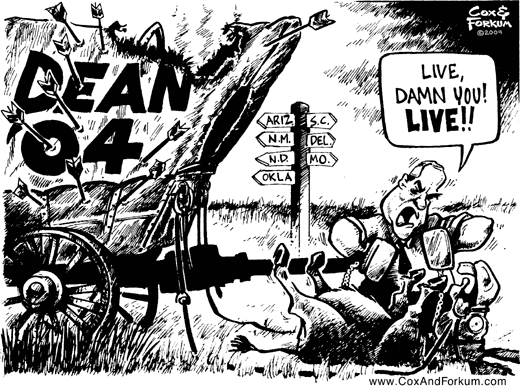
Fox News reported yesterday: Dean Machine Tries to Work Out Kinks.Howard Dean needs to win at least one primary in the next two weeks to keep from becoming political toast, political experts said Thursday. The former Vermont governor is trying to get his floundering campaign back on track after twin losses in Iowa and New Hampshire -- races he was expected to win handily only a few weeks ago. [...]
Dean named longtime Al Gore associate Roy Neel as his new campaign CEO on Wednesday and veteran campaign manager Joe Trippi resigned.
Capitalism Magazine features a good Larry Elder op-ed (along with a collection of our Dean cartoons): When Did The Howard Dean Meltdown Really Begin?Only a little over one month ago, national polls gave Dean a commanding 20 percentage-point lead over his closest Democratic rival, yet he staggered to a third-place finish in Iowa. Talk about a meltdown. If Dean continues to under-perform, his campaign ends, and the blame game begins. Expect his supporters to say the overreaction of the media and the pundits to Dean's, uh, rallying cry, brought him down.
Really? Maybe it began when Dean, on National Public Radio, mentioned a "theory" that President George W. Bush possessed prior knowledge of 9/11, yet took no steps to halt it. Two days later, he said that no, he didn't believe the theory. And a couple of days later, he called the theory "crazy."
Or maybe the meltdown began when Dean called himself an anti-war candidate, yet supported a resolution called Biden-Lugar, which authorized military action in Iraq without the need for the president to seek another resolution. Or maybe...
Jan 29, 2004 | Dollars & Crosses
From David Holcberg of the Ayn Rand Institute:
President Bush is wrong in proposing to increase the budget of the National Endowment for the Arts. Why?
Because art is a form of expressing ideas, and using taxpayers' money to promote ideas they may disagree with is immoral and violates their rights. Such misuse of taxpayers' money is a violation--not a promotion--of freedom of speech. As Thomas Jefferson explained, "To compel a man to furnish contributions of money for the propagation of opinions which he disbelieves and abhors, is sinful and tyrannical."
The Bush administration should stop demonstrating its "commitment to the arts" and focus instead on protecting individual rights. Getting rid of the National Endowment for the Arts would be a small step in the right direction.
Jan 28, 2004 | Dollars & Crosses
From Cox and Forkum:
ABC News reported Monday: Forget the South?.Sen. John Kerry, D-Mass., is discounting notions that any Democratic candidate would have to appeal to Southern voters in order to win the presidency, calling such thinking a "mistake" during a speech at Dartmouth College. [...]
"Everybody always makes the mistake of looking South," Kerry said, in response to a question about winning the region. "Al Gore proved he could have been president of the United States without winning one Southern state, including his own."
As Glenn Reynolds noted: "Um, no. Al Gore proved that he couldn't win the United States without carrying one Southern state, including his own."
The ABC News article concludes with a brief history of Democratic candidates and Southern states:Whether or not Democrats should cede the South for the November 2004 election and focus resources elsewhere has been fiercely debated privately in many Democratic circles. History is not on the side of those who would argue in favor of doing so.
The last three Democratic presidents -- Bill Clinton from Arkansas, Jimmy Carter from Georgia, and Lyndon Johnson from Texas -- were from the South. The last four Democratic presidential nominees to not win one Southern state -- Sen. George McGovern in 1972; former Vice President Walter Mondale in 1984; Gov. Mike Dukakis in 1988; and Gore in 2000 -- lost. Former Vice President Hubert Humphrey in 1968 and Carter in 1980 were able to win one Southern state apiece, though in the end they lost to Republicans nationwide. Of the victorious Democrats, Carter won 10 Southern states in 1976, and Clinton won four in both 1992 and 1996.
Jan 28, 2004 | Dollars & Crosses
From the New York Sun:
One questioner in a college auditorium in Keene, who identified himself as a war veteran, told Mr.Kerry that he was "horrified" that the senator supported the war, and questioned how he could be "conned by the administration. ..."
"I believe I voted correctly to protect the security of our nation," responded Mr.Kerry, who then criticized the Clinton administration for failing to act against the former dictator sooner.
...Mr. Kerry said that in 1998, he and two Republicans, Senator McCain of Arizona and Senator Hagel of Nebraska, suggested to President Clinton, "that he should have gone to the U.N. That he should have had the capacity to have the threat, the force, to get inspectors back in there to make Saddam Hussein to live up to the only thing that had left him in power--his obligation to disarm. "So, George Bush brings a legitimate security issue before the Congress in 2002. Am I supposed to turn away and ignore what I said in 1998, what I thought Clinton should have done? Do we ignore the fact that the last time we had inspectors there we had weapons that had not yet been destroyed? And our intelligence is telling us there are weapons?" he asked the audience.
Just in case you were worried:
Mr. Kerry then made his standard stump speech statement that he voted not in favor of a war, but in favor of a "process promised by the president." He said Mr. Bush should have taken more time to allow inspectors to search for weapons in Iraq, and should have built a broader international coalition through the U.N.