Feb 14, 2004 | Dollars & Crosses
From Yahoo News:
"JERUSALEM (Reuters) - A prominent Israeli rabbi has proposed hanging bags of pig fat in buses to deter Muslim suicide bombers who may want to avoid contact with an 'unclean' animal, an Israeli official said on Thursday."
Hat Tip: B. Harburg-Thomson
Feb 13, 2004 | Dollars & Crosses
Really, what good is the FCC anyway? As Mark Steyn comments:
When I was asked what I thought of the huge boob exposed in prime time, I thought it was a reference to Al Sharpton not knowing what the Federal Reserve was in that candidates' debate....
...I enjoy [breasts] when they turn up on BBC costume dramas and when you're driving through France enjoying the topography and they pop up on billboards so you can enjoy the topoffgraphy. There's something to be said for the relaxed Continental approach to nudity. There's nothing to be said for the hollow joyless mechanical pop culture trash of the Super Bowl show: It was sleazy and worthless when it was fully clothed.
Nonetheless, I don't see why we need a government investigation. Unlike Saddam Hussein's weapons of mass destruction, the existence of Janet Jackson's breast is not in doubt. We know where it is, there have been verified sightings; we're not relying on faulty intelligence and grainy satellite imagery....
[W]hat will be accomplished by a government investigation? Eventually, the FCC will issue a ruling and, if we're lucky, it won't be quite as ridiculous as their pronouncement on Bono's recent use of the f-word, which the FCC deemed permissible because he was using it adjectivally. If the point of these FCC investigations is to maintain standards of decency, then clearly they've been a colossal flop.
Feb 12, 2004 | Dollars & Crosses
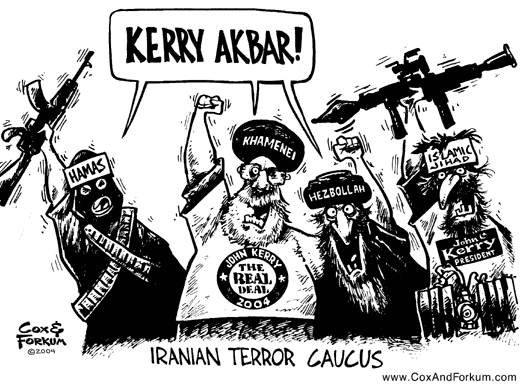
From Cox and Forkum:
 The Tehran Times recently published a John Kerry campaign letter: Kerry Says He Will Repair Damage If He Wins Election. (Via Little Green Footballs) Quoting the letter:
It is in the urgent interests of the people of the United States to restore our country's credibility in the eyes of the world. America needs the kind of leadership that will repair alliances with countries on every continent that have been so damaged in the past few years, as well as build new friendships and overcome tensions with others.
We are convinced that John Kerry is the candidate best qualified to meet this challenge. Senator Kerry has the diplomatic skill and temperament as well as a lifetime of accomplishments in field of international affairs. He believes that collaboration with other countries is crucial to efforts to win the war on terror and make America safer.
The Tehran Times did not included the list of the letter's signers, which can be seen at the Kerry Web site: Letter for Democrats Abroad. While there may some doubt as to who sent what to whom and why, what is clear is that the theocratic Iranian regime approved of the letter and its publication. And considering Kerry's approach to foreign policy, there's also no doubt that the mullahs would prefer Kerry over George "Axis of Evil" Bush.
In a 1970 interview, Kerry referred to himself as an "internationalist" and said, "I'd like to see our troops dispersed through the world only at the directive of the United Nations."
Kerry has since softened his language a bit, but his position today appears to be essentially the same. In his December 2003 speech to the Council on Foreign Relations, Kerry claimed that he "will not cede our security to any nation or institution." Yet throughout the speech he repeatedly invokes the United Nations and advocates "collective action," "international sanction," a "new era of alliances," and rejoining the "community of nations." In contrast, he criticizes President Bush for being "unilateral," "imperial" and "intoxicated" with American power.
Ultimately he declares: "I will treat the United Nations as a full partner -- not only in the war on terror, but in combating other common enemies like AIDS and global poverty."
A "full partner"? So much for not ceding our security to any nation or institution.
In regard to Iran, a country even our appeasing State Department ranks as the world's worst sponsor of terrorism, Kerry said:[T]he Bush Administration stubbornly refuses to conduct a realistic, non-confrontational policy with Iran even where that may be possible. As President, I will be prepared early-on to explore areas of mutual interest with Iran, just as I was prepared to normalize relations with Vietnam a decade ago.
Lest we forget what kind of regime Kerry proposes being "non-confrontational" with, WorldNetDaily reports: Iran hosting global terrorist conference.Just as the U.S. State Department approves wider contact with Iran and as members of Congress begin planning the first official trips in 25 years, Tehran is sponsoring a 10-day conference of major terrorist organization beginning [this] week.
The purpose of the conference is to discuss anti-U.S. strategy. Among the groups headed to Iran to participate are: Hamas, Hezbollah, Islamic Jihad and al-Qaida allies Ansar Al Islam.
Yesterday marked the 25th anniversary of Iran's Khomeinist revolution. A short history of its reign of terror is contained in Amir Taheri's op-ed, Tehran Tyranny's 25th. (Via 'Free Iran' News)Khomeinism, a form of fascism, was, and remains, a consistent political doctrine. [...] [Today's ruling] Khomeinists sincerely believe that a woman is half as valuable as a man and that she should cover her hair because it emanates rays that drive men wild with lust. They genuinely believe that men who shave their beards will go to hell. They regard the West as a civilization in decline, and its values, including human rights and democracy, as decadent.
Their strategic goal is to destroy Western-dominated civilization and replace it with a better, Islamic, one. They dream of wiping Israel off the map and, one day, hoisting their flag of faith atop the White House.
For the Iranian theocracy and the terrorists it supports, the choice for the next American president is no contest: John "Non-Confrontational" Kerry.Feb 12, 2004 | Dollars & Crosses
It's known that North Korea has concentration camps. Now comes testimony that it also has gas chambers. Jeff Jacoby of the Boston Globe reports:
"I witnessed a whole family being tested on suffocating gas and dying in the gas chamber. The parents, a son, and a daughter." The speaker is Kwon Hyuk, a former North Korean intelligence agent and a one-time administrator at Camp 22, the country's largest concentration camp.
His testimony was heard on a television documentary that aired last week on the BBC. "The parents were vomiting and dying, but till the very last moment they tried to save the kids by doing mouth-to-mouth breathing."
Like other communist officials, Kwon was not bothered by what he saw.
"I felt that they throroughly deserved such a death. Because all of us were led to believe that all the bad things that were happening to North Korea were their fault. . . . Under the society and the regime I was in at the time, I only felt that they were the enemies. So I felt no sympathy or pity for them at all."
Soon Ok-lee, who spent seven years in another North Korean camp, described the use of prisoners as guinea pigs for biochemical weapons.
"An officer ordered me to select 50 healthy female prisoners," she testified. "One of the guards handed me a basket full of soaked cabbage, told me not to eat it, but to give it to the 50 women. I gave them out and heard a scream. . . . They were all screaming and vomiting blood. All who ate the cabbage leaves started violently vomiting blood and screaming with pain. It was hell. In less than 20 minutes, they were dead."
Feb 11, 2004 | Dollars & Crosses
Interesting commentary on NYC City Council's grandstanding against the Patriot Act:
Obfuscating or outright lying about what the Patriot Act actually contains is no accident: It's part of the active, willing ignorance on the part of the opponents of the Bush administration to raise up a bogeyman figure. What's so silly about the council's contribution to this vacuous monologue is how seriously they take themselves while being decidedly unserious about honestly characterizing the Patriot Act.
Feb 11, 2004 | Dollars & Crosses
From the NYSun:
Electronic voting shows great promise.... But there are also grave concerns: Security breaches exposed as late as this weekend reveal that the results could be manipulated by hackers....Those blind spots have been exposed three times by independent researchers, first from Johns Hopkins University, then Rice University, and finally by a security firm hired by the state of Maryland to hack into the machines last weekend. In their report, the Maryland hackers picked the electronic locks on the voting machine cases "in under 10 seconds" and created fake access cards that gave them the ability to alter results and even end the election.
Feb 11, 2004 | Dollars & Crosses
From Cox and Forkum:
CNN reported this weekend: Kerry calls Bush 'extreme' and out of touch."In the face of the Bush administration's failures, we know what kind of campaign the Bush attack machine will run," Kerry said. "They did it to my friend John McCain in South Carolina in 2000. They did it to my friend Max Cleland in Georgia in 2002. Well, it's not going to work in 2004, for a very simple reason: They're extreme. We're mainstream, and we're going to stand up and fight back."
The Atlanta Journal-Constitution featured an op-ed with a contrasting opinion on how "mainstream" some of Kerry's ideas are: Kerry no hero in eyes of Vietnam-era veteran. (Via PowerLine)According to the Globe, Kerry became involved in the anti-war movement upon his return, and asked for and received an early discharge from the Navy so he could continue those efforts. How could Kerry so easily abandon his comrades in Vietnam, and then, 30 years on, call on those same men and women to back his presidential ambition? Kerry now holds himself up as a war hero and asks for my vote. Yet, 30 years ago he stood with Jane Fonda and gave aid and comfort to an enemy still killing our brother veterans by the hundreds. Bush's honorable service in the National Guard bothers me less than Kerry's abandonment of his brothers, his switching sides and his active contribution to an enemy's efforts to kill Americans.
Here's a picture of the cover of Kerry's 1971 book The New Soldier.
Mark Steyn on Kerry and Vietnam: Kerry won't scare any of the big beasts.The only relevant lesson from Vietnam is this: then, as now, it was not possible for the enemy to achieve military victory over the US; their only hope was that America would, in effect, defeat itself. And few men can claim as large a role in the loss of national will that led to that defeat as John Kerry. A brave man in Vietnam, he returned home to appear before Congress and not merely denounce the war but damn his "band of brothers" as a gang of rapists, torturers and murderers led by officers happy to license them to commit war crimes with impunity. He spent the Seventies playing Jane Fonda and he now wants to run as John Wayne.
Kerry is also touting himself as a populist candidate, but how "mainstream" is Kerry's net worth? This New York Post editorial puts things in perspective: The Real Kerry. (Via InstaPundit)Kerry lives in a mansion on Beacon Hill on which he has borrowed $6 million to finance his campaign. A fire hydrant that prevented him and his wife from parking their SUV in front of their tony digs was removed by the city of Boston at his behest. The Kerrys ski at a spa the widow Heinz owns in Aspen, and they summer on Nantucket in a sprawling seaside "cottage" on Hurlbert Avenue [...] It's a wonderful life these days for John Kerry. He sails Nantucket Sound in "the Scaramouche," a 42-foot Hinckley powerboat. Martha Stewart has a similar boat; the no-frills model reportedly starts at $695,000. Sen. Kerry bought it new, for cash.
Feb 10, 2004 | Dollars & Crosses
James Taranto found this item describing a meeting of the anti-globalization World Social Forum:
An Israeli backpacker added: "I am a good Israeli. I accept the Palestinian right to violent resistance." He was crushed by the response of Faisal from Tullkarm: "I know better Israelis; they are dead."
Feb 10, 2004 | Dollars & Crosses
Reports Yahoo! Health:
...Dr. Robert Atkins, whose popular diet stresses protein-rich meat and cheese over carbohydrates, weighed 258 pounds at his death and had a history of heart disease, a newspaper reported Tuesday.
Atkins died last April at age 72 after being injured in a fall on an icy street. Before his death, he had suffered a heart attack, congestive heart failure and hypertension, The Wall Street Journal reported, citing a report by the city medical examiner.
...Last month, the diet guru's widow, Veronica Atkins, demanded an apology from Mayor Michael Bloomberg after Bloomberg called her late husband "fat." She told the Journal she was outraged that the report had been made public. "I have been assured by my husband's physicians that my husband's health problems late in life were completely unrelated to his diet or any diet," she said.
...Stuart Trager, chairman of the Atkins Physicians Council in New York, told the Journal that Atkins' heart disease stemmed from cardiomyopathy, a condition that was thought to result from a viral infection.
To be certain of course one would need an autopsy.
Borakove said that, because of family objections to an autopsy, the medical examiner had conducted only "an external exam" and a review of Atkins' hospital records.
...One of the handwritten comments in the medical examiner's report referred to "MI" (myocardial infarction, the technical term for heart attack), the newspaper said. Trager said Atkins had no record of having had a heart attack, saying medical histories on examiner's reports are often written by less-experienced doctors who may not know a patient's detailed history.
Or were prevented from examining the possible blockages? For more on Atkin's see The Atkins' Cancer Revolution. Comments John McDougall on the latest Atkin's research:
...The mechanisms causing weight loss from the low-carbohydrate diets used in these studies should discourage doctors from recommending this approach to their patients. Followers of this diet complain of reduced appetite, nausea, and fatigue - all symptoms of illness. If followed strictly enough to enter ketosis - the goal of the Atkins diet - then there may be actual appetite suppression. Eating less, causes people to take in fewer calories and lose weight. Another result of eating less is they consume less saturated fat, cholesterol, sodium, and animal protein. Signs of improved health seem to appear because risk factors, like serum cholesterol, triglycerides, uric acid, and glucose, and blood pressure, decrease - and the patient is declared healthier. Not necessarily so. Similar benefits, for similar reasons, are seen when patients are placed on cancer chemotherapy - and doctors don't brag about these results.
If people want to know the truth about good nutrition, they simply need to look at the world picture. Populations following high-[unrefined] carbohydrate, low-fat, lower-protein diets, like those from traditional Asian and African countries are trim for a lifetime and avoid all the diseases common to people who follow the Western diet. The Atkins diet is simply an exaggeration of the unhealthy Western diet to a level that makes people sufficiently ill to lose their appetite.
Update (February 12, 2004): A reader writes the news article "...fails to mention that Atkins was under 200 pounds when he was admitted to the hospital after his fall; the weight difference between then and when he died is attributed to fluid retention during the eight day coma before he died."Feb 9, 2004 | Dollars & Crosses
We just have to hope that the suspicions the following article raises are correct:
America has mounted a covert operation to safeguard Pakistan's nuclear arsenal and prevent warheads from falling under the control of rogue commanders or Islamist terrorists. Teams of American specialists, deployed in Pakistan's most sensitive military sites, have formulated launch codes to prevent the unauthorised use of nuclear missiles....America's involvement in compiling missile codes raises the possibility that it might be able to prevent Pakistan from launching its nuclear weapons.
We'd better hope so, because the Taliban is taking power inside Pakistan:
Fame was no protection for one of Pakistan's most celebrated pop stars when he indulged in the "un-Islamic" practice of singing in public. Gulzar Alam was beaten with rifle butts and fists when 20 policemen armed with AK47s raided a wedding party where he was performing....
Mr Alam had fallen foul of the Islamist coalition running Pakistan's North-West Frontier Province. For the first time, extreme religious parties have won outright control of the government of this crucial area near the border with Afghanistan. They have a simple manifesto: to reinvent the Taliban in a corner of Pakistan.
Since winning power less than 18 months ago the coalition has banned anyone from playing music or singing in public and confiscated thousands of music tapes from the bazaars. These were heaped on a huge bonfire in Peshawar and set alight by the local police chief....
When the provincial assembly meets next month the authorities will press ahead with the next stage of their campaign. They will introduce a law creating a new body modelled on the Taliban's "ministry for the promotion of virtue and prevention of vice."
This will have sweeping powers to intervene in any area of life and uphold "Islamic standards." The law will also create a parallel police and judicial system to implement a Sharia Law Act passed by the provincial assembly last year. [UK Telegraph]
The same reporter reports that nothing has changed in the Pakistani religious schools, who support the Taliban.Feb 9, 2004 | Dollars & Crosses
Apologists for Palestinian terrorism often claim that Zionists are terrorists too--citing acts such as the July 22, 1946 bombing of the King David Hotel by Menachem Begin. James Taranto comments:
Now, it's probably fair to characterize the attack on the King David Hotel as terrorism. But the question is at least somewhat murky. The Irgun, the group that carried out the bombing, selected the hotel as a military target, since it was the headquarters of the British military command. And, as the Jewish Virtual Library points out:
Irgun leader Menachem Begin stressed his desire to avoid civilian casualties and said three telephone calls were placed, one to the hotel, another to the French Consulate, and a third to the Palestine Post, warning that explosives in the King David Hotel would soon be detonated.
On July 22, 1946, the calls were made. The call into the hotel was apparently received and ignored. Begin quotes one British official who supposedly refused to evacuate the building, saying: "We don't take orders from the Jews." As a result, when the bombs exploded, the casualty toll was high: a total of 91 killed and 45 injured. Among the casualties were 15 Jews. Few people in the hotel proper were injured by the blast.
In contrast to Arab attacks against Jews, which were widely hailed as heroic actions, the Jewish National Council denounced the bombing of the King David.
Taranto continues:
If the attack on the King David was terrorism, surely Palestinian Arab massacres of bus passengers or disco revelers--whose purpose is to murder civlians--qualify for the term.
Feb 9, 2004 | Dollars & Crosses
We may need to strengthen our intelligence services, but with regard to the invasion of Iraq, the failure to find weapons of mass destruction is a non-issue. As Barbara Amiel writes in the New York Sun:
This, after all, was a regime that just before the first Gulf War sent its entire air force for safekeeping in Iran. If the intelligence services were wrong, every Western service and regime, from France to America, from Clinton to Chirac, failed. It is conceivable that Saddam Hussein found it important to pretend that he had nuclear weapons. He might have been like any moronic hooligan or bank robber who, faced with the police, pretends they have a weapon and often die as they reach for their toy pistol--or sunglasses.
Iraq was a regime that had a nuclear reactor (before Israel bombed it), attempted to acquire technological information abroad, refused to follow 16 U.N. resolutions, and periodically kicked out U.N.
inspectors. If its WMD program was only disinformation, it was believed because Iraq did its level best to make it credible.
Mr. Bush's policy was that his was a pre-emptive doctrine. His action was based on the notion that once you find WMD it's too late. If deployment is to be the proof of their existence, the price tag becomes too high.
Leftist (former leftist?) Christopher Hitchens adds, in an editorial a day later:
[If Saddam Hussein] really didn't have any stores of unlawful weapons of mass destruction, it was very dumb of him to act as if he still did or perhaps even to believe that he still did. And it seems perfectly idiotic of anybody to complain that we have now found this out (always assuming that we have, and that there's no more disclosure to come). This highly pertinent and useful discovery could only be made by way of regime change....
It has since been established, by the Kay report, that there was a Baath plan to purchase weapons from North Korea, that materials had been hidden in the homes of scientists, and that there was a concealment program run by Qusay Hussein in person. This may look less menacing now that it has been exposed to the daylight, but there was no reason not to take it extremely seriously when it was presented as latent.
For extended excerpts from CIA director George Tenet's Georgetown speech reviewing the quality of American intelligence, click here, or, for a briefer summary--and a discussion of how Tenet's points specifically undermine John Kerry's campaign rhetoric--see the New York Sun's lead editorial, "Tenet's Finest Hour."Feb 8, 2004 | Dollars & Crosses
And the educrats who defend programs like these call their opponents "ideologues" who are out of touch with reality:
The number of students in city bilingual education programs who passed English proficiency exams plummeted to less than 4% last year--an 82% drop from the year before. [NY Sun]
New York Sun columnist J.P. Avlon has more details about the source of "The Scandal in Bilingual Ed."Feb 8, 2004 | Dollars & Crosses
A good example of the injustice of unearned forgiveness, and of its destructive effects:
President Gen. Pervez Musharraf pardoned the father of Pakistan's nuclear program Thursday for giving technology to Iran, Libya and North Korea, heading off a showdown with hardliners....Musharraf also lashed out at fellow Muslim nations Iran and Libya for cooperating with international inspectors and turning over documents on their nuclear programs. "Muslim brothers did not ask us before giving our names," he said....He said Pakistan would not submit to any U.N. supervision of its weapons program, and that no documents would be handed over to the U.N. nuclear watchdog, the International Atomic Energy Agency. He also ruled out an independent investigation of the military's role in proliferation. [USA Today]
Feb 8, 2004 | Dollars & Crosses
From Daniel Pipes:
"I Had a Good Time at Guantanamo, Says Inmate."
So reads the jaw-dropping headline in today's Sunday Telegraph (London). It tells the story of Mohammed Ismail Agha, 15, an Afghan boy who spent 14 months in detention as a terrorist suspect at the Guantánamo Bay base. In the first interview with one of the three juveniles held there, Mohammed spoke to a reporter in southern Afghanistan, close to his home village:They gave me a good time in Cuba. They were very nice to me, giving me English lessons. … At first I was unhappy … For two or three days [after I arrived in Cuba] I was confused but later the Americans were so nice to me. They gave me good food with fruit and water for ablutions and prayer.
The American soldiers taught him and the two other underage captives to write and speak a little English and supplied them with books in their native Pashto language. As the three boys departed the base, U.S. soldiers gave them a send-off dinner. "They even took photographs of us all together before we left," Agha said.
As the Sunday Telegraph notes, these words of praise echo those of Faiz Mohammed, an elderly Afghan farmer released in October 2002 after spending eight months at Guantánamo: "They treated us well. We had enough food. I didn't mind [being detained] because they took my old clothes and gave me new clothes."
These testimonies need to be remembered at a time when so-called human rights agencies insist that the U.S. detention of prisoners in Guantánamo is immoral, contravenes international law, and so on.
Feb 7, 2004 | Dollars & Crosses
From Cox and Forkum:
Larry Elder writes in On Iraq and Weapons of Mass Destruction: Did the American President Lie?:The near pathological contempt so many hold for President Bush clouds their ability to put themselves in the commander-in-chief's shoes. On Sept. 11, in America, over 3,000 people lost their lives. Meanwhile, Saddam Hussein continued to defy United Nations Security Council resolutions to come clean. He flouted the U.N.-sponsored Oil-for-Food program, diverting the money from its intended purpose.
Critics quite properly accuse the U.S. intelligence community for failing to connect the dots and thus prevent 9/11. After the first Gulf War in 1991, the advanced nature of Saddam Hussein's nuclear weapons program shocked intelligence analysts. Nuclear bomb testing in India and Pakistan came as a surprise, as did the advanced nature of Iran's and Libya's WMD programs. By all means, the U.S. intelligence failures call for serious soul-searching, and possibly housekeeping to improve accuracy.
But, in the case of pre-war Iraq, the president's critics suggest the following: Cross your fingers, hope for the best, and run the risk of another attack on American soil, this time possibly with chemical or biological weapons. No, the president acted upon the best available information and properly discharged his responsibility as commander-in-chief.
Meanwhile, this same commander-in-chief and other members of the U.S. government don't seem very concerned about the danger posed by the Iranian Islamofascist regime, from its funding of terrorists to its development of WMD. In fact, unlike Iraq, there's been a concerted effort even court diplomatic relations with this Axis of Evil member.
Michael Ledeen recently wrote about the danger of this policy of appeasement with Iran: The Seventh Level: Americans appeasing evil.If the Specter/Ney/Biden efforts to "improve relations" [with the Iranian theocracy] were simply acts of folly by men who don't know better, one might laugh them off. But they have serious consequences, as our diplomats -- who actively encouraged the representatives' acts of appeasement -- must realize. The Iranian people overwhelmingly hate the regime, and look to Washington for encouragement and support to carry out a democratic revolution, and therefore the mullahs try to create opportunities to convince the people that the Bush administration in fact approves of the regime itself. Any warm statement from a famous American is a body blow to the democratic opposition, and a balm to the mullahs, just as every critical word from President Bush has encouraged the people, and weakened the tyrants. Appeasers are sent deep into the Inferno, because their acts are truly wicked, shoring up our would-be killers and discouraging our would-be allies inside the country.
Also see: Winds of Change features Iran In Focus, a great collection of links compiled by 'Free Iran' News. Winds of Change also had this Iran entry from early this week: Iran: Pay Attention, which features a good post by Oxblog, and via 'Free Iran' News: Telegraph reports: Iran 'has secret atomic bomb project'.America has convincing new evidence that Iran is hiding an atomic bomb project despite Teheran's promise to open up all of its nuclear facilities to international inspectors, a senior US official has told The Telegraph. He said the Teheran regime was secretly trying to build a second and more advanced uranium enrichment plant in parallel to the large facilities in the town of Natanz revealed to the International Atomic Energy Agency (IAEA) last year. "There is no doubt in our mind that the Iranians have a lot that the IAEA does not know about," said the official. "The Iranians have a military programme that the IAEA has never set eyes on."
Feb 6, 2004 | Dollars & Crosses
Michael Kinsley on Democrats "desperately seeking electability":
"Democrats are cute when they're being pragmatic. They furrow their brows and try to think like Republicans. Or as they imagine Republicans must think. They turn off their hearts and listen for signals from their brains..."
Feb 6, 2004 | Dollars & Crosses
From the New York Sun:
An Iranian diplomat was arrested in Nigeria under suspicion that he was spying on Israel, Reuters reported.The Shin Bet confirmed the report. A police source in Nigeria told the news agency that the man was arrested on January 23rd after he was caught taking pictures of the Israeli embassy in the capital Abuja, with a digital camera. "A digital camera was found in his possession, with surveillance pictures of the embassy and several other international and local official buildings in the capital," a senior Israeli security source told Reuters. A Nigerian police spokesman said last Thursday that an Iranian was being questioned after taking photographs of strategic buildings in the capital.
This is the same Iran one of whose "diplomats" Argentina wants to arrest for blowing up a Jewish community center. Meanwhile, according to UPI, here's what Saudi "diplomats" are doing in the U.S. (Thanks, James Taranto.):
On Thursday State Department Spokesman Richard Boucher confirmed that 16 Saudi nationals who had been accredited to the embassy in Washington had been asked to leave. "We were able to determine that they were not, in fact, working as diplomats in the Saudi Embassy, but rather were teaching in Northern Virginia and therefore were not entitled to diplomatic status. Since they were on diplomatic visas, ... we had to tell them your visa status is no longer valid. We gave them till Feb. 22 to clean up their affairs and leave the country," Boucher said. The place of instruction is the Institute of Islamic and Arabic Sciences in America in Fairfax, Va. Phones at the institute were not answered Monday. The institute's Web site says it was established in 1989 and is affiliated with al-Imam Muhammad Ibn Saud Islamic University in Riyadh, Saudi Arabia.

 The Tehran Times recently published a John Kerry campaign letter:
