
The Saudi House of Hate
From Cox and Forkum:What is happening in some American mosques, including a few in the Chicago area, is deeply disturbing. In certain Islamic schools, textbooks spit vitriol against Jews, Christians and other non-Muslims: "Be disassociated from the infidels, hate them for their religion." In mosque publications, America is the "Abode of the Infidel." The idea of human and civil rights is heresy. Working women are immoral. These views are extreme, they promote violence and they are being espoused right under our noses. We knew this was happening in France, Germany and England but we didn't know the extent of the problem here. It is not happening in all mosques or Islamic schools, by any means, but in those select ones funded by the Saudi government to disseminate the fanatic Wahhabi-style Islam that has its demagogic roots in Saudi Arabia. The Center for Religious Freedom just issued a discomfiting report looking at the spread of hate propaganda in America by Saudi Arabia. The center collected 200 books and other publications from mosques across the country and spent the past two years analyzing them. "The Saudi textbooks and documents spread throughout American mosques preach a Nazi-like hatred for Jews, treat the forged Protocols of the Elders of Zion as historical fact, and avow that the Muslim's duty is to eliminate the state of Israel," writes Nina Shea, the Center's director. In addition, they "instill contempt for America because the United States is ruled by legislated civil law rather than by totalitarian Wahhabi-style Islamic law." Woe to Christians who should be actively hated because they stir up images of crusaders and colonists and because they are "enemies to Allah, his Prophet and believers." Woe to Muslims who advance tolerance and human rights -- they, too, are infidels. Woe to homosexuals or heterosexuals who have sex outside marriage -- it is considered "lawful" to kill them.A number of blogs reported this story last week. I first saw it on Little Green Footballs where Charles has noted that few in big media are picking it up (exceptions include Dallas Morning News and Investor's Business Daily). Perhaps the Sun-Times editorial will garner still more attention.
Live Event: Egoistic Justice & Some of its Practical Implications
Front Range Objectivist Supper Talks is pleased to announce Tara Smith speaking on: Egoistic Justice & Some of its Practical Implications. This lecture will explore Ayn Rand's illuminating account of the egoistic nature of justice. After tracing the practical case for being just, Dr. Smith will consider four of the unconventional implications that flow from this: the emphatic need to judge other people; the diametrical opposition between justice and today's ubiquitous ideal of egalitarianism; the proper place of forgiveness in a just man's life; the proper place of mercy in a just man's life. When, if ever, are forgiveness and mercy justified? Is either of them ever not merely permissible, but required? Details: February 19, 2005. Social Hour--6:00 PM; Supper--7:00 PM; Talk--8:00 PM. West Woods Golf Clubhouse, 6655 Quaker, Arvada, CO. http://www.FrontRangeObjectivism.comNew Direction for the Democrats
From Cox and Forkum:From CNN: Dean now sole candidate for DNC chair:
Tim Roemer, the only remaining opponent of Howard Dean in the race to be chairman of the Democratic National Committee, said Monday he's bowing out of the race -- but he offered a warning to Democrats. ...
The Father of Supply-Side Economics: How Wonderful The World Is
Bill Steigerwald interviews Arthur Laffer, the The Father of Supply-Side Economics, in "Is this a great world or what?" Pittsburg TRIBUNE-REVIEW, Saturday, (February 5, 2005).Laffer on Bush's economics:
I'm really shocked by it. ...I was not a fan of his father's. I voted for Clinton twice. I really thought Bush (the elder) and Bob Dole were tax collectors for the welfare state. The reason I voted for Bush W. was more Al Gore than it was Bush. And now I am just totally a fan. This guy is just incredibly good at economics...[however]...the steel tariffs (were) terrible. They're embarrassing.On Laffer's politics:
I'm pro-growth. I'm Democrat when Democrats are into pro-growth, and I'm Republican when they are....I like low, flat-rate taxes. I like sound money. I like free trade. And I like minimal regulation for serving social purposes...On the most important economic principle for voters:
If you tax people who work and you pay people who don't work, do not be surprised if you find a lot of people choosing not to work.Laffer on the American public (or at least half of it):
...I'm really impressed with the public. The electorate really sees through all this crap. They understand free trade. They understand low, flat-rate taxes. They understand sound money. The electorate is really cool. I'm superbly impressed by democracy -- and I'm not natively that way inclined, just so you know.On America's economic progress over the past two decades:
OK, let's take a look at what happened to marginal tax rates. The highest rate has gone from what -- 70 percent -- down to what, 35 percent? What's happened to inflation? What's happened to regulation restrictions? What's happened to America and the world? What's happened to the stock market? What's happened to everything you and I believe in? Do you remember what unemployment rates looked like back in 1979? Do you remember what the prime was when Ronald Reagan came into office on Jan. 20, 1981? It was 21 percent. ...I cannot believe how wonderful it is. When (Nobel Prize-winning economist) Bob Mundell and I sat there at the University of Chicago in 1967, '68 and '69, we dreamt of a world. That world is now. Can you imagine a world with no inflation? ... ...If you looked at (House Minority Leader) Nancy Pelosi and you looked at (Senate Minority Leader) Harry Reid Wednesday night, they looked really, really uncomfortable. They were running everything in 1979. They had the president, the Senate, the Supreme Court, the Fed chairman. They had every damn position in the world. They had everything -- the states, the houses, the governors. It was a Fabian redistributionist nightmare. Now it's really beautiful. I'm an old man, and old men are supposed to be curmudgeons and hate the modern day and love the ancient. But the truth of the matter is, we've won.
The Joy of Football
Writes thomas Bowden in The Joy of Football: The Super Bowl Offers a Too-Rare Celebration of Goal-Achievement:Traditional sources of inspiration in America have disappeared, but sports give us a look at heroes in action. Sporting events show us a vision of what life could, and should be like: Athletes earn their way by proving their superior ability, not by demanding a handout; rules are explicit and fair, not arbitrary and enforced at someone's whim; athletes take unapologetic pride in their abilities and achievements.
Nazis were socialists, professor. And you?
In a bumbled interview last night, CNN anchor Paula Zahn expressed outrage at professor Ward Churchill's unwillingness to apologize for public remarks in which he compared the victims of 9/11 to Adolf Eichmann, the infamous Nazi bureaucrat responsible for managing the logistics of the holocaust.But why are Zahn and others so shocked? Churchill's viewpoint is merely a logical extension of the ideas that Michael Moore and other Leftists have been advancing all along: namely, that corporate America is evil and capitalism is an oppressive, exploitative system deserving of punishment from seething Middle Easterners.
So long as the Leftist version of America is treated as legitimate, Churchill's characterization of World Trade Center office workers as "little Eichmanns"--technocratic cogs in a monstrous machine of capitalist imperialism--should come as no surprise.
Churchill shouldn't be denounced just for naming explicitly what others have only dared imply. Instead, the entire Left (including Churchill) should be detested for spewing their venomous ideas and for maligning the only economic system ever developed that respects individual rights: capitalism.
Wean yourself from the government teat…or offer yours
Any rational person knows that government handouts can cost private citizens an arm and a leg, but a 25-year-old German waitress recently discovered that sometimes they can cost less mundane body parts, too: genitals.The woman, a former information technology professional whose name was withheld for legal reasons, recently turned down a job offer to provide "sexual services" for a Berlin brothel. Consequently, the German government [could legally] cancel her meal ticket.
According to German law, a woman under 55 who has been unemployed for more than a year must take any available job or lose unemployment benefits. Because prostitution is legal in Germany, whoring counts.
Note to socialists everywhere: when one relies on the government to sustain one's life, it eventually becomes clear who owns it.[Updated: Feb, 12, 2005]
The Iraq Election
From Cox and Forkum:
This cartoon is from March 2004 and is in our book, Black & White World II. This weekend, Iraqis will brave death just to vote. Our hope is that no more Iraqis or coalition forces are harmed trying to exercise a freedom that we take for granted. We also hope that the election results will not be favorable to the Shiite religious parties. Politically secular candidates are in the running and competitive, including interim Prime Minister Iyad Allawi. President Bush should never have allowed the possiblity of a democratically established theocracy, but that's the reality. As we noted earlier this week, though the Shiite parties announced that their platform for governing Iraq would be secular and not an Islamic theocracy, there is reason to doubt their claims. For instance, the United Iraqi Alliance includes candidates who are followers of Moktada al-Sadr, the Islamist cleric who declared that 9/11 was "miracle from God" and whose militia killed American soldiers in Najaf. Other major parties in the Alliance are ruling Basra in a manner reminiscent of the Taliban. But the above article also reports that some Iraqis see that Islamists are not the answer to Saddam:
"Don't listen to what people tell you -- look at what they do on the ground," said Anwar Muhammad Ridha al-Jabor, 40, director of Al Nahrain Radio in Basra. She believes, based on her call-in radio show and polling conducted by her station, that people in the southern provinces are fed up with authoritarian rulers and are not impressed with a year and a half of Islamist rule. "People just got rid of Saddam," she said. "Now they want to be free, and not be threatened by anyone, including the Islamic groups."
We're rooting for Iraqis like Anwar. Here are more Iraqis who'll be speaking out as the election take place this weekend:
-- Friends of Democracy: Ground-level election news from the people of Iraq
-- Iraq the Model
-- Democracy in Iraq
UPDATE -- January 28: This editorial by Amil Taheri explains why the issue of theocracy (among others) will remain an issue after the election: Iraq Votes: The Issues. (Via TIA Daily)
Mosque and State: Some radical Shiite and Sunni groups want Islam declared to be not only the official state religion, but also the sole source of legislation. This is opposed by others across the political spectrum. The terror campaign has prevented fundamentalist Sunni groups from forging an alliance with their Shiite counterparts in a common quest for an Islamic government. And the bitter anti-Shiite tone of the insurgency has prevented Shiite fundamentalists from advertising their true colors in the campaign. ... Women's Rights: Thanks to U.S. pressure, all electoral lists consist of 30 percent women candidates; at least a quarter of the seats in the Assembly are likely to go to women. Most Islamist parties and some tribes oppose this, and the quotas imposed in favor of women in government departments. Even more serious is their objection to giving women equal rights in matters of marriage, divorce and child custody. Secularist parties, however, believe the measures must go further in favor of women. Reviewing the laws on such issues of private life will be one of the early tasks of the new parliament. While many fear that new laws will be more reactionary, women's organizations and secularist parties are determined to fight any such backtracking. ... Foreign Policy: Always a hot topic in Arab politics, it will be even more so in Iraq in this period of transition. Some want Iraq to withdraw from the Arab League and even OPEC and to seek a special relationship with the U.S.-led NAFTA. Others want to seek the leadership of the Arabs with a message of democratization. Some want Iraq to recognize Israel; others strongly oppose that move. Tehran's mullahs, operating through their clients and sympathizers inside Iraq, will do all they can to goad Iraq towards a "third-worldist" and anti-American posture. The United States and its allies, meanwhile, will work hard to persuade the new Iraq that it is in its best interest to jettison the prejudices and misconceptions that have passed for Arab foreign policy over the past five decades.
Open Season on Rice
From Cox and Forkum:
Condoleezza Rice won easy confirmation Wednesday to be President Bush's new secretary of state, despite strong dissent from a small group of Democrats who said she shares blame for mistakes and war deaths in Iraq. ... The Senate vote showed some of the partisanship that delayed Rice's confirmation vote by several days. Twelve Democrats and independent James Jeffords of Vermont voted against Rice. The Democrats included some of the Senate's best-known members such as Massachusetts Democratic Sens. Edward M. Kennedy and John Kerry, who was the party's presidential candidate in last year's election. Thirty Democrats voted for her. ... On the Senate floor Wednesday, Sen. John McCain, R-Ariz., suggested Democrats are sore losers. Rice had enough votes to win confirmation, as even her Democratic critics acknowledge, McCain said. "So I wonder why we are starting this new Congress with a protracted debate about a foregone conclusion," McCain said. Since Rice is qualified for the job, he said, "I can only conclude that we are doing this for no other reason than because of lingering bitterness over the outcome of the election."
United States retroactively responsible for mass extinction
Scientists now blame global warming for the "Great Dying." Known as the worst mass-extinction on Earth, 250 million years ago the "Great Dying" wiped-out 90 percent of marine life and 75 percent of all plants and animals.Although scientists blame this cataclysmic event on massive volcanic eruptions, any good environmentalist drone knows that global warming is caused by productive human activity: capitalism in general and industry in particular. Clearly, this is America's fault.
Kofi Annan is expected to condemn the U.S. in a brief statement later today.
Secular Face
From Cox and Forkum: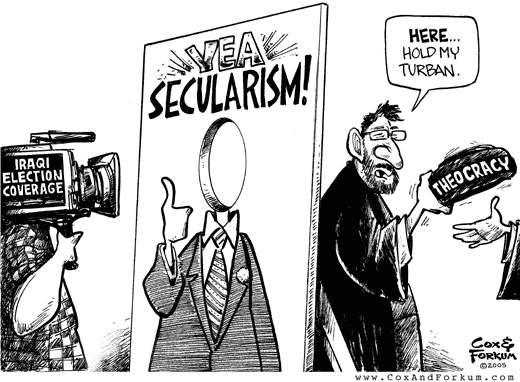
Allawi has taken advantage of his incumbency and name recognition, his image as a strongman and his Shiite ethnicity, presenting his slate as a secular alternative to the religious Shiite parties.The competing Shiite parties have taken notice of Allawi's secular appeal. The New York Times reported yesterday:
With the Shiites on the brink of capturing power here for the first time, their political leaders say they have decided to put a secular face on the new Iraqi government they plan to form, relegating Islam to a supporting role. The senior leaders of the United Iraqi Alliance, the coalition of mostly Shiite groups that is poised to capture the most votes in the election next Sunday, have agreed that the Iraqi whom they nominate to be the country's next prime minister would be a lay person, not an Islamic cleric. ... "There will be no turbans in the government," said Adnan Ali, a senior leader of the Dawa Party, one of the largest Shiite parties. "Everyone agrees on that."This should be great news -- after all, we certainly don't want to replace Saddam's regime with a theocracy. But the article goes on to indicate that the new "secular face" of the Shiite parties may be more political expediency than political enlightenment.
Shiite leaders say their decision to move away from an Islamist government was largely shaped by the presumption that the Iraqi people would reject such a model. But they concede that it also reflects certain political realities -- American officials, who wield vast influence here, would be troubled by an overtly Islamist government. So would the Kurds, who Iraqi and American officials worry might be tempted to break with the Iraqi state.Can these parties be trusted to truly reject theocracy? Just how Islamist were they before yesterday? Besides the Dawa Party, the United Iraqi Alliance also includes the Supreme Council for Islamic Revolution in Iraq, Iraq's main Shia political party. This report from The Telegraph raises suspicion about SCIRI's new secular position:
For a party that was set up in Iran in the 1980s to promulgate Islamic revolution in Iraq but now says it upholds secular values, dealing with the changing winds of fortune have become part of a careful political act. "We want to appeal to the broadest number of Iraqis. We need to build a consensus between parties to rule this country," said Mr Imarah, a 42-year-old educated in Iran. "Only that way will be able to get elected." Not only does the list containing SCIRI have the largest Shia parties, it also has the approval of the most revered Shia spiritual leader, Grand Ayatollah Ali al-Sistani. Mr Imarah insists that the involvement of Ayatollah Sistani in the election does not undermine the secular platform on which SCIRI and other Shia parties are standing. "We represent a very broad front," he insisted. However, many outside the Shia south believe SCIRI is only playing with secularism. Once in power the mask will fall away and the party will return to its core set of Islamic beliefs, they say. Many fear that Ayatollah Sistani will be supplanted in the organisation by clerics with closer ties to Iran.Still other reports indicate that concern about the Shiite parties "playing with secularism" is justified. From a Boston Globe report on campaign posters in Iraq:
...[O]n the streets of Baghdad, politics and religion freely mix in glossy posters and tattered fliers. "Your support for this list is support for the faithful, national Islamic march," read one poster for the Islamic Dawa Movement. The movement "declares its appreciation of the role of the clerics and the great religious authorities," read another statement. A poster for the United Iraqi Alliance, the group that has the tacit support of al-Sistani, bears the image of Islam's cubic Kaaba shrine in Mecca, along with that of the Shiite cleric and an Iraqi flag. "Not participating in the elections means your candidates won't be able to defend your religious and worldly affairs," it read.But another report in The Boston Globe is even more damning. According to the story, SCIRI and Dawa have worked together before -- to rule the town of Basra after the U.S.-led invasion. The resulting political environment is, to say the least, less than secular.
More than any other city in Iraq, Basra is a living test lab of Islamic rule in Iraq. Since the fall of Saddam Hussein's regime, two Islamic parties have controlled the provincial government: the Supreme Council for Islamic Revolution in Iraq and the Islamic Dawa Party. Both are traditional Islamist parties that fought the Baathist regime from bases in Iran. When the Baathist ruling class fled Basra after the U.S.-led invasion in March 2003, Islamic parties quickly came to power on a popular wave of belief that religious parties would be less corrupt and power-hungry than secular political parties. The provincial governor is a veteran of the Badr Brigade, the military wing of the Supreme Council for Islamic Revolution in Iraq, who spent years in exile in Iran. Traditional Islamic values have reshaped the dynamics in Basra, which a decade ago hosted a decadent array of bars, casinos and brothels that attracted visitors from Kuwait, Saudi Arabia, and Iran, where drinking, gambling and prostitution are major crimes. On the streets now almost no women are visible. Those who venture out are covered head to toe in black. Basra's liquor stores all closed down last summer when vigilantes began firebombing them. Openly, the fiercest power struggle is between two kinds of Islamists -- the established exiles in the Supreme Council for Islamic Revolution in Iraq and Dawa versus the young followers of the firebrand cleric Moktada al-Sadr, who are thought to be responsible for the liquor store attacks. [Emphasis added]President Bush left the door open for the establishment of an Islamic theocracy in Iraq rather than impose a free government. In his inaugural address, Bush reiterated his stance: "Our goal, instead, is to help others find their own voice, attain their own freedom and make their own way." One of those voices is that of terrorist Moktada al-Sadr, the same al-Sadr whose thugs are thought to have firebombed liquor stores in Basra. The same al-Sadr who referred to 9/11 as "miracle from God" and whose militia killed American soldiers in Najaf. The same al-Sadr who has 14 followers running as candidates in the United Iraqi Alliance. But there are other voices in Iraq. From the above report:
"Don't listen to what people tell you -- look at what they do on the ground," said Anwar Muhammad Ridha al-Jabor, 40, director of Al Nahrain Radio in Basra. She believes, based on her call-in radio show and polling conducted by her station, that people in the southern provinces are fed up with authoritarian rulers and are not impressed with a year and a half of Islamist rule. "People just got rid of Saddam," she said. "Now they want to be free, and not be threatened by anyone, including the Islamic groups."We can only hope that the attitude above wins election day.
Balancing Act: President Bush’s Second Inaugural Address
From Cox and Forkum: While there were good ideas in President Bush's second inaugural address, as is often the case with Bush, many of the good ideas were undermined by bad ones. I got the impression that Bush hoped to balance the ideas that might be viewed as "harsh" (personal economic independence, control of one's own destiny, ending tyranny) with ideas that that might be viewed as "compassionate" (service to others and a greater cause, helping other countries achieve democracy).
In the Jan. 20 edition of TIA Daily, Robert Tracinski provided a good analysis of the philosophical contradictions: Altruism vs. Liberty at the Inauguration.
While there were good ideas in President Bush's second inaugural address, as is often the case with Bush, many of the good ideas were undermined by bad ones. I got the impression that Bush hoped to balance the ideas that might be viewed as "harsh" (personal economic independence, control of one's own destiny, ending tyranny) with ideas that that might be viewed as "compassionate" (service to others and a greater cause, helping other countries achieve democracy).
In the Jan. 20 edition of TIA Daily, Robert Tracinski provided a good analysis of the philosophical contradictions: Altruism vs. Liberty at the Inauguration.The good part of the "Forward Strategy of Freedom" is Bush's recognition of the connection between tyranny and war. Nations that murder and enslave their own citizens always seek to export those evils outside their own borders. So it is true that America's long-term interests come from the spread of liberty across the globe. But the primary problem with Bush's theory is that he regards liberty as a causeless "yearning of the human heart" implanted there by God, which therefore requires no intellectual or cultural foundation. Notice that in Bush's speech the lack of freedom is regarded as the "deepest source" of terrorism -- while "ideologies that feed hatred and excuse murder" are regarded as mere by-products, as movements that opportunistically take advantage of the "simmering resentment" caused by tyranny. And so, for example, Bush believes that deposing Saddam's regime and holding elections is all that is required to promote the spread of liberty in the Middle East. No Western institutions or ideas are needed -- and indeed, he says later in the speech, "America will not impose our own style of government on the unwilling. Our goal instead is to help others find their own voice, attain their own freedom, and make their own way." That is the root of everything that is wrong with his administration's management of the occupation of Iraq.But Bush's "compassionate" ideas did nothing to forestall fears that his speech signaled a new aggressiveness in ending foreign tyranny. The administration, and even Bush's father, felt compelled to reassure critics that we would maintain the status quo. (Joe Gandelman has more.) And that is too bad, because it is exactly a new aggressiveness that is needed. On domestic issues, particularly in regard to Bush's Social Security reform, the contradictions were more glaring. Tracinski wrote:
The "broader definition of liberty" endorsed by Bush is the same view of freedom promulgated by Franklin Roosevelt, complete with the worst of Roosevelt's "Four Freedoms": "freedom from want." Bush explicitly endorsed the welfare-statist view that freedom means a social guarantee of prosperity, to be provided by the state. Thus, in proposing a semi-privatization of Social Security, Bush is not promising to lift the heavy hand of government out of our lives and reverse the disastrous legacy of the New Deal welfare state. No, he presents his reforms as a continuation and extension of Roosevelt's legacy, only in a newer, more practical form. It gets worse in the next paragraph, where Bush makes liberty conditional on religious belief and altruism. ... Bush advocated freedom -- but within the constraint that we are our brothers' keepers.There is no "freedom" for the government to force one generation to be the keeper of another. There is no "freedom" for a country to democratically establish an Islamic theocracy. Until Bush grounds the concept of "freedom" to individual rights, he will be unable to effectively fight for freedom at home or abroad. Another excellent observation from Robert Tracinski regarding the inauguration: The Protests Against Representative Government: Anti-Inauguration Protests Reflect the Left's Hostility to Liberty.
Government Should Get Out of Wal-Mart’s Way
IRVINE, CA--Last week, the New York City Council's Economic Development Committee held a hearing that basically opposed the plans of Wal-Mart to open its first-ever NYC store in Rego Park, Queens. "They have to make big changes if they want to come into New York," threatened Councilwoman Helen Sears, echoing the familiar objections raised by unions against Wal-Mart. But, said Dr. Andrew Bernstein, senior writer for the Ayn Rand Institute, "such political posturing represents an outrageous violation of the rights of countless individuals. Aside from the fact that Wal-Mart employs tens of thousands of individuals who all sought their jobs voluntarily--and that complaints against the chain do not typically come from employees, but from labor unions who want no non-union competition--by what presumptuous claim to dictatorial power does the government tell free men and women where they may and may not shop?" Bernstein pointed out that nationwide 100 million people per week voluntarily choose to shop at Wal-Mart. "The reason they do so is obvious: quality products in astonishing varieties and quantities at low prices." Bernstein concludes that Wal-Mart's stunning success was made possible by a revolution in productivity. "Sam Walton's firm pioneered the computer management of its stock and continually finds low-cost suppliers to keep its prices down. It is the efficiency of Wal-Mart's vast operation that enables it to provide a plethora of quality products at low prices. Such productivity should be celebrated by all Americans--even the politicians."Technology and Industry Save Lives
IRVINE, CA--The tidal waves that took so many lives two weeks ago again raised the question, why do devastating natural disasters wreak far more havoc in undeveloped nations than in advanced ones? Environmentalists often argue that disasters are caused by man's "interference with nature" through technology and industrialization. But as the "tsunami tragically demonstrated, environmentalists are dead wrong," said Dr. Andrew Bernstein, senior writer for the Ayn Rand Institute. "Far from being the cause of such tragedies, science, technology and industry provide the only means of safeguarding human lives against natural disasters." Bernstein points to the recurring example of the relatively undeveloped Caribbean islands, which suffer far worse devastation and loss of life from the same hurricanes that hammer Florida year after year. The U.S. makes its hurricane forecasts available to these island nations, but because of poor communications, bad roads and bridges, weak structures and buildings, lack of medicine, etc., the loss of life is often far greater than in the U.S., where "the use of satellites, radar and communication technology make it possible to predict hurricanes and warn people well in advance of danger; well-maintained highways enable people to evacuate swiftly and safely; steel and concrete homes better withstand nature's fury than wooden or thatched huts; hospitals and medicines are readily available to quickly treat the injured." "Nature," said Bernstein, "always has and always will produce earthquakes, volcanoes, tidal waves, hurricanes, etc. But only science helps us understand these potential killers, and only technology and industrialization help us protect ourselves from them."Tsunami
From Cox and Forkum: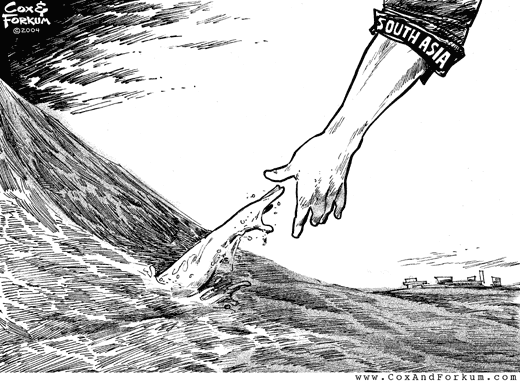 From an AP report: One third of those killed in disaster may be children.
The U.N. organization estimates at least one-third of the tens of thousands who died were children, and the proportion could be up to half, said UNICEF spokesman Alfred Ironside in New York. He said communities are suffering a double loss: dead children and orphaned boys and girls. "Our major concern is that the kids who survived the tsunami now survive the aftermath. Because children are the most vulnerable to disease and lack of proper nutrition and water." Children make up at least half of the population in Asia. Many of them work alongside poverty-stricken parents in the fishing or related industries in coastal areas, so they were in harm's way when the tidal waves came. Many children from the more affluent families would also have been on the beaches for a stroll or for Sunday picnics. In Sri Lanka, which suffered the biggest loss of life in the tsunami, crowds had come to the beaches to watch the sea after word spread that it was producing larger-than-normal waves. Thousands of children joined their elders to see the spectacle. The waves brought in fish. The old and the young collected them. Many waited for more fun. Then the 15 feet-to-20 feet tidal waves hit the tropical island of 19 million people. "They got caught and could not run to safety. This is the reason why we have so many child victims," said Rienzie Perera, a police spokesman who said reports from affected police stations indicated children made up about half the victims in Sri Lanka.And from The Wall Street Journal editorials: A Great Natural Disaster: Prosperity is the best defense against tsunami.
Rich countries suffer fewer fatalities from natural disasters because their prosperity has allowed them to create better protective measures. Consider the 41,000 death toll in last December's earthquake in Iran compared with the 63 who died when a slightly stronger earthquake hit San Francisco in 1989. The principal victims of the tidal waves in Sri Lanka and elsewhere Sunday were the poor people living in coastal shanty towns. The wealthier countries around the Pacific Rim have an established early-warning system against tsunamis, while none currently exists in South Asia. Developing countries that have resisted the Kyoto climate-change protocols have done so from fear that it will suppress their economic growth. These countries deserve an answer from the proponents of those standards. How are they supposed to pay for such protection amid measures that are suppressing global economic growth?Cheese and Crackers has a post with video, articles and donation links regarding the tsunami disaster. From CNN: Tsunami death toll tops 116,000. Digital Globe has high-resolution before and after pictures of the devastation caused by the tsunami (via LGF). Here's a U.S. government list of South Asia tsunami/earthquake relief agencies.
Ukraine Stakes
From Cox and Forkum: From CNN: Yushchenko: Ukraine finally free.
Opposition leader Viktor Yushchenko has said Ukraine will finally be free after declaring himself the winner of the rerun of fraud-filled presidential elections. However, despite Western monitors declaring the election came closer to meeting international standards, supporters of the pro-Russian candidate, Prime Minister Viktor Yanukovych on Monday vowed to challenge the results in court. ... Yanukovych had the backing of Russian President Vladimir Putin, while Yushchenko has stronger ties to the West. Rybachak said Yushchenko intended to go to Moscow right away for talks with Putin. "His first ... trip will be as president to go to Moscow to discuss with President Putin about bilateral relations," said Rybachak. "We clearly under[stand] Russia is our priority and Yuschenko's first trip will be to Putin."
Secularism for Christmas: The False Equation of Secularism with “Political Correctness”
IRVINE, CA--The attempts by governmental bodies around the country to eliminate the term "Christmas" are being perpetrated largely in the name of "political correctness"--to avoid offending anyone, particularly Muslims, whose beliefs would exclude them from any Christmas celebrations. "These efforts represent, not secularism," says Dr. Yaron Brook, executive director of the Ayn Rand Institute, "but the standard liberal, subjectivist philosophy of multiculturalism, which seeks to prohibit any 'offensive' actions and words--and it is a philosophy that should be denounced." Christmas can be celebrated as an entirely secular holiday, Dr. Brook maintains, and public schools should therefore be permitted to do so. The prohibition against the endorsement of religion by governmental entities, however, is an entirely different matter according to Dr. Brook: "It is a Constitutional issue of separation of church and state. While public schools may celebrate Christmas, they have no right to make it into a religious observance, by featuring explicitly religious themes like the Nativity." The essential point that needs to be emphasized in this issue, Dr. Brook concludes, "is that the separation of church and state is a principle that is not synonymous with the politically correct notion of showing 'sensitivity' to everyone's beliefs. The government may--and should--engage in actions that offend certain viewpoints, such as the viewpoints that are hostile to freedom and individual rights; government must, however--in order to preserve freedom and individual rights--refrain from supporting religion."Quote of the Day: “If capitalists are as evil as you say they are…”
Ayn Rand writing to John Hospers,"...if capitalists are as evil as you say they are, what magic faculty endows a politician with virtue? If men who deal with others by means of voluntary trade are selfish monsters--how does the possession of a gun, with the right to force others, transform a man into a selfless public servant.?"