Oct 24, 2008 | Dollars & Crosses
Health care has been an important issue in politics, especially in the last several years. Amidst much specific policy analysis and political quibbling over superficial issues, the fundamentals have been ignored: What are the underlying philosophic and economic considerations? Is universal health care moral? Does it achieve its stated goal? Is there an ethical and practical alternative? Come hear Professor Mark Kleiman and Dr. Peter LePort answer your questions about the issue of universal health care.
The UCLA Objectivist Club, is hosting an informal debate on universal health care between Professor Mark Kleiman (UCLA Department of Public Policy) and Dr. Peter LePort, M.D. (Ayn Rand Institute Board of Directors) on Universal Health Care: The Cure or the Disease? Thursday, October 30, 7:00pm - 9:00pm. UCLA Campus: Moore 100. More information, including maps and directions: Link.Oct 24, 2008 | Dollars & Crosses
Opponents of the free market are giddy at Alan Greenspan's declaration that the financial crisis has exposed a "flaw" in his "free market ideology." Greenspan says he is "in a state of shocked disbelief" because he "looked to the self-interest of lending institutions to protect shareholder's equity"--and it didn't.
But according to Dr. Yaron Brook, executive director of the Ayn Rand Center for Individual Rights, “any belief Greenspan ever had in truly free markets was abandoned long ago. While Greenspan long ago wrote in favor of a truly free market in banking, including the gold standard that such markets always adopt, he then proceeded to work for two decades as leader and chief advocate of the Federal Reserve, which continually inflates the money supply and manipulates interest rates. Advocates of free banking understand that when the government inflates the currency, it artificially increases prices and causes booms in certain sectors of the economy, followed by inevitable busts. But not only did Greenspan lead the inflation behind the .com bubble and the real estate boom, he blamed the market for their treacherous collapses. Greenspan should have recognized that what he wrote in 1966 of the boom preceding the 1929 crash applied here: ‘The excess credit which the Fed pumped into the economy spilled over into the stock market--triggering a fantastic speculative boom.’ Instead, he superficially blamed ‘infectious greed.’
“Should it be any shock that Greenspan now blames the free market for today's meltdown--rather than the Fed's policies, which fueled an inflationary housing boom, which rewarded reckless lenders and borrowers from Wall Street to Main Street? Greenspan didn't mention the word ‘inflation’ once in his testimony.
“Whatever Greenspan's economic philosophy is, it is not anything resembling a free market.”Oct 23, 2008 | Dollars & Crosses
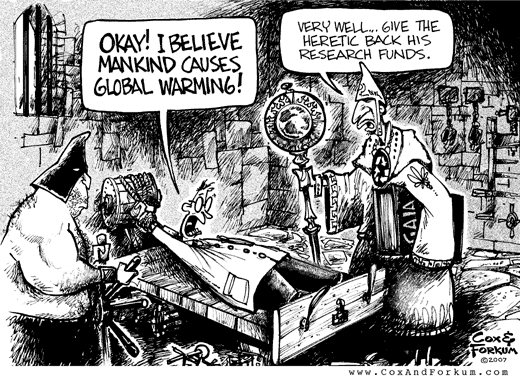
Washington, DC--On Tuesday evening, PBS premiered Heat, a Frontline documentary exploring the economics and politics of climate change. After travelling the world interviewing corporate CEOs and political leaders, Frontline correspondent Martin Smith argues that a “huge and concerted push from government” is necessary to prevent a major catastrophe. But according to Keith Lockitch, fellow of the Ayn Rand Center for Individual Rights: “A huge push from government on climate change would be a major catastrophe. “One thing the documentary shows pretty clearly is the repeated failure of government economic intervention--especially in the form of policies aimed at centrally planning energy production, such as government subsidies for corn ethanol. These have distorted world food markets by diverting billions of taxpayer dollars away from investments that market participants would have freely chosen and into the production of corn for burning up in our gas tanks, with the resulting distortions to world food prices causing food riots and starvation. “Government policies aimed at severely restricting carbon emissions would inflict a major blow to the economy. Industrial-scale energy is an indispensable, life-saving value, and currently there is simply no practical way to produce abundant carbon-free energy. Nuclear power could generate substantial amounts of electricity, but environmentalists have consistently fought it tooth and nail. And even nuclear can’t fuel the internal combustion engines of the world’s 800 million oil-powered vehicles. “The more important point is that there is no need whatsoever to restrict carbon emissions,” said Lockitch. “The scientific jury is still out on the extent of man’s contribution to global warming. But even if we are causing large-scale changes to the climate--this is not a planetary emergency. If individuals on the free market can smoothly absorb the major transitions that occurred in moving from the horse and buggy to the automobile or the rapid population growth that accompanied the Industrial Revolution, they can adapt to large-scale climate change. The freer we are from the burdens of government intervention, the more we can continue to produce wealth, economic growth, and the means of adapting to whatever changes occur, if any. “The irony is that the very policies that people are pushing for in the name of fighting global warming--such as a massive expansion of government control over the production and consumption of energy--would severely reduce our ability to cope with nature. This would inflict upon us an economic catastrophe far worse than anything the climate could deliver. “The real threat we face is not the possibility of large-scale changes to the climate, but the much more dangerous possibility of drastic government policies enacted in the name of climate change.”
Oct 21, 2008 | Dollars & Crosses
Washington, D.C. --“The 20-year jail sentence for blasphemy handed down to Sayad Kambakhsh in Afghanistan this week is the kind of outrage to be expected under any constitution that enshrines Islam as the state religion and the Koran as the supreme law of the land,” said Thomas Bowden, an analyst at the Ayn Rand Center for Individual Rights.
A council of mullahs acting under court authority had originally decreed capital punishment for Kambakhsh, a 24-year-old journalism student charged with possessing anti-Islamic books, starting un-Islamic debates in class, and downloading and distributing Internet articles saying that Muhammad ignored women’s rights. That death sentence, which was endorsed by Afghanistan’s upper house of parliament, has now been overturned on appeal.
“In 2006, mobs of clerics were clamoring for the death of Abdul Rahman, an Afghan whose ‘crime’ was converting to Christianity,” Bowden said. “And now, Sayad Kambakhsh faces two decades in jail unless an international outcry embarrasses Afghanistan’s government into lifting the sentence.
“Criminal punishment of blasphemy is fundamentally unjust and outrageous, and ad hoc protests offer no long-term solution. If Islam’s stranglehold on Afghanistan’s government is to end, that nation must adopt an American-style constitution protecting individual rights, including freedom of speech and religion. The strict separation of church and state erects an institutional barrier to religious persecution, as American history shows.
“But a nation that exalts mystical dogma and tribal allegiances cannot be expected to think in such terms. ‘The guy should be hanged,’ said an 18-year-old student at the American University in Kabul, at the time of Kambakhsh’s death sentence. Added a Muslim cleric: ‘He should be punished so that others can learn from him.’ For such people, freedom is an intolerable obstacle to the overriding goal of enforcing Islam.
“When the Bush administration invaded Afghanistan, its stated policy was to promote ‘democracy.’ That policy has now achieved its exact aim. The Afghan government reflects the democratic will of the people. The people want to punish blasphemers, and their constitution allows them to do so lawfully.
“Bush’s policy was based on his delusional belief that Afghans are as freedom-loving as Americans. But what they truly value is religion. Sayad Kambakhsh is living--at least for now--proof that religion injected into government is hostile to freedom.”Oct 16, 2008 | Dollars & Crosses
Ludwig Von Mises on the relationship between free-market banking ("free banking") and capitalism ("liberalism"):
Free banking is the only method available for the prevention of the dangers inherent in credit expansion. It would, it is true, not hinder a slow credit expansion, kept within very narrow limits, on the part of cautious banks which provide the public with all information required about their financial status. But under free banking it would have been impossible for credit expansion with all its inevitable consequences to have developed into a regular--one is tempted to say normal--feature of the economic system. Only free banking would have rendered the market economy secure against crises and depressions.
Looking backward upon the history of the last two centuries, one cannot help realizing that the blunders committed by liberalism in handling the problems of banking were a deadly blow to the market economy. There was no reason whatever to abandon the principle of free enterprise in the field of banking. The majority of liberal politicians simply surrendered to the popular hostility against money-lending and interest taking. They failed to realize that the rate of interest is a market phenomenon which cannot be manipulated ad libitum by the authorities or by any other agency. They adopted the superstition that lowering the rate of interest is beneficial and that credit expansion is the right means of attaining such cheap money. Nothing harmed the cause of liberalism more than the almost regular return of feverish booms and of the dramatic breakdown of bull markets followed by lingering slumps. Public opinion has become convinced that such happenings are inevitable in the unhampered market economy. People did not conceive that what they lamented was the necessary outcome of policies directed toward a lowering of the rate of interest by means of credit expansion. They stubbornly kept to these policies and tried in vain to fight their undesired consequences by more and more government interference. [Ludwig Von Mises, Human Action (1966) 444]
Oct 15, 2008 | Dollars & Crosses
Don't forget to read a seven part series detailing John Lewis and Paul Saunders objections to plans by the United States Environmental Protection Agency to claim unlimited power over the life of every American.

Cartoon by Cox and Forkum
The total of their objections may be accessed at: http://www.classicalideals.com/EPA_Ruination.htm
EPA Fascism versus America (1 of 7) (September 23, 2008)
On July 11, 2008 the Environmental Protection Agency of the United States issued an Advance Notice of Proposed Rulemaking (ANPR). This document details how the EPA intends to claim unlimited power over the life of every American.
EPA Fascism versus America: The EPA Plans are Immoral (2 of 7) (September 24, 2008)
The major impetus behind the man-made global warming scare--and the resultant political proposals--is rooted in something other than the rational identification of a genuine problem. It is erroneous moral ideas that are leading us to political disaster.
EPA Fascism versus America: There is No Natural Evidence for Man-made Global Warming (3 of 7) (September 25, 2008)
The provisions in the ANPR are based on a specious, unproven, scientifically unsupported, a-historical claim that impending disaster is caused by our very prosperity. This claim is leading us into the clear and present danger of federal economic controls imposed on a scale previously intolerable in the United States.
EPA Fascism versus America: There Is No "Consensus" Among Scientists (4 of 7) (September 26, 2008)
We oppose these measures on scientific grounds, because the assertions of a man-made global warming crisis are opposed by some of the best scientific minds in the world. There is no "consensus" among scientists that man-made global warming is a crisis requiring government intervention.
EPA Fascism versus America: The Failed Predictions of the Environmentalists (5 of 7) (September 27, 2008)
Claims to man-made global warming are merely the latest in a century-long series of failed predictions of climate catastrophe, built on emotion and not on reason. These dire predictions have alternated between cooling and warming--cycles that have run parallel to the Earth's natural climate variations.
EPA Fascism versus America: There Are No Practical Alternative Fuels in the Short-Term (6 of 7) (September 28, 2008)
There is no basis to conclude that practical development of so-called 'alternative' technologies can be achieved while destroying our industrial base in fossil fuels. Further, there is no basis for thinking that such technologies will be welcomed by environmental advocates, should they be made practical and available.
EPA Fascism versus America: The Descent into Dictatorship (7 of 7) (September 29, 2008)
The provisions of this ANPR grant virtually unlimited power to the Administrator of the EPA. This is a monstrous subversion of the very foundations of the independent American Republic, and the universal values it upholds: life, liberty, property, and the pursuit of happiness.
Those plans were laid out in an Advance Notice of Proposed Rulemaking (ANPR), dated July 11, 2008. Oct 15, 2008 | Dollars & Crosses
From Cox and Forkum:
From FOX News (using their front page headline): U.S. to Pour Up to $250 Billion Directly Into BanksU.S. officials announced Tuesday morning a broad range of measures designed to shore up the struggling financial system, including the purchase of stakes in some of the country’s largest banks and guarantees for most new debt issued by insured banks. [Emphasis added]
You think Hugo Chavez is jealous?
Good to see that not all banks are wanting government intervention. From the Washington Post: Smaller Banks Resist Federal Cash Infusions.Community banking executives around the country responded with anger yesterday to the Bush administration's strategy of investing $250 billion in financial firms, saying they don't need the money, resent the intrusion and feel it's unfair to rescue companies from their own mistakes.
But regulators said some banks will be pressed to take the taxpayer dollars anyway. Others banks judged too sick to save will be allowed to fail. ...
The opposition suggested that the government may have to continue to press banks to participate in the plan. The first $125 billion will be divided among nine of the largest U.S. banks, which were forced to accept the investment to help destigmatize the program in the eyes of other institutions. [Emphasis added]
Banks are being "pressed" and "forced" to accept money that was "pressed" and "forced" from taxpayers.
In defense of yet another socialist expansion, Bush gives us a classic A-is-non-A denial of reality: "These measures are not intended to take over the free market but to preserve it."
Clearly the man doesn't even know what the "free" in "free market" means. And unfortunately it neither do McCain and Obama.Oct 10, 2008 | Dollars & Crosses
The ARC site has three essays by Ayn Rand that every defender of capitalism in the 21st century should read and study:
“Man’s Rights” by Ayn Rand
This essay explains the fundamental nature of rights, the facts of reality that give rise to them, and what in essence they mean (and don’t mean) in practice.
“Collectivized ‘Rights’” by Ayn Rand
This essay shows why rights apply only to individuals, not to groups or collectives of people, and why acceptance of the notion of group “rights” necessarily leads to the violation of individual rights.
“The Nature of Government” by Ayn Rand
What a government is, why government is necessary to a civilized society, and why a proper government must be constitutionally limited to the function of protecting, not violating, the rights of the individual.
If you have never read them before --- enjoy!Oct 10, 2008 | Dollars & Crosses
Capitalism has an undisputed record of wealth generation, yet it has always functioned under a cloud of moral suspicion. In a culture that venerates Mother Teresa as a paragon of virtue, businessmen sit in stoic silence while their pursuit of profits is denounced as selfish greed. Society tells businessmen to sacrifice, to serve others, to “give back”--counting on their acceptance of self-interest as a moral crime, with chronic guilt its penance. Is it any wonder that productive giants from John D. Rockefeller to Bill Gates have behaved as if profit-making leaves a moral stain that only tireless philanthropy can launder but never fully remove?
It is time America heard the moral case for laissez-faire capitalism.
Two centuries ago the Founding Fathers established a nation based on the individual’s rights to life, liberty, property--and the selfish pursuit of his own happiness. But neither the Founders nor their successors could properly defend self-interest and the profit motive in the face of moral denunciation. The result has been a slow destruction of freedom in America, leading us to today’s economic mess.
In this inaugural lecture celebrating the launch of the Ayn Rand Center for Individual Rights (ARC), in Washington, D.C., executive director Yaron Brook will demonstrate how Ayn Rand’s revolutionary ethics of rational self-interest supplies the moral foundation that previous proponents of capitalism lacked. Dr. Brook will explain why individual rights are crucial for capitalism’s survival--why productivity and profit, the “selfish greed” that conservatives abhor, are not vices but cardinal virtues, and he will explain why Americans must reject McCain/Obama-style “national service” and instead proudly embrace the radical individualism their lives and happiness require.
Who: Yaron Brook, executive director of the Ayn Rand Center for Individual Rights
What: A talk defending the profit motive and presenting the moral case for laissez-faire capitalism. A Q&A will follow.
Where: National Press Club, 529 14th Street NW, Washington, D.C.
When: Wednesday, October 22, 2008, at 6:30 PM
The public and media are invited. Admission is FREE.Oct 10, 2008 | Dollars & Crosses
Washington, D.C. --The Treasury Department, as part of its ongoing assumption of control over the financial industry, is preparing to inject cash into U.S. banks in exchange for preferred shares of bank stock.
“Are we all socialists now?” said Yaron Brook, executive director of the Ayn Rand Center for Individual Rights. “Have we learned nothing from the devastation that socialist policies wrought worldwide in the twentieth century? Government intervention distorts markets and causes economic dislocations, no matter whether Uncle Sam controls private companies by regulation or assumes public ownership outright.
“A crisis doesn’t transform poison into medicine. Over decades, government manipulation of money, credit, and mortgages poisoned this economy and left it dangerously weak. Now Hank Paulson and his comrades are hooking up IV tubes filled with more of the same poison--bailouts, loan guarantees, cheap money, and more burdensome regulations--and hoping we will lie still and trust in their cure.
“But the real cure is capitalism, not more doses of socialism. We should act quickly to put government in its place, by rolling back the interventionist measures that caused the present emergency. Government’s proper role is to punish fraud and enforce contracts, not to own and manage the economy. We cannot achieve financial health unless we are willing to free the markets.”Oct 9, 2008 | Dollars & Crosses
Washington, D.C. --Asked when American combat forces should be used to quell humanitarian crises that pose no threat to U.S. security, Barack Obama pointed to Darfur and Rwanda, saying, “When genocide is happening…and we stand idly by, that diminishes us.” McCain agreed: “We must do whatever we can to prevent genocide.”
But according to Yaron Brook, executive director of the Ayn Rand Center for Individual Rights, “Vowing to send U.S. troops on selfless missions is a travesty.
“What Obama dismisses as standing ‘idly by’ really means: to protect the irreplaceable lives of American soldiers by refusing to ship them off on sundry ‘peacekeeping’ missions that do nothing to make us safe. That is not some cold-hearted gesture, but the government’s moral obligation. Nothing but a threat to American lives or freedom can justify putting our soldiers in harm’s way. Demanding they spill their blood in order to stop warring tribes from slaughtering each other is an obscene violation of their rights--regardless of how noble McCain or Obama thinks the cause is. “Our soldiers deserve better. Instead of sacrificing U.S. treasure and lives for the alleged welfare of foreigners, we should demand a foreign policy that treats American security as its exclusive concern.”Oct 7, 2008 | Dollars & Crosses
Washington, D.C.--Columbus Day, observed this year on October 13, will celebrate the 516th anniversary of Christopher Columbus’s discovery of America.
“Although in recent decades Columbus Day has fallen out of favor in many circles, it is vitally important that we continue to celebrate this holiday with pride,” said Thomas Bowden, an analyst at the Ayn Rand Center for Individual Rights.
“Columbus Day is, at root, a celebration of the worldwide spread of Western civilization--a value that is under attack by ‘multiculturalists.’
“Multiculturalism, which rejects the idea that some cultures are superior to others, makes it possible for American Indian activists to get away with castigating Columbus as a ‘cultural imperialist,’ calling for abolition of his holiday and replacing it with ‘Indigenous Peoples Day.’ This is outrageous. Contrary to the multiculturalist position, it is possible to demonstrate objectively that one society is superior to another--by the standard of what benefits human life. By this standard, modern industrial society is incomparably superior to the barbaric, tribalistic Stone Age culture of the Indians who predated Columbus.
“Those who attack Columbus Day are attacking the distinctive values of Western civilization that America so proudly embraces--reason, science, individual rights, and capitalism. Americans need to understand that their lives and happiness are at stake in the struggle to uphold the core values of Western civilization--a struggle that is epitomized by the continuing controversy over Columbus Day.
“We need not evade nor excuse Columbus’s flaws--his religious zealotry, his enslavement and oppression of natives--to recognize that he made history by finding new territory for a civilization that would soon show mankind how to overcome the age-old scourges of slavery, war, and forced religious conversion,” Bowden said. “On Columbus Day, we must continue to celebrate that civilization, and declare our resolve to defend it against both its intellectual and political enemies.”Oct 6, 2008 | Dollars & Crosses
Washington, D.C.--President Bush just signed into law what the Wall Street Journal describes as “a low-interest loan package to aid U.S. auto makers.”
“Have we learned nothing from the subprime mortgage fiasco?” said Alex Epstein, an analyst at the Ayn Rand Center for Individual Rights. “We are embroiled in a credit crisis, rooted in government policies that promoted and backed reckless, low-interest loans to subprime home buyers--loans that could eventually cost Americans trillions of dollars in bailouts and losses. And now, when lenders on the private market understandably won’t lend $25 billion to car companies that often shed billions by the quarter, the government is making reckless, low-interest loans to these subprime automakers?
“Obviously, our government has learned nothing from the crisis. But it has taught industry a terrible lesson: you fail, you get a bailout.”Oct 6, 2008 | Dollars & Crosses
From Thomas Bowden, author of The Enemies of Christopher Columbus:Q: [...] Multiculturalism regards all societies and traditions as of equal merit and is very critical of the West, claiming to see in America an explanation for the world's evils. How can you defend the West, as you do in your book, and claim that its traditions and civilization are superior?A: [...] Defending Western civilization is not defending the "superiority" of white men. That other peoples had not developed the application of reason to life does not mean that they are in any way inferior. It means that they had not yet achieved what the Europeans achieved over many centuries. But if we take an objective look at the standards of men's lives, then Western civilization is superior in very visible ways. The Indians might have developed it all on their own, but they did not. There is no such thing as a racial inferiority that says they couldn't have done it. But you don't have to invent everything yourself to benefit from it, and any gift of knowledge is a great gift. In any case, tribal society is prerational. And no moral blame can be attached to a tribal society living in a prerational, primitive manner. I always point out that there is no shame in having ancestors called "savages" since everyone living on Earth today has ancestors who were in fact savages. The root of the word is "forest," meaning people who live in the forest. [...] Q: But what about the ways the Europeans treated the Indians in America? Doesn't that prove that Western civilization was corrupt and brutish? A: What happened is that there were Europeans who abandoned civilized standards in dealing with the Indians. The problem wasn't that those Europeans had too much civilization. The problem was that they had too little. It is true that many Christian Europeans treated the Indians brutally. But it is also true that the Europeans treated the Indians no differently that they treated one another. Think of Europe's endless wars. And it is true that the Europeans treated the Indians in ways the Indian tribes treated one another. [Stephen Goode, Insight Magazine, 2007. Hat Tip: Provenzo Express]
Oct 2, 2008 | Dollars & Crosses
Writes Alex Epstein on the $700 Billion Bailout at FoxNews:
This socialistic power grab, just like the last half dozen, is being sold as a necessary, one-time “emergency” measure. But these measures are simply greater and greater doses of the poison that got us where we are in the first place: government manipulation of the housing and financial markets.
Government manipulator number one was the Federal Reserve, which dictated artificially low interest rates, inflating the currency to create the illusion of economic growth. The result was a borrowing spree by banks, which proceeded to lend nonexistent capital to homebuyers, who proceeded to collectively fuel a housing boom–which fueled a boom in mortgage-backed securities. Fannie and Freddie added dramatically to the number of bad loans and bad securities on the market under the banner of “affordable housing,” using their implicit government backing to make trillions in loans that wouldn’t have otherwise been made. And there were dozens of other government-created distortions, from rating agencies to the “too big to fail” policy.
Many private bankers and borrowers made foolish decisions: they should have known housing prices cannot go up forever. But today’s crisis could not have reached a fraction of its current proportions were it not for the government’s power to create bubbles and pervert lending practices in the name of some indefinable “public interest.” The basic solution, therefore, is to disentangle and remove the government from the financial and housing markets. This means, for starters, getting rid of the Fed’s power to manipulate interest rates, letting housing prices fall to market levels, dismantling Fannie and Freddie, and ending bailout promises.
Untangling this government mess is not an overnight job, and it is not obvious how best to proceed. It is conceivable that on the way to removing its toxic presence, a repentant government might need to take stopgap financial assistance measures to prevent market-wide catastrophe. The current plans, however, do not seek to dismantle the government’s command-and-control financial apparatus, but to expand it. Observe that Bush’s recent explanation of the causes of the crisis didn’t even mention the Federal Reserve, the Treasury, Fannie Mae or Freddie Mac, let alone give them proper blame. But he did mention them in all his solutions, which give these entities near-dictatorial control over financial markets.
Read the entire article here.Oct 1, 2008 | Dollars & Crosses
Alex Epstein on the roots of the financial crisis:
Too Big To Bail (March 18, 2008)
We need to phase out "too big to fail" and replace it with a free market in banking, which would reward sound long-term lending and borrowing practices and punish irresponsible ones. Otherwise, the next financial market fiasco is just a matter of time. Any doctrine that encourages overly-risky investing, and punishes sound risk-taking is unfair and destructive. We need to phase out "too big to fail" and replace it with a free market in banking, which would reward sound long-term lending and borrowing practices and punish irresponsible ones. Otherwise, the next financial market fiasco is just a matter of time.
Subprime Meltdown and Project Lifeline: Collaboration or Intimidation? (March 9, 2008)
What today's market desperately needs is for lenders and borrowers to bear the full consequences of their own bad decisions, and for the government to stop manipulating the market, violating property rights, and inviting future disasters.
Take Responsibility for Your Decisions: An Open Letter to Borrowers and Lenders (June 5, 2008)
Throughout the housing crisis, we have heard demands from spokesmen for desperate homeowners, banks, and investors for every variety of government bailout. But there is one group from whom the nation has not heard: the millions of Americans who, like me, had nothing to do with the crisis, who entered into mortgage contracts they could meet or who refused to buy at exorbitant prices, but who will be forced to pay the bills for these bailouts. If we had a spokesman, this is what I wish he would say.
The Injustice of "Doing Something" about Subprime (November 7, 2007)
As we witness large numbers of defaults on subprime loans--loans extended to those with no credit or bad credit--many are calling for the government to do something to stop the suffering. At the same time, many recognize that a bailout of struggling homeowners would be wrong. Thus, we see a growing list of proposed solutions that purport to save the day without a bailout: "borrower assistance" programs to refinance defaulting mortgages, crackdowns on "predatory lending" practices, or laws restricting mortgages the government deems too risky. In fact, regardless of how these proposals are described, all embody the essence of a bailout: they absolve individuals of responsibility for their bad decisions--and force those who did nothing wrong to pay the price.
Oct 1, 2008 | Dollars & Crosses
What: A lecture examining the escalating censorship in America and explaining what is needed to protect our freedom of speech
Who: Eric Daniels, research assistant professor at Clemson University’s Institute for the Study of Capitalism
Where: 101 Morgan Hall, University of California, Berkeley, Berkeley, CA 94720
When: Monday, October 6, 2008, 7 pm
Description: In this lecture, Dr. Daniels examines the state of free speech in America and finds that it is under serious threat. From campus speech codes to anti-discrimination and harassment law, from campaign finance to commercial speech, Americans today enjoy less and less freedom in communicating their ideas. Today’s colleges and universities have become a hotbed of censorship, producing generations of Americans who have accepted suppression of speech as the norm. Daniels argues that the emerging crisis is a result of the lack of a proper understanding of individual rights, especially property rights. Only by understanding the proper basis of rights can we act to secure our freedom of speech and to protect the rights that give rise to it.
Bio: Dr. Eric Daniels is a research assistant professor at Clemson University’s Institute for the Study of Capitalism. He has lectured internationally on American history, particularly on American intellectual history, business history and political history. He taught for five years at Duke University's Program on Values and Ethics in the Marketplace, where he was nominated for a university-wide teaching award. Dr. Daniels was a contributor to the recently published Oxford Companion to United States History, and wrote a chapter in The Abolition of Antitrust. He has appeared on C-SPAN and Voice of America Radio.
Sep 28, 2008 | Dollars & Crosses
Here is a letter by John Allison, President & CEO of BB&T, that was sent to every member of Congress.
Dear Senator/Congressman/Representative:
BB&T is a $136 billion multi-state banking company. We have 1,500 branches throughout the mid-Atlantic and southeast states. While we have been impacted by the real estate markets, we continue to have healthy profitability and a strong capital position.
We think it is important that Congress hear from the well run financial institutions as most of the concerns have been focused on the problem companies. It is inappropriate that the debate is largely being shaped by the financial institutions who made very poor decisions.
Attached are the issues that we believe are relevant from the perspective of healthy banks. Your consideration of these issues is greatly appreciated.
[Signature]
Key Points on a "Rescue" Plan From A Healthy Bank’s Perspective- Freddie Mac and Fannie Mae are the primary cause of the mortgage crisis. These government supported enterprises distorted normal market risk mechanisms. While individual private financial institutions have made serious mistakes, the problems in the financial system have been caused by government policies including, affordable housing (now sub-prime), combined with the market disruptions caused by the Federal Reserve holding interest rates too low and then raising interest rates too high.
- There is no panic on Main Street and in sound financial institutions. The problems are in high-risk financial institutions and on Wall Street.
- While all financial intermediaries are being impacted by liquidity issues, this is primarily a bailout of poorly run financial institutions. It is extremely important that the bailout not damage well run companies.
- Corrections are not all bad. The market correction process eliminates irrational competitors. There were a number of poorly managed institutions and poorly made financial decisions during the real estate boom. It is important that any rules post “rescue” punish the poorly run institutions and not punish the well run companies.
- A significant and immediate tax credit for purchasing homes would be a far less expensive and more effective cure for the mortgage market and financial system than the proposed “rescue” plan.
- This is a housing value crisis. It does not make economic sense to purchase credit card loans, automobile loans, etc. The government should directly purchase housing assets, not real estate bonds. This would include lots and houses under construction.
- The guaranty of money funds by the U.S. Treasury creates enormous risk for the banking industry. Banks have been paying into the FDIC insurance fund since 1933. The fund has a limit of $100,000 per client. An arbitrary, “out of the blue” guarantee of money funds creates risk for the taxpayers and significantly distorts financial markets.
- Protecting the banking system, which is fundamentally controlled by the Federal Reserve, is an established government function. It is completely unclear why the government needs to or should bailout insurance companies, investment banks, hedge funds and foreign companies.
- It is extremely unclear how the government will price the problem real estate assets. Priced too low, the real estate markets will be worse off than if the bail out did not exist. Priced too high, the taxpayers will take huge losses. Without a market price, how can you rationally determine value?
- The proposed bankruptcy “cram down” will severely negatively impact mortgage markets and will damage well run institutions. This will provide an incentive for homeowners who are able to pay their mortgages, but have a loss in their house, to take bankruptcy and force losses on banks. (Banks would not have received the gains had the houses appreciated.) This will substantially increase the risk in mortgage lending and make mortgage pricing much higher in the future.
- Fair Value accounting should be changed immediately. It does not work when there are no market prices. If we had Fair Value accounting, as interpreted today, in the early 1990’s the United States financial system would have crashed. Accounting should not drive economic activity, it should reflect it.
- The proposed new merger accounting rules should be deferred for at least five years. The new merger accounting rules are creating uncertainty for high quality companies who might potentially purchase weaker companies.
- The primary beneficiaries of the proposed rescue are Goldman Sachs and Morgan Stanley. The Treasury has a number of smart individuals, including Hank Paulson. However, Treasury is totally dominated by Wall Street investment bankers. They do not have knowledge of the commercial banking industry. Therefore, they can not be relied on to objectively assess all the implications of government policy on all financial intermediaries. The decision to protect the money funds is a clear example of a material lack of insight into the risk to the total financial system.
- Arbitrary limits on executive compensation will be self defeating. With these limits, only the failing financial institutions will participate in the “rescue,” effectively making this plan a massive subsidy for incompetence. Also, how will companies attract the leadership talent to manage their business effectively with irrational compensation limits?
And in a report by Bloomberg on "Allison's Alternative":
Allison is retiring in December after 19 years leading BB&T, the 14th-biggest U.S. commercial bank, with assets of $136.5 billion. BB&T avoided subprime lending, option adjustable-rate mortgages and complex debt securities that have slammed Wachovia Corp., Washington Mutual Inc. and other lenders. Still, BB&T more than tripled the money it set aside for loan losses in the second quarter, mainly because of loans to builders and developers in Georgia, Florida and the Washington, D.C., metropolitan area.
Rather than buying distressed assets, the U.S. government could offer a ``significant'' tax credit for home purchases, or even purchase vacant lots or houses under construction, Allison said. The market should be allowed to eliminate ``irrational competitors,'' he said. ``There were a number of poorly managed institutions and poorly made financial decisions during the real estate boom,'' Allison wrote. ``It is important that any rules post-`rescue' punish the poorly run institutions and not punish the well-run companies.''
He said the mortgage crisis was caused primarily by Freddie Mac and Fannie Mae. The government-chartered companies, which own or guarantee more than 40 percent of the $12 trillion of U.S. home loans, ``distorted normal market-risk mechanisms,'' and were abetted by a Federal Reserve that made the wrong decisions on interest rates, Allison wrote.