Scott Holleran Interview with John David Lewis

From Scott Holleran's blog:
The goal of a war is to defeat an enemy’s will to fight. So argues the author of Nothing Less than Victory: Decisive Wars and the Lessons of History (Princeton University Press, 2010), who makes the case that a strong military offense can win a war and establish lasting peace while playing defense often leads to destruction. This study of six major wars, from the Second Punic War to World War 2, by historian John David Lewis, contrasts the use of overwhelming force, such as the Greek victory over Xerxes’ army and navy, with a lack of reason, purpose, and commitment to fight. On the eve of the 10th year since the worst attack in American history, I turned to my friend John Lewis, a visiting associate professor of philosophy, politics, and economics at Duke University and teacher at Objectivist Conferences (OCON), to discuss today’s war from an historical perspective. Dr. Lewis is the author of Solon the Thinker: Political Thought in Archaic Athens and Early Greek Lawgivers. Scott Holleran: What is the theme of Nothing Less Than Victory: Decisive Wars and the Lessons of History?John David Lewis: That wars are driven and caused by people’s decisions to fight and that those decisions are based on the ideas they hold. This has enormous implications for what victory means, because it means discrediting the ideas we’re trying to defeat. For example, one could never explain Germany’s massive attacks [against other countries] or Japan’s massive attack on America, in which they launched into intercontinental warfare, without understanding the ideals that they held. The theme of Nothing Less Than Victory is that one must defeat the enemy by discrediting his ideas.Scott Holleran: How was Nothing Less Than Victory suggested by your students?John David Lewis: I was teaching a class on ancient and modern warfare and it became clear that a comparative history would be useful. My students posed good questions.Scott Holleran: While writing about the rise of the Nazis, did The Ominous Parallels: The End of Freedom in America by Leonard Peikoff help your understanding?John David Lewis: Yes, because it’s the only book I know of that places philosophical ideas as the lesson of history. It’s not only an explanation of Nazi Germany in terms of ideas but, much more deeply and widely, it demonstrates how ideas move history.Scott Holleran: The current administration supports military involvements in Iraq, Afghanistan and Libya, as well as other underreported incursions in nations such as Yemen and Pakistan, with something other than, or less than, a purpose let alone a victory. The Oxford English Dictionary defines warmonger as “a person who seeks to bring about or promote war.” As a commander-in-chief who supports and initiates militarism with no purpose or end, is President Obama a warmonger?John David Lewis: I think he’s incompetent but I don’t think Obama is a warmonger. He inherited those wars but he’s simply unable to bring those wars... [Read the rest at Scott Holleran's blog.]

Event: Sept 11—A Decade Later: Lessons for the Future

It has been a decade since the Sept. 11 attacks shocked and angered our nation. What lessons have we learned since then? Join us at a symposium, “Sept. 11—A Decade Later: Lessons for the Future,” on September 8, in Washington, D.C. The program will feature three panel discussions, presenting a range of viewpoints.
  • Upheavals in the Middle East: Assessing the Political Landscape

    What lessons can be drawn from the popular rebellions in Tunisia, Egypt, Libya and elsewhere in the Arab-Islamic world? Will these uprisings lead to fundamental changes to the political landscape? Who stands to gain the most from these changes? What impact might they have for U.S. interests in the region?
  • The Islamist Threat: From AfPak to Jyllands-Posten and Times Square

    In the years since the attacks of 9/11, what have we learned about the nature of the enemy that struck that day? What have we learned from the U.S. response, under G.W. Bush and now Barack Obama, that should shape current and future policy? If a failure of pre-9/11 policy-thinking was to neglect ‘connecting the dots,’ what patterns or trends can be identified now about developments in the Middle East, Europe (such as the furor over cartoons of Mohammad) and North America?
  • Iran, Israel and the West

    If—or when—Iran gains nuclear-weapons capability, what would be the impact on the region, on Israel, and on American interests? What lessons can be learned from America’s policy toward Iran—not only in recent years, but going back to the emergence of the Islamist regime in Teheran? What policy options are available to the U.S. for responding to Iran and its Islamist affiliates?
For full details visit here.

Alex Epstein Launches the Center for Industrial Progress

From Alex Epstein's newsletter:
Last month I left my position as the Ayn Rand Institute's Fellow on energy issues to start a new energy startup called the Center for Industrial Progress. Before I say anything about the new project, I just want to thank the Institute for all the support, intellectual and financial, that it has given me over the last decade--and that includes support for my decision to strike out on my own, which has always been a dream of mine.The basic concept behind the Center for Industrial Progress is that our culture desperately needs to re-embrace industrial progress as a cultural ideal. America's industrial progress has been declining, and with it, our economy--in large part thanks to the influence of the "green" movemenet, which has opposed industrial progress in the name of minimizing man's impact on nature. At CIP, we celebrate man's impact on nature, just as our ancestors celebrated Americans' ability to "tame a continent." We celebrate the never-ending project of the industrial revolution: to harness more and more energy to feed machines that do more and more work to make our lives better and better. This project is the key both to taking the American standard of living to the next level and to improving conditions for the desperately poor--the industrially poor--around the world.We reject the false dichotomy between industrial progress and environmental progress; historically, industrialization has brought with it a radical improvement of the human environment. Indeed, industrial progress is the improvement of the human environment, from sanitation systems to sturdier buildings to less onerous job conditions to the production of creature comforts to having healthy, fresh food at one's disposal year round, to the luxury of being able to preserve and travel to the most beautiful parts of nature. And so long as we embrace policies that protect property rights, including air and water rights, we protect industrial development and protect individuals from pollution. What "green" policies do is not improve the human environment, but sacrifice it to the non-human environment--just ask anyone trying to build an industrial project today.For too long, Americans have taken industrial progress for granted, and carelessly embraced "going green" as an ideal--expecting that the unprecedented standard of living we had would automatically continue, even though we permitted environmentalists to oppose new energy production and new development at every turn. Today, we are paying the price, with an economy whose productive fundamentals are less and less sound. This needs to change--but not just to stave off the current problems. At CIP, our goal is not simply to stop bad policies and preserve the status quo. It is to champion great policies, policies that fully respect property rights and fully allow free markets, such that the brilliantly talented individuals of this great country can lead us to the next industrial renaissance.At CIP, we believe that the potential for industrial progress is unlimited. Human beings, if left free,  have unlimited potential to produce more energy, create more wealth, create more productivity, raise living standards for every hard-working person, increase leisure time, transport things more quickly, conduct more complex scientific experiments, build sturdier, more comfortable places to live, travel farther and faster, experience more, and generally make life better and better. We can do this as a nation if we make industrial progress a cultural ideal, a goal to strive for. That is the goal of the Center for Industrial Progress. Or, to use one of our slogans, our goal is to convince Americans to stop "Going Green" and start "Going Industrial."As for how we're going to do that, including what collaborators will be involved, stay tuned. And keep up with our various websites:http://www.alexepstein.comhttp://www.youtube.com/industrialprogresshttp://powerhour.alexepstein.comAlso, note that I will be doing a lot more public speaking this coming Fall and Winter, so if you want to hear an illuminating, entertaining talk on today's most important energy/industrial/environmental issues, go www.alexepstein.com and click on "Book Me" for my all new lineup, including "The Green Blackout," "In Defense of Fracking," and "Why America Needs to Stop Going Green and Start Going Industrial."

Amy Peikoff Talks with Jihad Watch’s Robert Spencer

From Don't Let It Go:
I am pleased to share, as a podcast, my interview with Robert Spencer, director of Jihad Watch and author of many books, including two New York Times bestsellers, The Truth About Muhammad and The Politically Incorrect Guide to Islam (and the Crusades). We have been reading Mr. Spencer’s Qur’an Commentary as a supplement to our reading of the Koran for our Koran Reading Group. Mr. Spencer answers a range of questions in the interview, from general observations about the poetic nature of the Koran, to discussion and interpretation of specific passages of it–including those that call for the use of violence against non-Muslims and require women to produce four witnesses in order to prove that they were raped. You can listen to and download the interview here: Robert Spencer Interview

Warren Buffet Hypocrite

Writes Richard M. Salsman on Warren Buffett and Other Anti-Rich Capitalists:
Omaha-based billionaire investor Warren Buffet announced this week that he’d invest $5 billion in newly-issued preferred stock of troubled Bank of America (yielding 6%), not unlike the $10 billion he invested in the preferred shares of a shaky Goldman Sachs (yielding 10%) back in 2008. Neither bank would exist today absent the billions-of-dollars in bailouts they got from Washington (taxpayers) or the billions in cheap loans they got from the Federal Reserve. Buffet simultaneously complains that he and other rich Americans are materially under-taxed. But if he had any real integrity on such matters, if Buffet were to practice what he preaches, he’d send his $15 billion to the U.S. Treasury, via PayPal, here.  Yet he refuses to do so. Why?
Read the rest in Warren Buffett and Other Anti-Rich Capitalists. 

Amy Peikoff Q & A On Privacy and Social Media

Professor Amy Peikoff did a short Q & A on privacy and social media for the Summer 2011 issue of Chapman Magazine. You can find it here, just click on the issue with “A Roaring 20″ on the cover, and use the online reader to flip to page 10.Also don't forget to check out her 2 hour special podcast, where topics include: Hurricane Irene, including our government’s reaction to it and global warming hype about it; David Letterman’s reaction to the jihadist threat; Steve Jobs’s retirement, Obamanomics vs. Reaganomics; Federal Raid on Gibson Guitars; Bloomberg’s decision to have no clergy present at 9/11 commemoration.If you were unable to attend live and would like to hear this week’s webcast/podcast, click here for hour one, and click here for hour two, or you can access the files via iTunes

Scholarships to Study Free-Market Economics and the Philosophic Foundations of Capitalism

National University of La Jolla, CA has a limited number of scholarships available for three online courses that focus on free-market economics and the philosophical foundations of capitalism. These scholarships are being funded by a grant from the Charles G. Koch Charitable Foundation. The scholarships cover the full tuition for the courses plus the application fee to NU. Two courses (ECO 401 and 402, Market Process Economics I and II, respectively) use Capitalism: A Treatise on Economics by George Reisman as the required textbook. One course (ECO 430 - Economics and Philosophy) uses Ayn Rand’s The Virtue of Selfishness and Capitalism: The Unknown Ideal as the required textbooks. These courses can be taken from anywhere in the world, as long as one has access to the internet. The courses incorporate live chat sessions in which the professor and students interact in a virtual classroom, much as they would in a traditional classroom.The courses run for the next time in the summer and fall of 2012. More information about the courses on the web can be found here:ECO 401 – Market Process Economics IECO 402 – Market Process Economics IIECO 430 – Economics and PhilosophyTo apply for one or more of these scholarships, send your name, transcript from your high school or university, and an essay of no more than 750 words discussing why you believe you deserve a scholarship and your future education and career plans to Dr. Brian P. Simpson.Send them to bsimpson@nu.edu or 11255 North Torrey Pines Rd.; La Jolla, CA 92037. Please indicate which course or courses for which you are applying for a scholarship. You can apply for one to three scholarships, depending on how many courses you are interested in taking. Note that to receive a scholarship you will have to apply to National University and enroll in the course(s). If you have questions, please contact Dr. Simpson at the email address above or 858-642-8431.

“Baseline” Gimmick: “Cut” is in Reality a Lower Increase in Spending

Richard Salsman crunches the numbers at Forbes on the attempt to "cut" the size of the public debt:
[...] Even the most “radical” GOP plan, to “cut” $9 trillion, would boost federal outlays by 30% in the coming decade versus outlays in the past decade, while the most modest GOP plan, to cut a mere $2 trillion, would boost outlays by 55%. Yet Democrats lambaste GOP plans as “Draconian,” prone to trigger a “depression.”By “baseline” federal spending over the coming decade, the CBO means the sum that’ll be spent even with no changes in current fiscal policy, whether in tax rates or spending schemes. As mentioned, the CBO says $45.8 trillion in outlays over the coming decade are effectively on “auto-pilot,” so any proposed “cut” is relative only to this huge number. As mentioned, Washington spent $28.3 trillion over the past decade, so embedded “baseline” spending of $45.8 trillion in the coming decade already entails an astounding increase of 62%. In the coming decade neither U.S. population nor real economic output would rise nearly so much.[...] Why are today’s politicians, journalists and economists so complicit in deliberately misleading the public about the current and future state of U.S. finances? Why do they speak of “cuts” in future federal spending when the CBO routinely projects increases in the range of +30% to +65%? Check those numbers again, dear citizen: they’re positive, not negative. “Baseline budgeting,” which blithely presumes a perpetually-growing government, was first enacted by the U.S. Congress in 1974, in order to side-step White House efforts to “impound” (limit) federal spending; but that doesn’t condone the gimmick – or justify lying to the public. When people hear that Washington will “cut” spending by $2 trillion over the coming decade, they think that’s a lot of money and that outlays might be $2 trillion lower a decade hence – not higher by 50% or more. Even Boehner’s budget plan, like many others, backloads the “cuts” into later years; he’d “cut” outlays by only $23 billion in 2012, equivalent to less than three days of total federal spending at the current spending rate.  [Richard Salsman, Forbes,  Washington’s Budget “Cuts” Would Boost Spending 50%]

Democrat Casino Mogul Steve Wynn on Obama’s “Weird” Job Destroying Philosophy

From Wynn Resorts' CEO Discusses Q2 2011 Results - Earnings Call Transcript - Seeking Alpha:
Well, here's our problem. There are a host of opportunities for expansion in Las Vegas, a host of opportunities to create tens of thousands of jobs in Las Vegas. I know that I could do 10,000 more myself and according to the Chamber of Commerce and the Visitors Convention Bureau, if we hired 10,000 employees, it would create another 20,000 additional jobs for a grand total of 30,000.

I believe in Las Vegas. I think its best days are ahead of it. But I'm afraid to do anything in the current political environment in the United States. You watch television and see what's going on, on this debt ceiling issue. And what I consider to be a total lack of leadership from the President and nothing's going to get fixed until the President himself steps up and wrangles both parties in Congress. But everybody is so political, so focused on holding their job for the next year that the discussion in Washington is nauseating.

And I'm saying it bluntly, that this administration is the greatest wet blanket to business, and progress and job creation in my lifetime. And I can prove it and I could spend the next 3 hours giving you examples of all of us in this market place that are frightened to death about all the new regulations, our healthcare costs escalate, regulations coming from left and right. A President that seems -- that keeps using that word redistribution.

Well, my customers and the companies that provide the vitality for the hospitality and restaurant industry, in the United States of America, they are frightened of this administration. And it makes you slow down and not invest your money. Everybody complains about how much money is on the side in America. You bet. And until we change the tempo and the conversation from Washington, it's not going to change. And those of us who have business opportunities and the capital to do it are going to sit in fear of the President. And a lot of people don't want to say that. They'll say, "Oh God, don't be attacking Obama."

Well, this is Obama's deal, and it's Obama that's responsible for this fear in America. The guy keeps making speeches about redistribution, and maybe we ought to do something to businesses that don't invest or holding too much money. We haven't heard that kind of talk except from pure socialists. Everybody's afraid of the government, and there's no need to soft peddling it, it's the truth. It is the truth. And that's true of Democratic businessman and Republican businessman, and I am a Democratic businessman and I support Harry Reid. I support Democrats and Republicans.

And I'm telling you that the business community in this company is frightened to death of the weird political philosophy of the President of the United States. And until he's gone, everybody's going to be sitting on their thumbs.

State of the Culture: Amy Peikoff Interview with ARI’s Yaron Brook

Dr. Yaron Brook, along with business hero John Allison and philosopher Leonard Peikoff, are the leading voices today in promoting Ayn Rand's philosophy of Objectivism: which advocates reason, individual rights and the virtue of selfishness (i.e., the pursuit of one's long-term happiness). Listen to this full-hour Interview with Yaron Brook, President of the Ayn Rand Center for Individual Rights and the state of the Culture at Don’t Let It Go…Unheard #22.


Richard Lindzen: A Modern Day Galileo on Climate


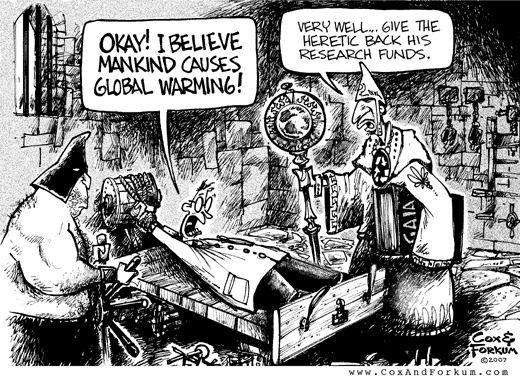
Cartoon by Cox and Forkum.


Richard Lindzen is a professor of meteorology at Massachusetts Institute of Technology who thinks that man-caused global warming is real, but will hardly cause any change at all. The NY Times has an interesting article on him: A Climate Change Dissenter Who Has Left His Mark on U.S. Policy. Here are some choice excerpts:
 [...] [Lindzen argues that] the answer that emerges from most climate models is wrong because they assume the Earth's clouds and water will amplify the rising heat. According to Lindzen's calculations, the clouds should have the opposite effect, minimizing the warming effect.

In his paper, Rahmstorf added a "Personal Postscript": "Can Lindzen seriously believe that a vast conspiracy of thousands of climatologists worldwide is misleading the public for personal gain? All this seems completely out of touch with the world of climate science as I know it and, to be frank, simply ludicrous." In a reply, Lindzen skewered Rahmstorf in a footnote, arguing that the German scientist was "addicted to the use of words like 'entirely,' 'fact,' 'irrefutable,' etc. Such words are inappropriate to a primitive and immature science -- which is what climate science is at present."

Richard Goody, 90, who taught meteorology to Lindzen at Harvard, says the critics of his former pupil are "focusing on his propensity to debate. He [Lindzen] loves debating. He absorbs an enormous amount of information, and he loves arguing with you about it. Since he's so well-informed and so smart, he usually wins. This doesn't endear you to a lot of people." [...] Goody is quick to add: "But science is not about gentility. It's about discussing the facts. He's just doing what he should do." [...] "This machine turns out a number for something that will happen 100 years in the future. Science doesn't usually work that way. There's not much evidence about the behavior of these climate models," he said.

[...] Roger Pielke Jr., a political scientist at the University of Colorado, specializes in studying the scientific process. He sees the rough-and-tumble of the climate debate as an unstable brew of science and politics. "If we were to view science as a field where a lot of conflicts happen, then Lindzen is an expected part of the scenery. But if science is a community where there is only one acceptable view, then Lindzen stands out." Pielke blames environmental groups for making climate a two-sided debate.

[...] In a paper he wrote earlier this year, he managed to lash out at his scientific critics, bureaucrats, politicians -- including former Vice President Al Gore -- and environmental groups before training his rhetoric on the public. "And finally, there are the numerous well-meaning individuals who have allowed propagandists to convince them that in accepting the alarmist view of anthropogenic climate change, they are displaying intelligence and virtue. For them, their psychic welfare is at stake," he wrote.

The paper gives the essence of his argument, which is that, while man-caused warming certainly exists, by itself it is small. It was roughly 0.7 degree Celsius in the 20th century. If the amount of carbon dioxide in the atmosphere doubles, which many scientists predict that it will by the end of this century, that will increase global mean temperatures by a little more than 1 degree, he thinks. "A hundred years from now, I don't really know, but I don't think it [the climate] will be radically different. The climate is always changing. It's natural variability," he said in an interview.

[...] "Now we're seeing a doubling down, a desperate movement among professional [scientific] societies that have committed themselves to the issue," he said. Asserting that groups such as the National Academy of Sciences or the American Meteorological Society are wrong about climate projections and proposed government responses doesn't endear Lindzen to the nation's science establishment. But he doesn't stop there. He proposes to cut off most government funding because it rewards what he calls "alarmist" studies about climate change and discourages dissenting views. "There has to be a return to non-government support of science," he told the Cato group. [A Climate Change Dissenter Who Has Left His Mark on U.S. Policy]


How Ben Bernake Using The Power of the FED Triggered The Great Recession

Another great op-ed in Forbes by Richard Salsman on How Bernanke’s Fed Triggered the Great Recession:
[...] in 2008-2009 Bernanke did nearly let “it” happen again — a banking collapse, a depression, deflation — by bringing the U.S. financial system to its knees by roughly the same Fed policy adopted in the 1930s, followed by his blizzard of paper-money printing that has caused a dollar debasement unprecedented in U.S. history. The result has been a huge destruction of wealth, spreading fiscal chaos and stagflation as far as the eye can see.

How did Bernanke create this horrible morass? First, in 2006-2007 he deliberately inverted the Treasury yield curve, even while knowing it would cause a recession and credit-financial crisis. Second, he imposed on the reeling economy a $1.7 trillion flood of “quantitative easing” (QE), euphemistic for the hazardous policy of money-printing. His first policy caused economic stagnation, his second policy caused monetary inflation, and combined, his policies have generated “stagflation” — the corrosive mix last seen in the 1970s. It’s the direct opposite of the supply-side polices (pro-growth, sound-money) that made the 1980s and 1990s so prosperous.

How can we hold Bernanke accountable for this widespread mess? Consider first the economic stagnation. By training, Bernanke knew full well (and still knows) that an inverted Treasury yield curve — wherein the Fed deliberately keeps short-term interest rates above longer-term Treasury bond yields — invariably causes recessions and crises in the modern (fiat paper money) era.

He knows that an inverted yield curve severely and nearly instantly renders unprofitable most financial intermediation, which is the process of “borrowing short to lend long.” The normal case is for short-term borrowing yields to trade below long-term investment yields (an upward-sloped yield curve), which is profitable for credit intermediaries, given the positive yield margin. In contrast, the rarer case is for short-term rates to trade above long-term rates (an “inverted,” or downward-sloped yield curve), which is far less profitable or an outright loser for lenders, due to the negative yield margin.

Read the rest.

John Allison on Job Destruction: Rule of Regulators vs a Rule of Law

Writes John Allison in Unshackle The Job Creators - Investors.com:
[...] As a longtime banking CEO, I know first-hand and with certainty how jobs are created — and it's not by government bureaucrats waving magic wands. Jobs are created by private businesses, from the large multinational corporation down to the sole proprietor who mows grass and spreads mulch.

[...] In today's economy, entrepreneurs and business leaders are eager to ramp up production, launch new products, open new branches and create new jobs. But what's standing in the way of translating that eagerness into paychecks? Government policies that undermine the rule of law, create destructive boom-and-bust cycles, and generate massive deficits.

Under the rule of law, the legal system specifically defines unlawful behavior and gives fair warning of the punishment for wrongdoing. Instead, we suffer under the rule of regulators.

Every year, Congress and state legislatures concoct new schemes to clamp down on business freedom. Using real wrongdoers as a pretext, they declare the entire business world guilty without a trial and pass a sentence of perpetual supervision by an army of bureaucrats who halt progress until they get around to doling out licenses, permits, inspections and new rules.

The result is that businessmen live in perpetual fear of government reprisals.

Read the rest...

Books: Freedom and School Choice in American Education

Freedom and School Choice in American Education has just been released. In the book, leading intellectual figures in the school reform movement, all of them favoring approaches centered around the value of competition and choice, outline different visions for the goal of choice-oriented educational reform and the best means for achieving it. This volume takes the reader inside the movement to empower parents with choice, airing the more interesting debates that the reformers have with one another over the direction and strategy of their movement.Features an important and somewhat controversial essay by C. Bradley Thompson on "Do Children Have a Right to an Education?" 

The Philosophy of the New Left

Writes C. Bradley Thompson: "In 1958 Mike Wallace interviewed the Marxist social theorist, Erich Fromm (author of "The Sane Society"). If you want to understand the philosophy behind the New Left and the world in which we live today, I recommend that you watch it. [...] Watching the Fromm interview helps us to understand why the Dustin Hoffman film, The Graduate, was such a hit in 1967. The culture had been prepared by Fromm, Marcuse, et. al. The famous line uttered by Mr. McGuire to Benjamin is straight out of Fromm: 'I just want to say one word to you. Just one word. . . Are you listening? . . . Plastics.' "Watch the Erich Fromm Interview

Republicans Going to War without a Weapon: The Budget Debate

Over at Forbes Yaron Brook and Don Watkins have penned a poignant op-ed on What’s Missing From The Budget Debate:
House Budget Committee Chairman Paul Ryan’s budget has come under severe attack for daring to curtail some elements of the entitlement state. Although we are certainly not defenders of the plan’s details — it doesn’t even cut spendingwhat’s striking is how easily its supporters have been put on the moral defensive, and to how devastating an effect. In a column typical of the attacks on the Ryan budget, New York Times columnist Paul Krugman called the plan “cruel,” “heartless” and “mean-spirited.” Ryan “has talked a good game about taking care of those in need,” but that can’t be reconciled with cutting the welfare state.

It was nothing new: Every attempt to cut entitlements has been denounced as unethical and immoral. But this time there was a new twist. The real motive behind the plan, critics say, is a philosophic opposition to entitlements — an opposition fueled by the ideas of the controversial philosopher Ayn Rand.

Rand of course was both an uncompromising critic of the entitlement state and a preeminent champion of laissez-faire. But whatever influence Rand might have had on Ryan’s goal — he credits her with inspiring him to go into politics — one thing is for sure: Her arguments have been conspicuously absent in the budget debate. Frankly, that’s like going to war without a weapon. Rand's ideas are indispensable in the struggle to limit government: they provide the key to answering the moral argument for the entitlement state.

Read the rest...

Voice of Capitalism

Capitalism news delivered every Monday to your email inbox.

Subscribed. Check your email box for confirmation.

Pin It on Pinterest