Nov 2, 2020 | Business
https://youtu.be/vZypHdh2SrUMarcin Chmielowski and Krzysztof Paweł Bogocz have produced a documentary on one of the greatest economists of the 20th century -- Ludwig Von Mises.Ludwig von Mises was one of the most important economists in history. Unfortunately, he is commonly known and appreciated only in a narrow circle of experts and enthusiasts - ordinary people don’t know him or his extraordinary achievements. A fearless intellectual, scientist, teacher and in some sense a social inventor, Mises showed that human action is an important area of study, and that we all need to work to secure the blessings of liberty. But at the same time he was a conscript, refugee, husband, friend. A normal everyday person, somebody like our professor or a neighbor. We want to show that interesting combination, and to stress that in every freedom fighter lies a spark of genius.
Project financing was based entirely on voluntary donations from individual and corporate donors. No taxpayers suffered during production of this movie. The movie was produced by the Freedom and Entrepreneurship Foundation, an independent organization whose aims include: developing economic education, spreading libertarian philosophy and the concept of the minimal state, as well as exemplifying the benefits of a voluntary cooperation.
Oct 20, 2020 | Philosophy
https://www.youtube.com/watch?v=vEOdDGSZGt4&feature=youtu.beDr Andrew Bernstein on discovering the values you want to pursue in life.

Sep 23, 2020 | Business
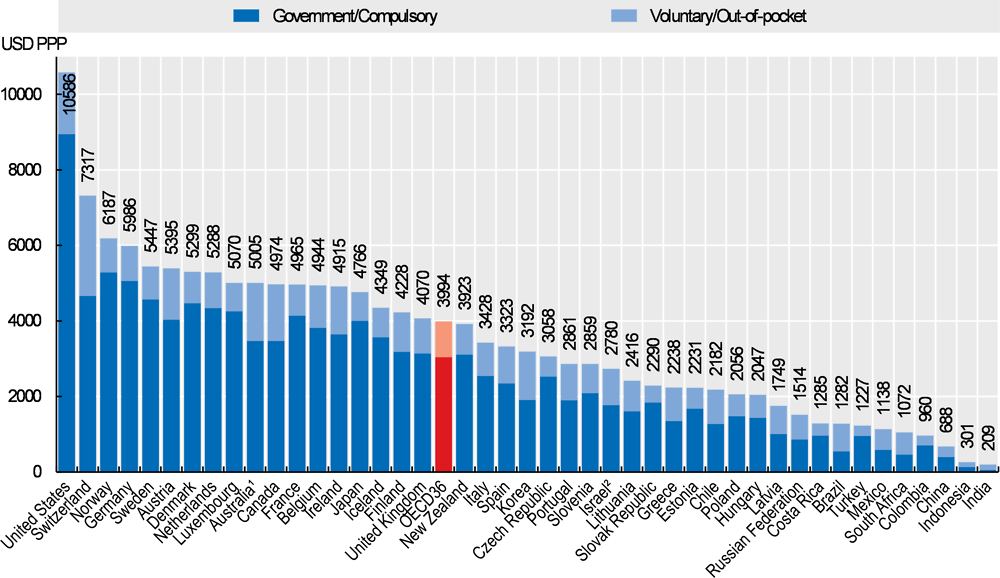
Here is a breakdown from OECD on Health expenditure per capita, 2018 (or nearest year).*Observe that the U.S. leads the way. George Shultz and Vidar Jorgensen write in the Wall Street Journal on Singapore's "Market-Based" Healthcare System:
Does a real health-care market exist anywhere in the world? It certainly doesn’t in the U.S., where health-care providers don’t tell patients in advance about pricing, outcomes or alternatives. Consumers don’t know what they’re buying or how much it costs. And the costs are largely paid by insurance companies, which don’t spend their own money. With a health-care market this dysfunctional, little wonder the U.S. spends 18% of gross domestic product on health.If the U.S. wants lower costs, better outcomes, faster innovation and universal access, it should look to the country that has the closest thing to a functioning health-care market: Singapore. The city-state spends only 5% of GDP on medical care but has considerably better health outcomes than the U.S.…What does Singapore do that’s so effective?…All health-care providers in Singapore must post their prices and outcomes so buyers can judge the cost and quality.…Singaporeans are required to fund HSAs through a system called MediSave and to purchase catastrophic health insurance. As a result, patients spend their own money on health care and get to pocket any savings.…The combination of transparency and financial incentives has led to price and quality competition so intense that health-care costs are 75% lower in Singapore than in the U.S.…Singapore’s system of health-care finance shouldn’t seem foreign to Americans, nor should we doubt that it could work here. The U.S. has already seen that the combination of competition and price transparency can be successful: Witness the falling prices for Lasik and cosmetic surgery, which aren’t covered by insurance. ("A Real Market in Medical Care? Singapore Shows the Way", WSJ, June 15, 2020)
*Source: OECD Health Statistics 2019, WHO Global Health Expenditure Database. Note: Expenditure excludes investments unless otherwise stated. 1. Australia expenditure estimates exclude all expenditure for residential aged care facilities in welfare (social) services. 2. Includes investments.


 In addition, the Canadian founder of the Proud Boys founder is married to an American Indian (Native American) and has 3 kids with her: