Victoria's odyssey began when she was 17, fresh out of school in Chisinau, the decayed capital of the former Soviet republic of Moldova. "There was no work, no money," she explained simply. So when a friend--"at least I thought he was a friend"--suggested he could help her get a job in a factory in Turkey, she jumped at the idea and took up his offer to drive her there, through Romania. "But when I realized we had driven west, to the border with Serbia, I knew something was wrong."
It was too late. At the border she was handed over to a group of Serb men, who produced a new passport saying she was 18. They led her on foot into Serbia and raped her, telling her that she would be killed if she resisted. Then they sent her under guard to Bosnia, the Balkan republic being rebuilt under a torrent of international aid after its years of genocidal civil war.
Victoria was now a piece of property and, as such, was bought and sold by different brothel owners ten times over the next two years for an average price of $1,500. Finally, four months pregnant and fearful of a forced abortion, she escaped. I found her hiding in the Bosnian city of Mostar, sheltered by a group of Bosnian women.
In a soft monotone she recited the names of clubs and bars in various towns where she had to dance seminaked, look cheerful, and have sex with any customer who wanted her for the price of a few packs of cigarettes. "The clubs were all awful, although the Artemdia, in Banja Luka, was the worst--all the customers were cops," she recalled.
Victoria was a debt slave. Payment for her services went straight to her owner of the moment to cover her "debt"--the amount he had paid to buy her from her previous owner. She was held in servitude unless or until the money she owed to whomever controlled her had been recovered, at which point she would be sold again and would begin to work off the purchase price paid by her new owner. Although slavery in its traditional form survives in many parts of the world, debt slavery of this kind, with variations, is the most common form of servitude today.
The US State Dept also has online their 2003 Trafficking in Persons Report, where fifteen countries ranked as the worst offenders, who could face the possibility of sanctions from the US government. Also worth reading is Hopes Betrayed: Trafficking of women and girls to post-conflict Bosnia and Herzegovina for forced prostitution.
Oct 23, 2003 | Dollars & Crosses
From Cox and Forkum:
AP reports today: Iran Turns Over Nuclear Documents to U.N.
Iran on Thursday turned over to the U.N. nuclear agency documents on its past atomic energy activities, but the dossier apparently did not include the origin of traces of weapons-grade uranium found in the country.
Oct 23, 2003 | Dollars & Crosses
Pregnant North Korean refugees repatriated after being rounded up in China have their babies forcibly aborted or killed after birth, according to a report that adds more horror to what is known of the Stalinist state's gulags. Evidence from a number of women who have escaped from the prison camps of the North Korean dictator, Kim Jong-il, reveals a pattern of infanticide, principally due to concern that babies conceived outside the country might not be "ethnically pure".More gruesome details at the UK Telegraph
Oct 23, 2003 | Dollars & Crosses
There are two big types of errors people make.One error is the assumption that you can and should know everything. For example, you discover a better way of doing something. "Why didn't I know this before?" You get down on yourself and on life for not knowing everything ahead of time.
The other error is the assumption that you can't know anything. "What do I know? Who am I to judge?" This kind of error not only undercuts self-respect and self-esteem; it also acts as kind of an excuse for not having to think and take responsibility for yourself.
You can't know everything all the time. Yet it doesn't follow from this that you can't know anything.
Oct 22, 2003 | Dollars & Crosses
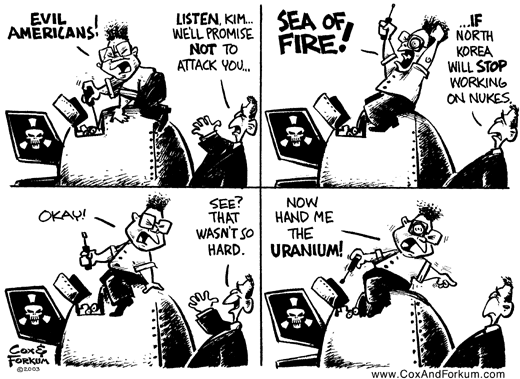
From Cox and Forkum:
Reuters reports: North Korea Says U.S. Security Offer Laughable.
Oct 22, 2003 | Dollars & Crosses
From the NY Sun:The problem is cultural, and that cannot be fixed overnight....Put simply, there are things the CIA does not want to know, and it acts to ensure that it will not know them. Of these important things, the most important is Iran. For 25 years now, we have had bad intelligence on Iran....
[I]n the last few years, the CIA has repeatedly missed the vital Iranian role at the heart of the terror network, typically chanting the false mantra that "Sunnis and Shi'ites don't work together." That nonsense prevented them from seeing that, as the Washington Post wrote on Wednesday... Iran was in cahoots with Al Qaeda.
...The CIA does not seem to have accepted this intimate relationship. If they did, it would be impossible for the State Department to believe, as it clearly does, that we can enlist Iran in the war against terrorism, or that Iran would ever deliver to us top Al Qaeda leaders.
Yet that information was not hard to obtain. Much of it was on the public record, including official court transcripts from Germany and Italy. Other pieces came from European intelligence services, with whom the CIA's relationship is surely better than mine or the Washington Post's. Over the past two years, the CIA has repeatedly refused to take seriously information about Iran's financing of international terrorism, Iran's close working relationship (often brokered by the royal family of Dubai) with Saddam Hussein, and, as the Associated Press has just reported, the claim that there is a cache of enriched uranium in Iraq, a portion of which was transported to Iran several years ago...
Oct 22, 2003 | Dollars & Crosses
From the UK Telegraph:For the second time in less than a year, Zimbabwe's justice minister has seized a farm after forcing its white owners to leave.
In February, Patrick Chinamasa, the minister of justice, legal and parliamentary affairs, sent the police to arrest Peter Baker, a white farmer. Mr Baker had refused to vacate his farm, Rocklands, after successfully challenging its seizure in court. He went into hiding for two months as police searched for him, although no charges were ever laid. Eight months after the seizure, the farm's water supply has been squandered, undermining its future productivity and that of the neighbouring farms.
This weekend, Richard and Cally Yates... fell victim to the justice minister. Although there were no legal grounds for Mr Chinamasa to seize the farm, Mr Yates was powerless to resist, having been told by the police that if the minister wanted it, the couple must leave. In July last year, Mr Yates had accepted a government offer to subdivide his farm between himself and state-appointed "settlers", in return for being able to continue operating. He believed that having made this compromise his future as a farmer in Zimbabwe was secure. But three months ago he was told that his farm had been allocated to Mr Chinamasa.
The minister claims that he has been justly allocated the farm by the state under the land reform programme.... He added: "The courts should rule only on matters of compensation and not on the process of acquisition."
Oct 21, 2003 | Dollars & Crosses
Sol Stern in the New York Sun on Oct 21:This September's re-education sessions for teachers drove home the party line relentlessly: Your students must not be sitting in rows. You must not stand at the head of the class. You must not do "chalk and talk" at the blackboard. You must have a "workshop" in every single reading period. Your students must be "active learners," and they must work in groups. As one circular distributed to principals put it: Your teachers must transform themselves from the "sage on the stage" to the "guide on the side."
Stern has a longer article on the subject in City Journal.
Oct 21, 2003 | Dollars & Crosses
From the UK Telegraph:For the first time in their history, [Paris] tobacconists were on strike, in protest against a 20 per cent rise in taxes on cigarettes. Their action, copied throughout the country, sent shivers through the government... Plastered to the shuttered kiosks of Paris were signs berating the government for its hypocrisy and calling on smokers, and all those who care for personal liberty, to support them.... In its editorial yesterday Le Monde warned the government not to let its obligation to public health lead it to become too nannyish. "Smoking is a right," the newspaper said. If the government seemed to be making smoking socially unacceptable or even somehow illegal, it would be crossing a dangerous line.