Jan 28, 2004 | Dollars & Crosses
From Cox and Forkum:
ABC News reported Monday: Forget the South?.Sen. John Kerry, D-Mass., is discounting notions that any Democratic candidate would have to appeal to Southern voters in order to win the presidency, calling such thinking a "mistake" during a speech at Dartmouth College. [...]
"Everybody always makes the mistake of looking South," Kerry said, in response to a question about winning the region. "Al Gore proved he could have been president of the United States without winning one Southern state, including his own."
As Glenn Reynolds noted: "Um, no. Al Gore proved that he couldn't win the United States without carrying one Southern state, including his own."
The ABC News article concludes with a brief history of Democratic candidates and Southern states:Whether or not Democrats should cede the South for the November 2004 election and focus resources elsewhere has been fiercely debated privately in many Democratic circles. History is not on the side of those who would argue in favor of doing so.
The last three Democratic presidents -- Bill Clinton from Arkansas, Jimmy Carter from Georgia, and Lyndon Johnson from Texas -- were from the South. The last four Democratic presidential nominees to not win one Southern state -- Sen. George McGovern in 1972; former Vice President Walter Mondale in 1984; Gov. Mike Dukakis in 1988; and Gore in 2000 -- lost. Former Vice President Hubert Humphrey in 1968 and Carter in 1980 were able to win one Southern state apiece, though in the end they lost to Republicans nationwide. Of the victorious Democrats, Carter won 10 Southern states in 1976, and Clinton won four in both 1992 and 1996.
Jan 27, 2004 | Dollars & Crosses
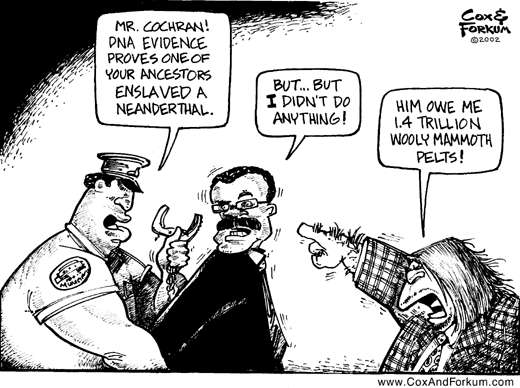
FoxNews reported this week Federal Judge Dismisses Slave Reparations Case:
A federal judge on Monday dismissed a lawsuit brought by descendants of slaves against corporations they say profited from slavery, saying the plaintiffs had established no clear link to the companies they targeted.
Comments Edwin A. Locke of the Ayn Rand Institute:
A Chicago federal judge was right to dismiss a lawsuit brought by descendants of slaves against corporations that profited from slavery in the 19th century, but the decision did not go far enough. The judge left the door open for further litigation, by implying that it might be legitimate if the plaintiffs could show actual links to the companies in question. No such door should have been left open, because such lawsuits are without merit in principle.
Slavery was abolished in the United States nearly 140 years ago. Those who were slaves are long dead. If claims could be made by anyone who had long-dead relatives who were harmed by someone, then everyone in the entire world could claim compensation for such victimization. But people who were not themselves the object of harm have no right to make any such claim.
And who would be responsible for such unjust compensatory payments?
People who are now living who had no role in causing the harm. If people who were not themselves harmed can force people who were not responsible for any harm to pay them "compensation" for the suffering endured by others, then the result is not justice but a double injustice.
From Cox and Forkum:
Jan 26, 2004 | Dollars & Crosses
The lead editorial in the Jan. 26 New York Sun recounts some stories from Lydia Segal's book Battling Corruption in America's Public Schools:
[There's] the custodian who used his school basement to raise chickens for cockfighting, telling inspectors that the hundreds of labeled eggs he was incubating there were to feed students. Another custodian "let his boiler operator store his gun collection near the lunchroom and live in the basement, where he slept, entertained women, and kept a dog," the book says.
The harshest portraits come from transcripts of undercover investigations of community school board members. "I'm a political leader, that's why I'm here.... I make sure my people get [expletive] jobs," one said. Another laughingly admitted, "I've never heard the word 'children' or 'education' enter into our discussions in the last few years... with anybody." Another board member recounted, "If we recommend somebody," the district had to hire that person so long as "they're not illiterate or deformed or something the matter with them."
Jan 26, 2004 | Dollars & Crosses
Most Iranian ministers and vice presidents have submitted resignations in protest of "reformist" candidates being barred from upcoming elections. But at least some Iranians are not expecting the officials to follow through.
Pakistan is beginning to detain nuclear scientists suspected of selling its nuclear secrets to countries such as Iran and Libya.
French journalist Michel Gurfinkiel writes an extensive report on just how bad antisemitism has become in France.
Conservatives feel uncomfortable fighting to uphold self-interest, so they are always looking for ways to cast their policies as altruistic. The latest is their realization that environmentalism harms the Third World (which it does) and their resulting crusade against "eco-imperialism."
Amity Shlaes recounts the history of the Gramm-Rudman-Hollings Balanced Budget Act of 1985--"a sort of crude chastity belt for Congress"--and why today's Democrats are waving its banner.Jan 25, 2004 | Dollars & Crosses
From the AP:
Secretary of State Colin Powell held out the possibility Saturday that prewar Iraq may not have possessed weapons of mass destruction. Powell was asked about comments last week by David Kay, the outgoing leader of a U.S. weapons search team in Iraq, that he did not believe Iraq had large quantities of chemical or biological weapons. "The answer to that question is, we don't know yet," Powell told reporters... "We had questions that needed to be answered. "What was it?" he asked. "One hundred tons, 500 tons or zero tons? Was it so many liters of anthrax, 10 times that amount or nothing?"
But the article also says:
The Sunday Telegraph in London reported that Kay said elements of Saddam's weapons program were sent to Syria. "We are not talking about a large stockpile of weapons but we know from some of the interrogations of former Iraqi officials that a lot of material went to Syria before the war, including some components of Saddam's WMD (weapons of mass destruction) program," the paper quoted Kay as saying. "Precisely what went to Syria, and what has happened to it, is a major issue that needs to be resolved." Kay told reporters in Washington in October that "senior Iraqi officials, both military and scientific," had moved to Jordan and Syria, "both pre-conflict and some during the conflict, and some immediately after the conflict."
Jan 25, 2004 | Dollars & Crosses
Hundreds of religious hard-liners rallied Sunday in support of Pakistani nuclear scientists, hailing them as "national heroes" and denouncing their detentions over allegations they profited from selling nuclear technology to Iran. [Yahoo News]