Feb 2, 2004 | Dollars & Crosses
Colin Powell had an op-ed published in Russian newspaper Izvestia:
While he praised the two countries' cooperation on issues ranging from the war on terror to the fight against AIDS, Mr. Powell also warned that the U.S.-Russia relationship "will not achieve its potential" unless the two countries share "basic principles. ..." "Russia's democratic system seems not yet to have found the essential balance among the executive, legislative, and judicial branches of government. Political power is not yet fully tethered to law," Mr. Powell wrote. "Key aspects of civil society--free media and political party development, for example--have not yet sustained an independent presence."
Just in case you were worried:
"As far as I was concerned, it wasn't in any way an attempt on my part to interfere in the internal dynamic of Russian political life," he told reporters. "It was in the spirit of friendship that I discussed all these issues. ..." Mr. Powell made no mention of concrete consequences for Russia's actions, and political analysts said it was unlikely the Bush administration would take matters that far.
Feb 2, 2004 | Dollars & Crosses
From NY Sun:
Mary Robinson, an architect of the U.N. Durban human rights conference in 2001 that was boycotted by Secretary of State Powell because the Bush administration deemed it too hostile to Israel, has been hired as a professor by Columbia University. [January 29, 2004]
Feb 1, 2004 | Dollars & Crosses
From Cox and Forkum:
This cartoon was created the day of the Columbia Shuttle disaster. Last year, Capitalism Magazine posted two op-eds about Columbia. The Spirit of the Space Shuttle Columbia: The Essence of the American Soul by Robert Garmong.The ground of east Texas trembled with the horror overhead. The shock waves spread as the worst fears were confirmed: space shuttle Columbia had turned from a high-precision machine into a lifeless meteor, its crew lost. Americans were hit with a degree of shock not equaled since September 11. [...] Only something that struck uniquely close to the American soul could have caused the degree of shock and horror with which we have responded to the Columbia disaster.
And Hail Columbia by Nicholas Provenzo.Those of us who remember the loss of the Challenger and the Apollo fire before then, are reminded that great leaps often entail great risks. Yet we should be loath to say that the heroes of Columbia died for space flight. They lived for it, and that included the real risk that they might die. They turned space into a new frontier; a frontier that speaks to our every potential as a species.
Jan 30, 2004 | Dollars & Crosses
From Cox and Forkum:
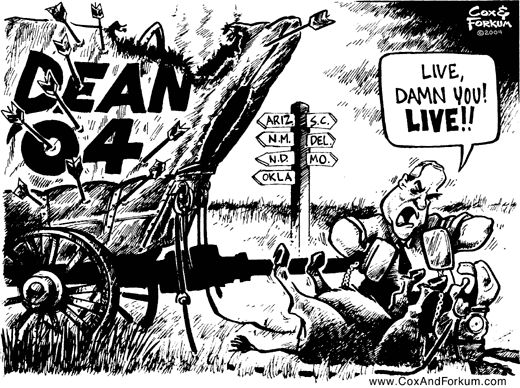
Fox News reported yesterday: Dean Machine Tries to Work Out Kinks.Howard Dean needs to win at least one primary in the next two weeks to keep from becoming political toast, political experts said Thursday. The former Vermont governor is trying to get his floundering campaign back on track after twin losses in Iowa and New Hampshire -- races he was expected to win handily only a few weeks ago. [...]
Dean named longtime Al Gore associate Roy Neel as his new campaign CEO on Wednesday and veteran campaign manager Joe Trippi resigned.
Capitalism Magazine features a good Larry Elder op-ed (along with a collection of our Dean cartoons): When Did The Howard Dean Meltdown Really Begin?Only a little over one month ago, national polls gave Dean a commanding 20 percentage-point lead over his closest Democratic rival, yet he staggered to a third-place finish in Iowa. Talk about a meltdown. If Dean continues to under-perform, his campaign ends, and the blame game begins. Expect his supporters to say the overreaction of the media and the pundits to Dean's, uh, rallying cry, brought him down.
Really? Maybe it began when Dean, on National Public Radio, mentioned a "theory" that President George W. Bush possessed prior knowledge of 9/11, yet took no steps to halt it. Two days later, he said that no, he didn't believe the theory. And a couple of days later, he called the theory "crazy."
Or maybe the meltdown began when Dean called himself an anti-war candidate, yet supported a resolution called Biden-Lugar, which authorized military action in Iraq without the need for the president to seek another resolution. Or maybe...
Jan 29, 2004 | Dollars & Crosses
From David Holcberg of the Ayn Rand Institute:
President Bush is wrong in proposing to increase the budget of the National Endowment for the Arts. Why?
Because art is a form of expressing ideas, and using taxpayers' money to promote ideas they may disagree with is immoral and violates their rights. Such misuse of taxpayers' money is a violation--not a promotion--of freedom of speech. As Thomas Jefferson explained, "To compel a man to furnish contributions of money for the propagation of opinions which he disbelieves and abhors, is sinful and tyrannical."
The Bush administration should stop demonstrating its "commitment to the arts" and focus instead on protecting individual rights. Getting rid of the National Endowment for the Arts would be a small step in the right direction.
Jan 28, 2004 | Dollars & Crosses
From the New York Sun:
One questioner in a college auditorium in Keene, who identified himself as a war veteran, told Mr.Kerry that he was "horrified" that the senator supported the war, and questioned how he could be "conned by the administration. ..."
"I believe I voted correctly to protect the security of our nation," responded Mr.Kerry, who then criticized the Clinton administration for failing to act against the former dictator sooner.
...Mr. Kerry said that in 1998, he and two Republicans, Senator McCain of Arizona and Senator Hagel of Nebraska, suggested to President Clinton, "that he should have gone to the U.N. That he should have had the capacity to have the threat, the force, to get inspectors back in there to make Saddam Hussein to live up to the only thing that had left him in power--his obligation to disarm. "So, George Bush brings a legitimate security issue before the Congress in 2002. Am I supposed to turn away and ignore what I said in 1998, what I thought Clinton should have done? Do we ignore the fact that the last time we had inspectors there we had weapons that had not yet been destroyed? And our intelligence is telling us there are weapons?" he asked the audience.
Just in case you were worried:
Mr. Kerry then made his standard stump speech statement that he voted not in favor of a war, but in favor of a "process promised by the president." He said Mr. Bush should have taken more time to allow inspectors to search for weapons in Iraq, and should have built a broader international coalition through the U.N.