Aug 6, 2013 | Politics, Sci-Tech
From Richmond Times-Dispatch: Central Virginia:
Gun-related violent crime in Virginia has dropped steadily over the past six years as the sale of firearms has soared to a new record, according to an analysis of state crime data with state records of gun sales. The total number of firearms purchased in Virginia increased 73 percent from 2006 to 2011. When state population increases are factored in, gun purchases per 100,000 Virginians rose 63 percent. But the total number of gun-related violent crimes fell 24 percent over that period, and when adjusted for population, gun-related offenses dropped more than 27 percent, from 79 crimes per 100,000 in 2006 to 57 crimes in 2011.The numbers appear to contradict a long-running popular narrative that more guns cause more violent crime, said Virginia Commonwealth University professor Thomas R. Baker, who compared Virginia crime data for those years with gun-dealer sales estimates obtained by the Richmond Times-Dispatch.
[...] "My opponents are constantly saying, 'If you got more guns on the street, there's going to be more crime.' It all depends on who has the handgun," Van Cleave said. "As long as it's going into the hands of people like you or me, there's not going to be a problem. Criminals are going to continue to get their guns no matter what."[...]"From my personal point of view, I would say the data is pretty overwhelming," said Baker, who is new to VCU and studied under Florida State University professors Gary Kleck and Marc Gertz, whose nationally recognized research on guns and homicides in the District of Columbia was cited in a landmark U.S. Supreme Court decision in 2008 that overturned the district's handgun ban. "But we're pretty cautious in the social sciences in talking about causality. We only talk in probabilities."The multiple years of data for gun purchases and gun-related crime help strengthen the premise that more gun sales are not leading to an increase in crime. Using what Baker calls the "lag model," the data show that an increase in gun purchases for one year usually is followed by a decrease in crime the next year.
[...] Gun-control lobbyist Goddard, whose son was wounded during the Virginia Tech massacre five years ago, doesn't dispute the numbers but questioned their significance."It's quite possible that you can sell a whole lot more guns and crime is still going down," Goddard said. "But is the crime going down because more people are buying guns, or is the crime going down because the crime is going down?" [Gun-related violent crimes drop as sales soar in Va. -]
So is he saying that guns don't cause crime, but criminals do?
Aug 4, 2013 | Business, Politics, Sci-Tech
Lawrence Livermore National Lab (LLNL) has published flow charts (also referred to as “Sankey Diagrams”) of energy use. This allows energy to be "visualized as it flows from resources (Coal, Oil, Natural Gas, etc.), through transformations (electricity generation) to end uses (Residential, Commercial, Industrial, Transportation)." Walter Hickey over at Business Insider makes a few poignant observations:
- Renewables — Hydro, geothermal, wind and solar — are still absurdly tiny in the grand scheme of things, despite significant investment and recent growth.
- The amount of rejected energy — that's energy lost in transportation — should make every American wince. It's just shocking how much energy is lost due to grid inefficiencies, heat waste, and exhaust.
- Petroleum runs cars and industry, but nowhere near as much electrical generation as one might expect.
- Natural Gas use has grown, driven almost entirely by use in electrical generation. Coal use has demonstrably shrunk.
- Nuclear power declined since 2011, which is disappointing due to how inexpensive it is.
Also of interest are "Carbon Flows":
Jun 14, 2013 | Sci-Tech
A passionate post by climatologist Dr. Robert Spencer:
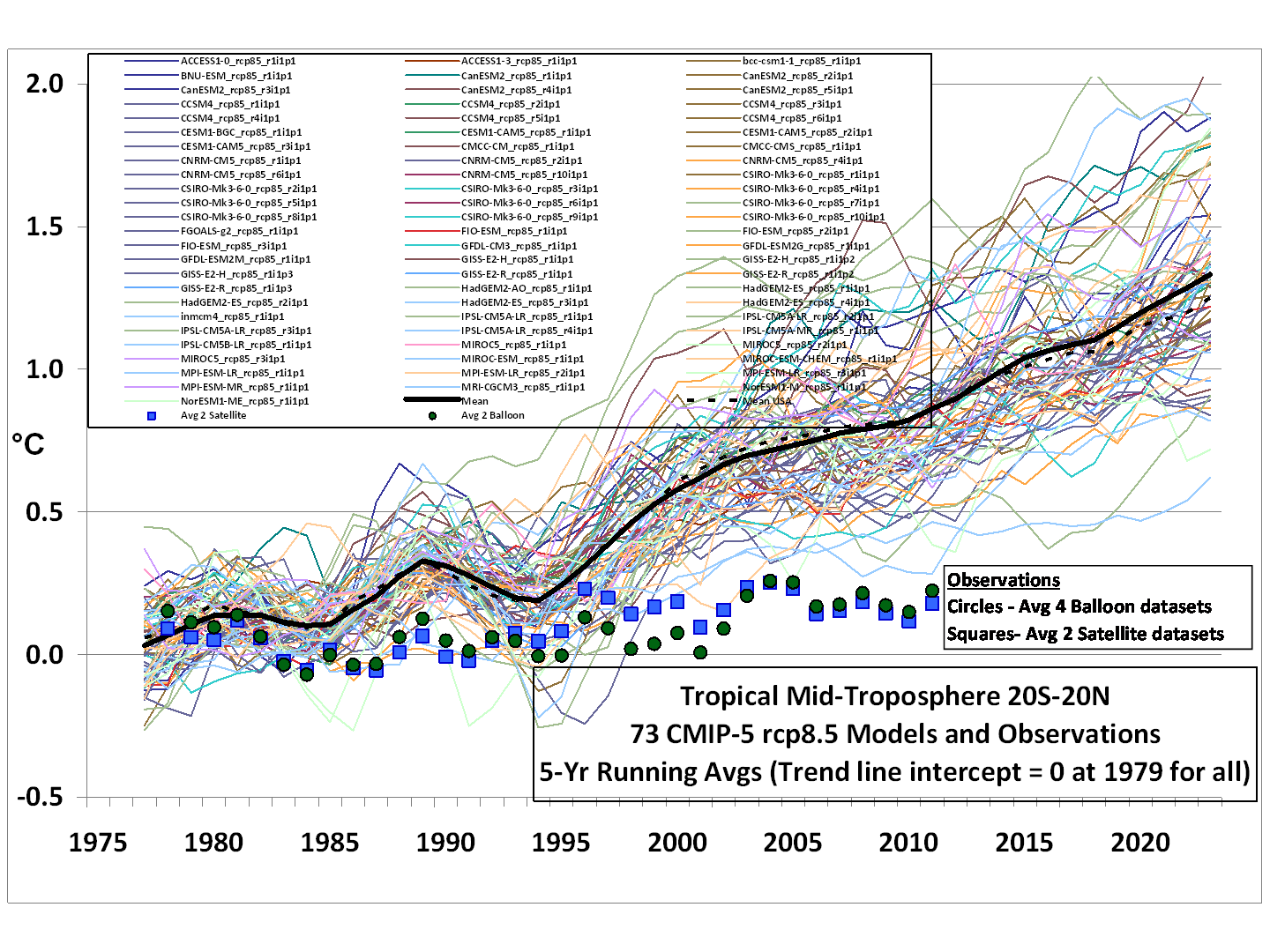
In response to those who complained in my recent post that linear trends are not a good way to compare the models to observations (even though the modelers have claimed that it’s the long-term behavior of the models we should focus on, not individual years), here are running 5-year averages for the tropical tropospheric temperature, models versus observations (click for full size):
 In this case, the models and observations have been plotted so that their respective 1979-2012 trend lines all intersect in 1979, which we believe is the most meaningful way to simultaneously plot the models’ results for comparison to the observations.In my opinion, the day of reckoning has arrived. The modellers and the IPCC have willingly ignored the evidence for low climate sensitivity for many years, despite the fact that some of us have shown that simply confusing cause and effect when examining cloud and temperature variations can totally mislead you on cloud feedbacks (e.g. Spencer & Braswell, 2010). The discrepancy between models and observations is not a new issue…just one that is becoming more glaring over time.It will be interesting to see how all of this plays out in the coming years. I frankly don’t see how the IPCC can keep claiming that the models are “not inconsistent with” the observations. Any sane person can see otherwise.If the observations in the above graph were on the UPPER (warm) side of the models, do you really believe the modelers would not be falling all over themselves to see how much additional surface warming they could get their models to produce?Hundreds of millions of dollars that have gone into the expensive climate modelling enterprise has all but destroyed governmental funding of research into natural sources of climate change. For years the modelers have maintained that there is no such thing as natural climate change…yet they now, ironically, have to invoke natural climate forces to explain why surface warming has essentially stopped in the last 15 years!Forgive me if I sound frustrated, but we scientists who still believe that climate change can also be naturally forced have been virtually cut out of funding and publication by the ‘humans-cause-everything-bad-that-happens’ juggernaut. The public who funds their work will not stand for their willful blindness much longer. [STILL Epic Fail: 73 Climate Models vs. Measurements, Running 5-Year Means « Roy Spencer, PhD]
Robert Spencer is a true hero.
Jan 30, 2013 | Politics, Sci-Tech
From Climate shocker: Carry on as we are until 2050, planet will be FINE • The Register
New research produced by a Norwegian government project, described as "truly sensational" by independent experts, indicates that humanity's carbon emissions produce far less global warming than had been thought: so much so that there is no danger of producing warming beyond the IPCC upper safe limit of 2°C for many decades.“In our project we have worked on finding out the overall effect of all known feedback mechanisms,” says project manager Terje Berntsen, who is a professor at the University of Oslo’s Department of Geosciences and a senior research fellow at the Center for International Climate and Environmental Research – Oslo (CICERO).
“We used a method that enables us to view the entire earth as one giant ‘laboratory’ where humankind has been conducting a collective experiment through our emissions of greenhouse gases and particulates, deforestation, and other activities that affect climate.”
Berntsen and his colleagues' results derive in large part from taking account of the way that global temperatures have remained flat for the last fourteen years or thereabouts, instead of climbing as they ought to have done with increased carbon levels.“The Earth’s mean temperature rose sharply during the 1990s. This may have caused us to overestimate climate sensitivity," explains the prof.“We are most likely witnessing natural fluctuations in the climate system – changes that can occur over several decades – and which are coming on top of a long-term warming."At the moment levels of CO2 stand at around 395 parts per million (ppm), climbing at around 2 ppm each year and accelerating. In pre-industrial times the levels is reckoned to have been 280 ppm. Depending on various factors, the amount of atmospheric CO2 might have doubled to 560-odd ppm around the year 2050.According to the Intergovernmental Panel on Climate Change, that would be disastrous as it would probably mean 3°C warming or more: and the IPCC considers that anything above 2°C means terrible consequences for humanity. Thus the organisation has long sought to limit atmospheric CO2 at 450 ppm, though this is regarded as a lost cause by many.But Berntsen and his crew say that analysis is much too pessimistic. They consider that the likeliest result from doubled carbon (which would actually occur some decades after the doubled level was reached) would be just 1.9°C - within the IPCC target. According to the Research Council of Norway, the government arm which funded the new research:
When [the] researchers instead calculate a probability interval of what will occur, including observations and data up to 2010, they determine with 90% probability that global warming from a doubling of CO2 concentration would lie between 1.2°C and 2.9°C.This maximum of 2.9°C global warming is substantially lower than many previous calculations have estimated. Thus, when the researchers factor in the observations of temperature trends from 2000 to 2010, they significantly reduce the probability of our experiencing the most dramatic climate change forecast up to now.
Other recent research has suggested warming of this sort with doubled CO2, but so far the IPCC and the warmist-alarmist community generally has been reluctant to accept the new findings. However the state of the accepted science is beginning to change, with Britain's Met Office lately revising its forecasts of warming sharply downwards.Renowned Swedish climate boffin Caroline Leck, who was not involved in the research, commented:“These results are truly sensational. If confirmed by other studies, this could have far-reaching impacts on efforts to achieve the political targets for climate.”The Research Council's announcement of the new results can be read here.
To quote Harry Binswanger "While President Obama is calling for more tilting at windmills, pun intended, the news on the climate front continues to go against him."

 Walter Hickey over at