Jan 5, 2014 | Sci-Tech
John McLean, author of three peer-reviewed papers on climate and an expert reviewer for the latest IPCC report elaborates on how a Lack of accountability clouding the climate change debate.He explains how the "world's so-called authority on climate change engages in exaggerated science and has become a political tool."
The [Intergovernmental Panel on Climate Change's] charter from the outset has been ''to assess on a comprehensive, objective, open and transparent basis the scientific, technical and socio-economic information relevant to understanding the scientific basis of risk of human-induced climate change, its potential impacts and options for adaptation and mitigation''.The IPCC's focus is therefore very specific - any human influence on climate. It has no mandate to examine other causes of climate change. IPCC assessment reports claim that the human influence is significant but look closely and we find the claims are based on the output of climate models that the IPCC admits are seriously flawed, that the IPCC often asserts a level of certainty that the data cannot sustain and that as ''Climategate'' showed us, a clique of scientists has in the past sought to control the material cited by these reports.What starts out being a scientific report becomes a political instrument because after a hard-core group of IPCC supporters draft the Summary for Policymakers, government representatives discuss, negotiate and eventually agree on the wording of each sentence. The scientific component of the report is then modified to better align it with the thinking of government representatives.If the IPCC reports were accepted for exactly what they are - exaggerated science with a large dollop of politics - this would be the end of the matter. Unfortunately, various bodies actively encourage us to believe the reports are entirely scientific, accurate and completely authoritative on all climate matters, this despite the IPCC's charter and the political interference.Foremost among those who imply that the IPCC has a wider remit than it does is the United Nations Framework Convention on Climate Change (UNFCCC). At its inaugural meeting in 1992 the UNFCCC declared that anthropogenic emissions of CO2 were causing significant and dangerous climate change. This statement had no factual basis. [...]The UNFCCC's deceit continues via its annual conferences that try to pressure countries into reducing carbon dioxide emissions despite the absence of any clear evidence that warrants such action.
He then goes on how various government bodies (i.e., Department of Climate Change the now-privatised Climate Commission), environmental "green" organisations (Greenpeace and WWF), sustainable energy industry, and scientists (whose "income and reputation rest on the IPCC's position") have vested interests to endorse and "push the IPCC view, implying it's the ultimate authority on climate matters."
The reality is that the IPCC is in effect little more than a UN-sponsored lobby group, created specifically to investigate and push the ''man-made warming'' line. With no similar organisations to examine other potential causes of climate change, it's only the IPCC voice that is heard. But the IPCC's voice isn't heard in context and with all the necessary caveats; it's distorted via the UNFCCC and others who imply that the IPCC is the sole scientific authority on climate matters.Of course those with vested interest support it, which include governments, politicians, government bodies, ''green'' groups and many scientists. Ultimately it's the unquestioning media, or perhaps a media unwilling to admit that the UN and its agencies might be dishonest or wrong, that misleads the public into believing the IPCC is something it's not.
Read the full article: http://www.brisbanetimes.com.au/comment/lack-of-accountability-clouding-the-climate-change-debate-20140102-307ja.html#ixzz2pZDoQ0f5
Oct 15, 2013 | Sci-Tech
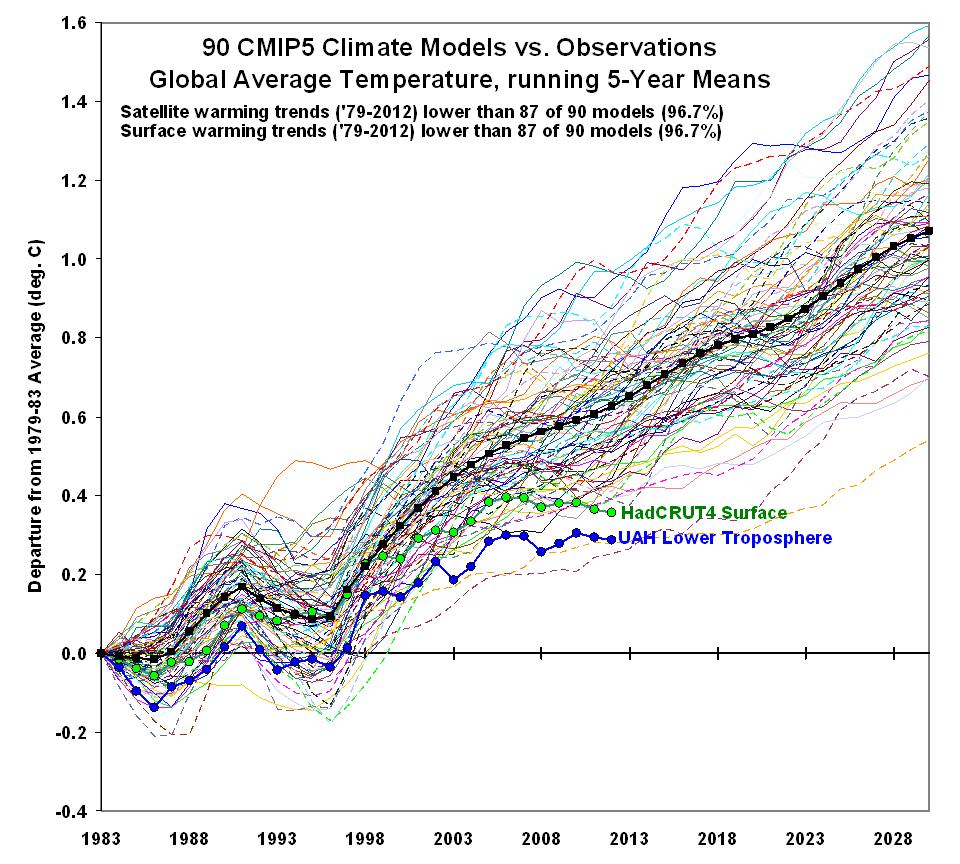
Maybe That IPCC 95% Certainty Was Correct After All « Roy Spencer, PhD
As seen in the following graphic, over the period of the satellite record (1979-2012), both the surface and satellite observations produce linear temperature trends which are below 87 of the 90 climate models used in the comparison.

Sep 16, 2013 | Politics, Sci-Tech
Another one from Alex Epstein in Forbes:
I explicitly acknowledged the phenomenon of global warming. And if you read the work of the rest of the “deniers,” you’ll find that most if not all of them do, too.The real point of contention is not whether there is some global warming and whether human beings have some climate impact, but a) whether warming is a problem and b) whether fossil fuel energy should be restricted. My answers are a) “No” and b) “No!” As I explained in the column Rolling Stone cited (but may not have read):
Our cultural discussion on “climate change” fixates on whether or not fossil fuels impact the climate. Of course they do—everything does—but the question that matters is whether it is becoming safer or more dangerous. Here, the data is unambiguous—in the last 80 years, as fossil fuels have increased the concentration of CO2 in the atmosphere from .03% to all of .04%, we have become 50 times less likely to die because of climate-related causes. Give thanks to the proliferation of climate-protection technology (climate control, sturdy homes, weather satellites, drought-relief convoys, modern agriculture), which are made possible by fossil fuels.
And, as I also explained in the column, Rolling Stone cited, not only do fossil fuels make us safer from the climate, they dramatically improve human life across the board.
The average life expectancy of a human being without electricity–and there are 1.4 billion in this category–is 48 years old. In the last 30 years, thanks to a tripling or more of electricity production in countries throughout the developing world, mostly using coal, over 2.5 billion people have added 6 years to their life expectancy. Think about someone you love that you lost early, and think about what 6 more years would mean. Now multiply that by 2.5 billion people.Around the world, hundreds of millions of individuals have gotten their first light-bulb, their first refrigerator, their first year with clean drinking water or a full stomach, their first decent-paying job thanks to coal-based electricity. Without coal, none of that would have been possible. In the US, 30 years ago the average household had 3 electronic devices—today it has 25, overwhelmingly thanks to fossil fuels.
If Rolling Stone has a counter-argument to the economic and environmental case for fossil fuels, let it make it. But to pretend that case doesn’t exist, to pretend that its advocates deny basic scientific facts, is dishonest.
Read the rest of Rolling Stone Attacks Global Warming 'Deniers' As Anti-Science, Then Commits Big Scientific Blunder.
Aug 8, 2013 | Philosophy, Politics, Sci-Tech
Best-selling philosopher Ayn Rand on racism:
Racism is the lowest, most crudely primitive form of collectivism. It is the notion of ascribing moral, social or political significance to a man’s genetic lineage—the notion that a man’s intellectual and characterological traits are produced and transmitted by his internal body chemistry. Which means, in practice, that a man is to be judged, not by his own character and actions, but by the characters and actions of a collective of ancestors.Racism claims that the content of a man’s mind (not his cognitive apparatus, but its content) is inherited; that a man’s convictions, values and character are determined before he is born, by physical factors beyond his control. This is the caveman’s version of the doctrine of innate ideas—or of inherited knowledge—which has been thoroughly refuted by philosophy and science. Racism is a doctrine of, by and for brutes. It is a barnyard or stock-farm version of collectivism, appropriate to a mentality that differentiates between various breeds of animals, but not between animals and men.Like every form of determinism, racism invalidates the specific attribute which distinguishes man from all other living species: his rational faculty. Racism negates two aspects of man’s life: reason and choice, or mind and morality, replacing them with chemical predestination. [“Racism,” The Virtue of Selfishness, 126]
Aug 6, 2013 | Politics, Sci-Tech
From Richmond Times-Dispatch: Central Virginia:
Gun-related violent crime in Virginia has dropped steadily over the past six years as the sale of firearms has soared to a new record, according to an analysis of state crime data with state records of gun sales. The total number of firearms purchased in Virginia increased 73 percent from 2006 to 2011. When state population increases are factored in, gun purchases per 100,000 Virginians rose 63 percent. But the total number of gun-related violent crimes fell 24 percent over that period, and when adjusted for population, gun-related offenses dropped more than 27 percent, from 79 crimes per 100,000 in 2006 to 57 crimes in 2011.The numbers appear to contradict a long-running popular narrative that more guns cause more violent crime, said Virginia Commonwealth University professor Thomas R. Baker, who compared Virginia crime data for those years with gun-dealer sales estimates obtained by the Richmond Times-Dispatch.
[...] "My opponents are constantly saying, 'If you got more guns on the street, there's going to be more crime.' It all depends on who has the handgun," Van Cleave said. "As long as it's going into the hands of people like you or me, there's not going to be a problem. Criminals are going to continue to get their guns no matter what."[...]"From my personal point of view, I would say the data is pretty overwhelming," said Baker, who is new to VCU and studied under Florida State University professors Gary Kleck and Marc Gertz, whose nationally recognized research on guns and homicides in the District of Columbia was cited in a landmark U.S. Supreme Court decision in 2008 that overturned the district's handgun ban. "But we're pretty cautious in the social sciences in talking about causality. We only talk in probabilities."The multiple years of data for gun purchases and gun-related crime help strengthen the premise that more gun sales are not leading to an increase in crime. Using what Baker calls the "lag model," the data show that an increase in gun purchases for one year usually is followed by a decrease in crime the next year.
[...] Gun-control lobbyist Goddard, whose son was wounded during the Virginia Tech massacre five years ago, doesn't dispute the numbers but questioned their significance."It's quite possible that you can sell a whole lot more guns and crime is still going down," Goddard said. "But is the crime going down because more people are buying guns, or is the crime going down because the crime is going down?" [Gun-related violent crimes drop as sales soar in Va. -]
So is he saying that guns don't cause crime, but criminals do?
Aug 4, 2013 | Business, Politics, Sci-Tech
Lawrence Livermore National Lab (LLNL) has published flow charts (also referred to as “Sankey Diagrams”) of energy use. This allows energy to be "visualized as it flows from resources (Coal, Oil, Natural Gas, etc.), through transformations (electricity generation) to end uses (Residential, Commercial, Industrial, Transportation)." Walter Hickey over at Business Insider makes a few poignant observations:
- Renewables — Hydro, geothermal, wind and solar — are still absurdly tiny in the grand scheme of things, despite significant investment and recent growth.
- The amount of rejected energy — that's energy lost in transportation — should make every American wince. It's just shocking how much energy is lost due to grid inefficiencies, heat waste, and exhaust.
- Petroleum runs cars and industry, but nowhere near as much electrical generation as one might expect.
- Natural Gas use has grown, driven almost entirely by use in electrical generation. Coal use has demonstrably shrunk.
- Nuclear power declined since 2011, which is disappointing due to how inexpensive it is.
Also of interest are "Carbon Flows":

 Walter Hickey over at