
Mossoff: Patents are Not Monopoly Grants But Property Rights
The statement below is from Professor Adam Mossoff, whose law review articles (here and here) were heavily cited in Justice Gorsuch’s dissent (joined by Chief Justice Roberts) in today’s opinion in Oil States v. Greene’s Energy:For the first time, the Supreme Court holds that patents for new inventions are regulatory grants similar to monopoly grants for bridges or toll roads. The decision ignores the Supreme Court’s own substantial case law over the past two centuries that patents are private property rights that secure the fruits of productive labors under the Constitution—like all other property rights in homes, farms, and animals. Instead, the Court rules that the U.S. follows the original practice by English Kings and Queens who bestowed royal privileges on their subjects as “patent” grants, applying to U.S. patent owners the historical dictum that “what the government giveth, the government can taketh away.”As the dissenting Justices point out, this turns the Constitution and the U.S. patent system on their heads. It perverts the function of the constitutional protections afforded to the property rights of all U.S. citizens, an increasingly commonplace occurrence today under the growing and all-encompassing administrative state. It also undermines the foundation that patents provide to the U.S. innovation economy, as stable and effective property rights are the necessary platform from which inventors, venture capitalists, and companies create the new products and services that have made life a modern miracle. - Adam Mossoff, Professor of Law, Antonin Scalia Law School, George Mason University
John Allison: The 2008 Financial Crisis Was Caused By Regulatory Policy
From A Conversation With John Allison, the CEO Who Led BB&T Through the Financial Crisis:
The Fool: In your opinion, what caused the crisis?
Allison: I view the crisis differently than a lot of people. I was a long-serving CEO when the crisis struck and I think the whole thing was caused by regulatory policy.Yes, some big banks made mistakes. But it was a combination of government housing policy, Fannie Mae and Freddie Mac in particular, which had $5 trillion in liabilities and $2 trillion in subprime mortgages when they failed, and the Federal Reserve, which held interest rates below inflation, that contributed to the bubble in the housing market, along with bubbles in other markets.I don't believe the whole industry was failing. I think that's ridiculous. It was a relatively small number of large institutions that were in trouble. Banks like Citigroup. I think they should have been allowed to fail and the world would be a better place today.The whole idea that everybody would have gone broke if one of the big banks failed was absurd. We had been doing business with investment banks like Bear Stearns andGoldman Sachs, but we controlled our risk with those companies just like we did with any borrower. If they had gone broke, we would have lost money, but not nearly as much as we lost to residential builders in the marketplace.It was a relatively small number of large banks and a handful of small banks that were in trouble. It was not an industrywide crisis, except to the degree that the regulators created a crisis by choosing to fail Wachovia, save Citigroup, fail Lehman Brothers, save Bear Stearns. The uncertainty caused by that response took what was going to be a normal correction and transformed it into a crisis, making everything worse than it had to be. The Fool: How did regulators' response to the financial crisis differ from their responses in past crises that you witnessed?Allison: I went through the financial correction in the early 1980s, which should have been more severe because we were in bad trouble economically after the inflation of the 1970s. I also went through the correction in the early 1990s. In neither case did we have a panic. And the reason we didn't have a panic was because at least you knew what to expect.Thousands of banks and thrifts failed in the 1980s and 1990s. The unwillingness to let banks fail in the latest crisis -- they were effectively bailing out everybody -- prevented the natural correction process from happening.We had rule of law in the past. In this crisis, we had no rule of law. When Washington Mutual failed, instead of taking the losses out of the FDIC fund, they took it from bondholders. That crashed the capital markets, which then caused Wachovia to fail. That was a regulatory decision.
The entire interview is definitely worth a read.Link: A Conversation With John Allison, the CEO Who Led BB&T Through the Financial Crisis.
Yaron Brook’s Passionate Moral Defense of Finance and Banking
https://youtu.be/IPy9C54wsgM?t=3m56sYaron Brook (Executive Chairman, Ayn Rand Institute) delivers the Adam Smith Institute's fifth annual Ayn Rand Lecture arguing that the public are wrong to demonise financiers and bankers.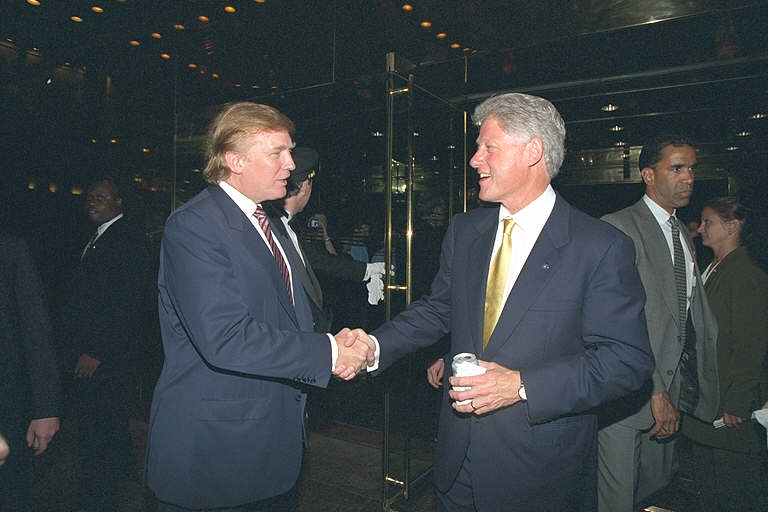
What Do Donald Trump and Bill Clinton Have In Common?
Reading Glenn Woiceshyn's 1998 article The Lewinsky Sex Allegations Against Clinton are Totally Believable draws some interesting parallels to President Trump:Clinton became president not because he is a deft man of principle, but because he is a deft pragmatist, one who skillfully monitors (and manipulates) public opinion, and alters his “principles” accordingly.
Pragmatism, the philosophy dominating modern politics, involves eschewing principles in the name of “doing what will work.” The classic example of a pragmatist was Britain’s then Prime Minister, Neville Chamberlain, who abandoned principles to appease Hitler’s power lust by giving him Czechoslovakia, all in the name of peace. The result was war. Without principles, one cannot identify what will and won’t work.
Pragmatism eschews valid moral principles, such as honesty, integrity and justice, which leads to a policy of “doing whatever I can get away with.” If elections can be won by making promises one knows one can’t keep, or deliberately generating false hope about disastrous and wasteful schemes like Medicare and Social Security, or accepting financial contributions from Chinese dictators, or lying about adulterous affairs (such as with Gennifer Flowers), then do it. Clinton’s latest big lie was his claim in his recent State of the Union speech that “We have the smallest government in 35 years.”
How does one know if one will get away with lying or adultery? Ultimately, by feelings. Pragmatism sinks to: “Do I feel that I will get away with it this time?” If one is impulsively driven by strong adulterous urges and gets away with satisfying them once, that builds “confidence” to try again. “Success” at fooling others breeds recklessness, and a perverted feeling of triumph over others and over reality. According to Gennifer Flowers, Clinton once asked her to have sex in a bathroom at the Arkansas’ governor’s mansion while his wife and 50 guests were outside on the lawn. (CNN — Larry King Live, Jan. 23, 1998.) Imagine the “triumphant” feeling of getting away with that!Read: The Lewinsky Sex Allegations Against Clinton are Totally Believable over at Capitalism Magazine.
A Moving Tribute To The Loss of A Great Love
Writes Dr. George Reisman in a moving tribute to his wife Edith Packer:
Edith was born on October 27, 1924. At this point, I don’t think she can hold it against me for revealing her age. So when she died this last Sunday she was over 93 years old. I had always expected her, and ardently desired her, to live to be at least 105. The fact that she didn’t, has devastated me. For over 48 years her presence filled my life, and now it’s simply gone. I feel a great void.
[...]
As I’ve said, Edith’s passing has left a great void in me. And my knowledge and commitment to reality and rationality have only made it worse. I know that Edith no longer exists as any kind of actual being. All that physically remains of her is a small pile of ashes. She no longer has eyes and so she cannot see me. She no longer has ears and so she cannot hear me. There just is no longer any “she.” But nevertheless, I pretend that in some way, she still exists and that she can still see and hear me, and so I still talk to her every day. And when I’m alone, out of anyone else’s hearing, I talk to her out loud. So I now need Edith more than ever—as my psychotherapist, in addition to everything else. But you know what. Until just this last Sunday, I did talk to Edith out loud, in reality, practically every day, for almost half a century. And so it feels much more normal to go on talking to her, even if only in pretense, than to slam into the brick wall of the fact that she simply is no more. So what I think I’m doing is trying to tap the brakes gently, so to speak, and come to a smooth stop, if that’s possible. I don’t think that’s actually unreasonable. ["Obituary and Eulogy for My Wife Edith Packer"]
The entire tribute is worth a read.
***Dr. Packers' Lectures on Psychology: A Guide to Understanding Your Emotions include some invaluable articles on understanding your own psychology including: The Art of Introspection, Toward a Lasting Romantic Relationship and Happiness Skills.