Novak Djokovic: Deported for ‘Thought Crimes’ in Australia

The number one tennis player in the world, and reigning Australian Open champion, Novak Djokovic, was deported for the 'thought-crime' of being a symbol of those who opposed dystopian vaccine mandates.According to the WSJ:
"Australia’s decision to cancel tennis star Novak Djokovic’s visa for a second time was driven by fear that letting him stay could foster antivaccine sentiment during a surge in Covid-19 cases, court documents show. Immigration minister Alex Hawke didn’t dispute Djokovic’s claim of a medical exemption from rules that travelers to Australia must be vaccinated against Covid-19, according to documents made public Saturday. Hawke, who canceled Djokovic’s visa on Friday, said allowing the player to stay could sway some Australians against getting vaccinated."[...] "Djokovic’s lawyer Nick Wood argued in a late-night court hearing on Friday that Hawke’s reasoning was flawed because he hadn’t considered that Djokovic’s deportation could have an impact on antivaccine sentiment."[...] "Hawke didn’t refute Djokovic’s contention that he posed a negligible health risk, documents showed. Djokovic has said his Covid-19 infection in December confers similar protection to a vaccine, the documents said." [Australia Feared Letting Novak Djokovic Stay Would Fuel Antivaccine Sentiment, Stuart Condie, 15 Jan 2022"]
It is instructive to note that Djokovic was not finally deported for an invalid medical exemption (the Australian federal government ended up not questioning that validity in the final hearing), nor that he was a physical threat to others (as he tested negative for COVID), nor that he was unvaccinated (as he has "natural immunity" from previous COVID infections which exempts him from the vaccination).Djokovic was deported because he may be seen as a symbol for "anti-vaccination sentiment" by the Federal government, according to Mr. Hawke, and that under section 133C(3) of the Migration Act he has the legal power to cancel the visa held by Djokovic “on health and good order grounds, on the basis that it was in the public interest to do so.”Comments Mr. Hawke:
“Mr Djokovic is such a person of influence and status. Having regard to the matters set out above regarding Mr Djokovic’s conduct after receiving a positive COVID-19 result, his publicly stated views, as well as his unvaccinated status, I consider that his ongoing presence in Australia may encourage other people to disregard or act inconsistently with public health advice and polices in Australia."“In addition, I consider that Mr Djokovic’s ongoing presence in Australia may lead to an increase in anti-vaccination sentiment generated in the Australian community, potentially leading to an increase in civil unrest of the kind previously experienced in Australia with rallies and protests which may themselves be a source of community transmission.”“These matters go to the very preservation of life and health of many members of the general community and further are crucial to the maintaining the health system in Australia, which is facing increasing strain in the current circumstances of the pandemic.”
(Note that in Australia's population of those age 16 and over, more than 90 percent have been double vaccinated.)

***

This brings to my mind these wise words by Rav Arora:
"Honesty, nuance, and compassion are especially needed when it comes to personal health choices. We are only born with one body and we must make medically informed decisions at our own volition without governmental coercion or political pressure."
Apparently not in the fascist state of Australia.
***
Avi Yemini has an excellent breakdown of the context surrounding his unjust deportation: Related: Novak Djokovic: Global Standard Bearer for Body Autonomy
Adam Mossoff: Google’s Intellectual Property Theft Problem

Adam Mossoff: Google’s Intellectual Property Theft Problem

Writes Adam Mossoff, in Big Tech has an IP piracy problem:
Years ago, Big Tech companies like Google decided that they profit more by stealing smaller companies’ intellectual property than buying or licensing it. Google, Apple, Samsung and others — with cash reserves in the tens, even hundreds, of billions of dollars — do not sweat legal fees, court costs or even damages they might have to pay for this theft. Google has a reported $142 billion in cash in the bank. This is far beyond what most companies make in total annual profits.Big Tech thus takes what it wants. It then uses scorched-earth litigation tactics to beat up on complaining IP owners. It drags out litigation over many years and imposes massive litigation costs on IP owners seeking justice. Many IP owners don’t even file a lawsuit. They know it is ruinous and self-defeating to try to protect what is rightfully theirs.Simply put, Big Tech benefits from stealing IP. The legal costs and potential damages, if ever issued after years of litigation, are paltry by comparison.A few companies have fought back, and the results confirm this predatory infringement practice. The story of Google’s abuse of Sonos is one of the more telling ones.
Read the rest.Image: Pixabay 
Individual Rights: Paul Hseih Makes The Case Against Government Vax Mandates

Individual Rights: Paul Hseih Makes The Case Against Government Vax Mandates

In "Not Everyone Wants To Be Vaccinated. I’m OK With That", Dr. Paul Hseih (who voluntarily chose to be vaccinated) writes:
For the record, I do not support making the vaccine legally mandatory. You have a right to decide what goes into your body. That’s one of the core principles of medical ethics – and of individual rights. As a corollary, others have the right to decide whether or how to interact with you in person, based on your decisions. A private business may choose to only allow vaccinated people to attend their indoor events, or a private employer may set vaccination as a condition for any in-person work with others. They also have that right.And of course, everyone has a free speech right to encourage (or discourage) others to becoming vaccinated. Those who wish others to be vaccinated can make their best possible case in favor of the vaccine; those who oppose it can do likewise.
Paul Hseih also makes an interesting point, that just as the principle of individual rights means that private businesses (individuals) can require vaccination as a condition of employment (and association), they can also do the reverse:
For example, one private school in Florida is reportedly requiring that teachers not be vaccinated as a condition of employment, citing safety concerns. This is their right, and this is the flip side of a school’s right to require vaccination as a condition of employment. Similarly, media personality Joe Rogan has publicly encouraged young people not to get vaccinated. I don’t agree with these positions, but I respect their rights to express their views – and the rights of others to offer their best counterarguments (which many are doing.)Ultimately, if the purpose of a vaccination campaign is to help the country return to “normal,” then a crucial part of that normal is a respect for individual rights and personal medical autonomy.
What about the case for vax mandates in legitimate government organizations, such as the police, military, and courts? That is a thorny issue, I lean on the side that the state can require such vaccines as a condition of employment, especially, in the case of the military (which is voluntary) to protect them from enemy viral attacks. (There could also be exemptions for those with natural immunity.)

Ghate & Bayer: Roe vs Wade and the Right to Abortion

Philosophers Onkar Ghate and Ben Bayer have a timely discussion on Roe vs Wade and the right to abortion.Topics covered include:
  • A brief history of abortion jurisprudence since Roe v. Wade;
  • Ayn Rand’s view of Roe and her support for abortion rights;
  • Why abortion rights are not grounded in a right to privacy;
  • Why activities don’t need to be concretely enumerated to be protected by fundamental rights;
  • Why we need abstract principles to state fundamental legal principles;
  • Why conservative sympathy for the reversal of Lochner v. New York implies a presumption in favor of government power;
  • Whether the potential to feel pain is the basis of rights;
  • How Roe v. Wade tries to balance competing interests, not to protect rights;
  • Why regarding life as sacred from conception is a baseless religious viewpoint;
  • Why it’s arbitrary to regard viability as the limit for justifiable abortion;
  • Whether religion or judicial philosophy motivates Justice Thomas;
  • Whether “individual responsibility” means a woman who chooses to have sex should carry a pregnancy to term;
  • The Supreme Court Justices’ unphilosophical approach.
Mentioned in the discussion are Leonard Peikoff’s essay “Abortion Rights Are Pro-Life,” Ben Bayer’s essays “Ayn Rand’s Radical Case for Abortion Rights” and “Science without Philosophy Can’t Resolve Abortion Debate,” and Tom Bowden’s “Justice Holmes and the Empty Constitution.”

CNN Reports the News: Sara Sidner on the Kyle Rittenhouse Not Guilty Verdict

Once upon a time, CNN was the world's leading news organization. Times have changed, as the once admired news organization, is referred to as the leading source of "fake news," and perhaps deservedly so. Such is not the case of CNN Senior News Correspondent Sara Sidner who regards the reporting of facts as the only means of ascertaining the truth. Sadly the same cannot be said of some of CNN's editorialists and reporters who apparently are ignorant of their own news coverage. Transcript:
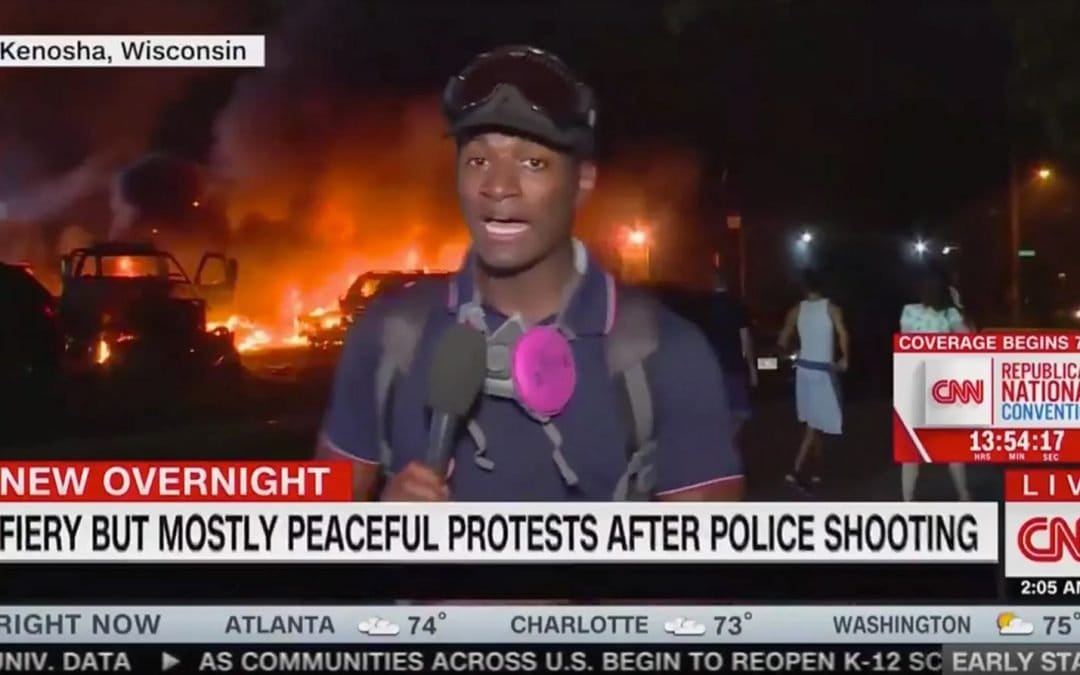
SIDNER: ...We learned a lot of things in this trial that we should sort of go over. And I was just kind of reviewing some of the things that we learned in the trial that were not necessarily public knowledge before that. One, there has been a lot of talk, especially by politicians, about where Rittenhouse was the night of this shooting. And it turned out he was already in Kenosha, that he had family here, including his father, that the gun was here in Kenosha. He did not bring that over state lines. It turned out during this trial that we learned that the gun that he had a hold of, he actually could legally possess, according to the judge, and according to the law here, because of the measurements of the gun. Had it been shorter and a short-barreled gun, then it would have been illegal. But because it wasn't, the judge said that that needed to be thrown out. And, indeed, that charge of a minor in possession of a gun illegally was thrown out in this case, the jury only looking at those who were injured, those who are endangered and those who were killed the night in August that Rittenhouse ended up shooting people.We also learned that he was working here that night, that he had stayed over that night here. ........ we did learn a lot of things from that video because it was very clear what was going on. There was a video of Rosenbaum chasing after Kyle Rittenhouse during this time when he had his gun.And at one point Rittenhouse levels his gun at Rosenbaum. Rosenbaum continues towards him. And as he gets close to Kyle Rittenhouse, Kyle Rittenhouse fires his gun several times. We learned also in the trial that he was hit four times. And, obviously, this is an AR-style rifle that has the capability of firing very quickly.....we heard from Gaige Grosskreutz. And that -- this was a pivotal moment in the trial, hearing from the one defendant who was shot, but survived Kyle Rittenhouse shooting at him.And he said that -- when asked whether or not Kyle Rittenhouse shot at him when his hands were up, he said no. And then he was asked by the defense, did you point your gun at Kyle Rittenhouse, and then he said shot you? And he said, correct.[13:25:01] That was a big moment for the jury, for sure, because that could be self-defense.....When you go through each one. Anthony Huber, who was who was also shot before Grosskreutz, he had a skateboard. And he attempted and you can see on the video hitting Kyle Rittenhouse.....the jury clearly thought that, in this case, after Kyle Rittenhouse tripped and fell and turned his gun and people started coming at him, that he was only defending his own life or from great bodily harm.....This has been a political football, if you will. It has been -- the right has looked at Kyle Rittenhouse this whole time as a hero. The left often or the far left has looked at Kyle Rittenhouse as a devil.....And it is pretty clear that people are sticking to their side. But they were not in this court. And many folks did not watch this trial. We did. We were in court watching every second of it. And the jury looked at all of the evidence.....And so it seems that, in this case, yes, Gaige Grosskreutz was an important witness, but the video seemed to be the star in this case, because the video shows you exactly what happened that night...
Another Transcript:
...There is so much vitriol that is out there right now on all sides of this. Depending on where you stand, and what you believe. One of the things, I think, that a lot of people who are making some of these very strong statements, some of them, which are factually incorrect. They didn't watch the trial and they didn't look at the same evidence that the jury looked at.
Weiss on the Outright Lies About Kyle Rittenhouse

Weiss on the Outright Lies About Kyle Rittenhouse

Bari Weiss dismisses the lies by the Democrats and their press in The Media's Verdict on Kyle Rittenhouse:

Writes Weiss:
  • There was zero evidence that Rittenhouse was connected to white supremacist groups at the time of the shooting.
  • In addition to having a job in Kenosha, Rittenhouse testified that much of his family lived there: his father, his grandma, his aunt and uncle, and his cousins.
  • Kyle Rittenhouse did not travel to Kenosha to oppose protesters. He testified under oath that he had traveled to Kenosha for his job the night before the shootings, and was staying at a friend’s house.
  • Rittenhouse didn’t bring the gun to Kenosha. The gun was purchased for Rittenhouse months earlier by a friend and stored in Kenosha at the home of that friend’s stepfather, as then-17-year-old Rittenhouse was too young to purchase it. Under Wisconsin law, 17-year-olds are prohibited from carrying rifles only if they are short-barreled. The weapon Rittenhouse was carrying was not short-barreled. Which is why, during closing arguments, the court threw out the charge.
  • [T]here’s no clear indication that Rittenhouse sought to kill anyone. What we know is that he showed up with a first aid kit and an AR-15-style rifle. Video evidence, and Rittenhouse’s own testimony, indicates that he offered medical assistance to protestors and ran with a fire extinguisher to try to put out fires—and that later, after being pursued, he killed two people, Joseph Rosenbaum and Anthony Huber, and severely wounded a third. Both video evidence and the only living person that Rittenhouse shot that night, Gaige Grosskreutz, undermined the idea that Rittenhouse was simply an aggressor looking for a fight. During cross examination Grosskreutz acknowledged that Rittenhouse shot him only after Grosskreutz had pointed his own gun at Rittenhouse.
Read the rest.

Voice of Capitalism

Capitalism news delivered every Monday to your email inbox.

Subscribed. Check your email box for confirmation.

Pin It on Pinterest