Oct 27, 2005 | Dollars & Crosses
From Cox and Forkum:
From AFP today: Iran condemned over anti-Israel remark, regime unrepentant.Iran was hit by a barrage of Western condemnation after its hardline president called for Israel to be "wiped off the map", but the clerical regime struck back with yet more verbal attacks against the Jewish state.
Mahmoud Ahmadinejad's speech, delivered Wednesday at a conference entitled "The World without Zionism", came just hours before a suicide bombing in Israel and provoked fresh fears that Iran has a covert nuclear weapons programme.
The European Union said Thursday that the comments -- the first time in years that such a high-ranking Iranian official has openly called for Israel's annihilation -- were "despicable and unacceptable" and "inconsistent with any claim to be a mature and responsible member of the international community". ...
And Israel, which alleges Iran is seeking nuclear weapons and long-range missiles, said the Islamic republic should be expelled from the United Nations.
But Iran's regime was unrepentant, confirming its dramatic shift to the right that came with Ahmadinejad's shock election win in June.
The spokesman of Iran's Revolutionary Guards, Seyed Massoud Jazihiri, backed up Ahmadinejad by describing Israel as a "cancerous tumour".
He said the West "was right to be afraid, because two decades ago when the Imam (Khomeini) called for Israel to be wiped off the map they thought it was a slogan, but as time passes we are seeing signs of unity in the Islamic world."
"We have no doubts that at the end of the road, the victory of Muslims and the defeat of Israel is inevitable," Jazihiri told the Fars news agency.
Iran's foreign ministry also ordered its diplomats to lodge official protests over Europe's attitude toward "Zionist crimes". [Emphasis added]
UPDATE I: From Investor's Business Daily: Hate, Iranian Style.There's nothing Israel can do to please such Islamic radicals. Ahmadinejad called Israel's recent withdrawal from the Gaza Strip only a "new instigation, which aimed at Israel's recognition by the Islamic countries." No concessions on the part of Israel hold meaning to the Iranian regime; it wants nothing less than the state's eradication, and by extension the Jews themselves.
More significant than words is what Iran has been up to. Iran's determination and ability to act against the U.S. should not be underestimated.
The November issue of the German monthly Cicero will report that, according to Western intelligence sources, the Iranian Republican Guards are providing haven in and near Tehran to 25 members of al-Qaida — from Saudi Arabia, Egypt, Uzbekistan and Europe. ...
What's more, the deadlier, more sophisticated bombs now being used by insurgents to kill American troops in Iraq make use of TNT from Iran seven times stronger than the TNT available in Iraq, according to a Washington Post interview of a former Iraqi army officer who is now a member of al-Qaida.
And lest there be any doubt about the fascistic tendencies of his regime, Ahmadinejad recently led a committee of Islamic clerics in banning Western films from being shown or sold in Iran. [Emphasis added]
UPDATE II -- Oct. 28: From FoxNews: Iranians Rally in Support of President's Anti-Israel Stance.Tens of thousands of Iranians staged anti-Israel protests across the country on Friday, repeating calls by their ultraconservative president for the Jewish state's destruction. ...
Iranians staged multiple demonstrations in the capital, Tehran (search), and other cities such as Mashad in Iran's east, holding banners carrying anti-Israeli and pro-Palestinian slogans. "Death to Israel, death to America," read many of the placards.
The demonstrations are part of the annual al-Quds — Jerusalem — Day protests, which were first held in 1979 after Shiite Muslim clerics took power in Iran.
The state-organized rallies are expected to grow ahead of midday mosque sermons across Iran. Hundreds of thousands of Iranians have attended previous protests.
Oct 27, 2005 | Dollars & Crosses
IRVINE, CA--As fears of an avian flu pandemic grow, demands that governments trample on the property rights of drug companies also grow. Many people want governments to violate the patent rights of Roche AG, licensed manufacturer of Tamiflu, so that other organizations can manufacture the drug.
"These demands are immoral," said Dr. Yaron Brook, executive director of the Ayn Rand Institute. "Instead of vilifying Roche we should be praising it for having the foresight to license and manufacture Tamiflu in the first place, the drug which appears to be the most effective treatment for the current strand of avian flu. Governments that wish to stockpile Tamiflu should enter into contracts to purchase it. The surge in demand will lead Roche to manufacture as much of the drug as it profitably can and to license its patent to other manufacturers for a fee. The new demand will be swiftly met. That Roche will profit is only just.
"We must remember that without Roche and Gilead (the inventor of the drug), Tamiflu would not exist. And without unyielding recognition of a creator's patent rights, research into the next anti-flu drug will be stifled. Government intervention has already made many avenues of drug research unprofitable--to the detriment of the health of each of us. The threat of an influenza pandemic is ongoing. We must not let governments destroy this vital area of research too."Oct 25, 2005 | Dollars & Crosses
Why 'big business' likes the minimum wage -- their 'small business' competitors cannot afford to pay it.
From the Motley Fool:
Also, in a bit of irony, Wal-Mart took a stance on public policy by advocating an increase in the minimum wage. The company has often drawn fire for its labor practices and employee pay. However, it maintains that it pays its employees at rates above the minimum wage, while trends indicate that its customers can't afford to purchase basic necessities throughout the month. Given its average wage of approximately $10 an hour, Wal-Mart's call to increase the minimum wage above $5.15 would actually place an additional burden on many of its smaller, low-wage competitors.
Oct 20, 2005 | Dollars & Crosses
From Cox and Forkum:
From FoxNews: Saddam Pleads Not Guilty.At the start, the 68-year-old ousted Iraqi leader — looking thin in a dark gray suit and open-collared shirt — stood and asked the presiding judge: "Who are you? I want to know who you are."
"I do not respond to this so-called court, with all due respect to its people, and I retain my constitutional right as the president of Iraq," he said, brushing off the judge's attempts to interrupt him.
"Neither do I recognize the body that has designated and authorized you, nor the aggression because all that has been built on false basis is false."
From The New York Times: Iraqis Watch the Trial on TV, With Emotions Running High.Viewpoints varied widely, some calling it a tawdry display of victor's justice, others a long-awaited, if somewhat unsatisfactory, accounting for sins too numerous to list.
The opinions generally divided along ethnic and sectarian lines, with many Sunni Arabs expressing some sympathy for Mr. Hussein, one of their own, and long-persecuted Shiites and Kurds barely containing their hatred. Everyone, though, seemed to take notice of Mr. Hussein's fierce disposition and his unwillingness to bend to his captors.
Oct 18, 2005 | Dollars & Crosses
From Cox and Forkum:
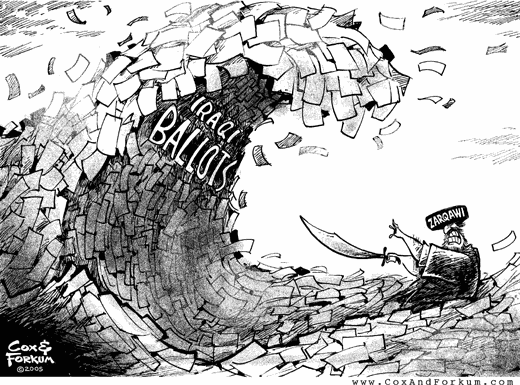
From FoxNews: Iraqis Continue Checking Referendum Results.The first bags containing sheets of vote counts from Iraq's provinces arrived in Baghdad for tabulation, but delays from other areas mean a final result in the landmark referendum may not be known until the end of the week, election officials said Tuesday.
Complicating the count is the need to audit results that have raised eyebrows because they show an unexpectedly high number of "yes" votes, triggering questions of irregularities. Two crucial provinces that could determine the outcome are apparently among the regions that need investigation.
Despite these questions, and despite concerns about what the constitution will ultimately mean for Iraq and America, TIA Daily's Robert Tracinski pointed out something of which we can be certain: Zarqawi loses, again.The significance of Saturday's vote on the Iraqi constitution is not that the constitution itself will be adopted. The constitution provides only woozy protections for individual rights, offset by a possible basis for theocratic rule, plus a mechanism to allow Shiites to set up a "federal" theocracy in Southern Iraq -- with all of this to be decided later on. So it decides very little about the actual shape of the Iraqi government.
What is significant about the election is that it amounts to a public endorsement of how those decisions are to be made: through electoral politics, rather than through terrorist bombings. While many voted for the constitution because it increased the power of their group (whether Shiite or Kurdish), others, like the man quoted in this New York Times article, voted for it because they want a system in which government depends on their consent. ...
The election was a loss for the terrorist insurgency, which mounted even fewer attacks during this election than during the parliamentary elections in January. This time, crucially, Sunnis did not boycott the polls and many apparently voted in favor of the constitution. This could be the beginning of the end for the insurgency, as Sunnis reluctantly choose to engage in political debate rather than to obstruct it. ...
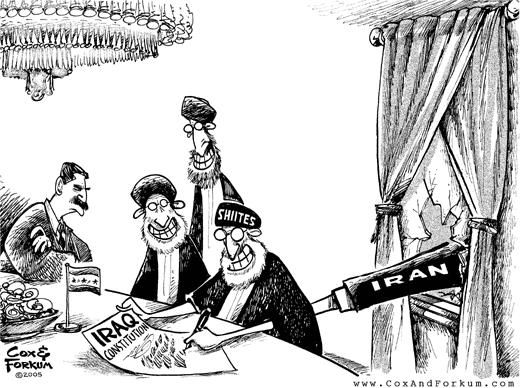
[T]he real battle in Iraq becomes a political one to prevent a theocratic takeover in the south. Having failed to get a commanding majority in the January elections, the Iranian-backed Shiite theocrats have fallen back on a new strategy, campaigning for a semi-independent "federal" region in the south, where they have the votes to take over.
This merely highlights the fact that the real enemy in this war is Iran, which arms and finances these Shiite theocrats and provides the theocratic model they hope to emulate. Meanwhile, our diplomats are at least beginning to issue threats against Iran for providing high explosives to insurgents who have attacked American and British troops. But when will this stop being a mere war of words?
Oct 17, 2005 | Dollars & Crosses
From Cox and Forkum:
FoxNews reports today that voting for the Iraqi constitutional referendum has begun.Iraq's most powerful Shiite cleric, Grand Ayatollah Ali al-Sistani, also weighed in, ordering Shiites to vote "yes" in the referendum, one of his aides, Faisal Thbub, said. It was the most direct show of support for the charter by al-Sistani, whose call brought out huge numbers of voters to back Shiite parties in January elections.
Though the constitutional compromise is being hailed, VOA reports: Some Iraqis Fear Constitution Will Give Power to Iran (via Free Thoughts).For months, secular Iraqi politicians like Mithal al-Alousi have been warning that Shi'ite Iran is trying to stoke sectarian tension and is aiming to create a breakaway Islamic state in the mostly-Shi'ite southern Iraq.
"I am very sure we have Iranian influence in Basra. We have Iranian influence in Amarah. We have the Iranian intelligence agency. They have control in Basra," he said.
U.S. and British military intelligence officials say they believe Iran is running intelligence-gathering operations in southern Iraq and providing arms and money to several active Islamic groups operating in the region.
The groups are accused of carrying out attacks on coalition forces, imposing Islamic laws by force, and assassinating former members of Saddam Hussein's Ba'ath Party.
The largest of these Islamic groups is the Badr Organization, a Shi'ite militia force of about 20,000 men, trained by the Iranian Revolutionary Guards. The Badr group also acts as the armed wing of the Supreme Council for Islamic Revolution in Iraq (SCIRI), which operated out of Iran for decades during Saddam's rule and is now the largest and the most powerful political party in Iraq.
The head of the SCIRI party, religious cleric Abdul Aziz al-Hakim, has been the leading proponent of a provision in Iraq's draft constitution, which calls for the creation of a Shi'ite mini-state in the oil-rich south.
The federalist arrangement is also supported by members of the Islamic Dawa Party, led by interim Prime Minister Ibrahim al-Jaafari. Like SCIRI, the Dawa Party has strong ties to Iran. [Emphasis added]
Other expressions of concern over Iran's influence in Iraq:
From Space War: Iran's Influence Growing In Iraq by Martin Sieff, UPI Senior News Analyst:Prime Minister al-Jaafari and the United Iraqi Alliance he leads represents the Shiite majority and dominates the government. Al-Jaafari's own al-Dawaa party has very strong ties to Iran. For that matter, so does Deputy Prime Minister Ahmed Chalabi who runs energy policy. U.S. intelligence concluded last year that he may have given crucial U.S. intelligence secrets to Tehran. ...
Jaafari's United Iraq Alliance looks to Grand Ayatollah Ali Sistani as its political as well as religious mentor. Sistani has been quiet, politic, cautious and shrewd since Saddam was toppled. But two facts about him stand out. He remains a citizen of the Islamic Republic of Iran and in the two and a half years since U.S. forces liberated Baghdad, he has never once officially met any U.S. representatives.
Jaafari's appointment as prime minister was welcomed in Washington as a giant stride toward the goal of establishing a peaceful, stable, constitutional state in Iraq friendly to the United States. But his emergence as the first Shiite national leader of Iraq in its history may also be seen part of a very different process -- the rise of a new, militant, politicized and revolutionary Shiism articulated and shaped by the late Grand Ayatollah Ruhollah Khomeini in Iran.
From the New Hampshire Union Leader: Iran hopes constitution bolsters Shiites by Ali Akbar Dareini, Associated Press Writer:There is little question that Iran hopes the referendum on the Iraqi constitution will help consolidate the power of Shiites in Iraq after decades of Sunni Arab domination.
Others see more sinister goals.
U.S. officials have accused Iran of secretly backing the Sunni-led insurgency in Iraq to reduce the impact of America's victory there as it tries to strengthen democracy in the region. Tehran has repeatedly said it doesn't see Iraq as a battleground between Iran and the United States.
Oct 17, 2005 | Dollars & Crosses
Capitalists are often the worst enemy of capitalism. Google is a case in point. Instead of proudly proclaiming that it created and earned its billions, Google is bowing to the cries of altruists and "poverty activists." It announced yesterday that it is "giving back to the community" $1 billion--thereby implicitly admitting that by moral right the money is the property of society. "This is the moral principle of socialism, not capitalism," says Dr. Andrew Bernstein, author of "The Capitalist Manifesto."
Google's actions in China show just how fully it accepts the corrupt moral principle that whatever society commands, the individual must obey. Goggle, along with other high-tech firms like Yahoo and Microsoft, has been helping Chinese censors identify customers who e-mail words forbidden by this repressive government, words like "freedom," "democracy" and "Tiananmen massacre." In one recent case a Chinese reporter was sentenced to ten years in prison for doing nothing more than requesting pro-democracy information from a colleague in New York
How do Google and other American businesses justify their complicity in the destruction of an individual's free speech? These companies say they have to obey the laws, regulations and customs of the countries where they do business. In other words, the will of society trumps the rights of the individual.
Bernstein wonders: "Why do business in China if it forces you to destroy the very rights and freedoms that made your own economic success possible in America? What happened to Google's motto 'Do no evil'?"Oct 17, 2005 | Dollars & Crosses
Dr. Keith Lockitch, fellow at the Ayn Rand Institute will debate "Intelligent Design" with Dr. Jim Buchholz, professor of physics at California Baptist University in Riverside on KABC radio with host - Al Rantel. This will take place on Monday, October 17 at 8PM pacific time. Tune in to 790 on the AM dial in the LA area or listen to it on the net at www.kabc.com. Dr. Lockitch will also be speaking at the University of Southern California on Tuesday, October 25th at 7:30 PM in SGM-123. For details see the USC Objectivist Club website: www.uscobjectivistclub.comOct 16, 2005 | Dollars & Crosses
From Cox and Forkum:
From FoxNews: Neo-Nazi March Causes Riots.Protesters at a white supremacists' march threw rocks at police, vandalized vehicles and stores and cursed the mayor for allowing the event.
Mayor Jack Ford said when he and a local minister tried to calm the rioters Saturday, they were cursed and a masked gang member threatened to shoot him. ...
At least two dozen members of the National Socialist Movement, which calls itself "America's Nazi Party," had gathered at a city park to march under police protection. Organizers said they were demonstrating against black gangs they said were harassing white residents.
The violence broke out about one-quarter of a mile away along the planned march route shortly before it was to begin. One group of men pounded on a convenience store, and others overturned vehicles. ...
When the rioting began, Ford tried to negotiate with those involved, but "they weren't interested in that." He said people in the crowd swore at him and wanted to know why he was protecting the Nazis.
They were mostly "gang members who had real or imagined grievances and took it as an opportunity to speak in their own way," Ford said.
"I was chagrined that there were obvious mothers and children in the crowd with them," he said.
Thomas Frisch, 76, said a large group of men destroyed the exterior of a gas station next to his home of 30 years.
"A whole big gang started to come in here. Next thing you know, they're jumping on the car. Then they overturned it. Then they started on the building, breaking windows, ripping the bars off," he said.
Ratajski and his nephew left Jim & Lou's Bar as a crowd gathered in front, pelting police with rocks and breaking the windows. "I was shaking. I feared for my life," said Ratajski's nephew, Terry Rybczynski.
UPDATE I: FoxNews has updated the above link, adding and deleting information. This was added:The neighborhood northwest of downtown, full of tree-lined streets and well-kept brick homes, once was a thriving Polish community. But within the last decade it's become home to poorer residents. ...
The neo-Nazi group became interested in the neighborhood because of a white resident's complaints to police about gang violence, Bill White, a group spokesman, said earlier this month. ...
Rioters set fire to 86-year-old Louis Ratajski's neighborhood pub, Jim & Lou's Bar, but he and his nephew, Terry Rybczynski, escaped the flames.
And in a Reuters article, Mayor Ford said of the violent reaction by gangs: "That's exactly what (the white supremacist group) wanted."
UPDATE II -- Oct. 17: More interesting links and commentary by Michele Malkin, Martin Lindeskog, and Committees of Correspondence.
UPDATE III: From CNN: Mayor: Nazis had right to march in neighborhood.Oct 9, 2005 | Dollars & Crosses
From Cox and Forkum:
From AFP: Islam permits killing of 'infidel' civilians: Zarqawi tape (via Jihad Watch).DUBAI -- Al Qaeda frontman in Iraq Abu Musab Al Zarqawi has said Islam permits the killing of "infidel" civilians, according to an audiotape broadcast on the Internet early Saturday.
"In Islam, making the difference is not based on civilians and military, but on the basis of Muslims and infidels," said the voice attributed to the fugitive leader who has a 25-million-dollar price on his head.
"The Muslim's blood cannot be spilled whatever his work or place, while spilling the blood of the infidel, whatever his work or place, is authorized if he is not trustworthy," said the tape, whose veracity could not be determined.
The recording comes a day after US officials claimed to have seized a letter allegedly sent to Zarqawi by Al Qaeda number two Ayman Zawahiri, in which he raised concerns over the impact on Arab opinion of videotaped executions.
Zarqawi, a Jordanian-born Islamist extremist, is Iraq's most wanted man.
His Al Qaeda Group of Jihad in the Land of Two Rivers has claimed responsibility for some of the most gruesome attacks in Iraq, including the beheadings of foreign hostages and Iraqis.
UPDATE I -- Oct. 10: Regarding President Bush's speech last week, I'm happy to note that he finally -- four years after 9/11 -- came out and explicitly named the enemy: "Some call this evil Islamic radicalism; others, militant Jihadism; still others, Islamo-fascism." For this, we applaud the President. Unfortunately, in the very next sentence he quickly added: "Whatever it's called, this ideology is very different from the religion of Islam." "Very different"? There may be many secularized, moderate Muslims today. But to say what motivates the terrorists is somehow foreign to Islam is ridiculous. Apparently Bush is still disarmed by the some sort of multicultural/religious sensitivity. Investor's Business Daily had an excellent editorial detailing the shortcomings of President Bush's speech: Defining The Enemy.Continuing to pretend that terrorism is a distortion of Islam's supposedly "peaceful" and "tolerant" nature — and not a predictable outcome of jihad, its 6th pillar — may soothe the savage beast of political correctness. But it's no way to win a war against real savages. That can only come from frank national discourse over what is motivating them, where they are getting that motivation, and how to implement effective methods to disrupt it.
UPDATE II: The first article above mentions a letter seized by the U.S. military, which indicated "concerns over the impact on Arab opinion of videotaped executions." There was even more to the letter than that. From CNN: Pentagon: Bin Laden deputy complains about money, Iraq tactics.An intercepted letter from Osama bin Laden's deputy to the al Qaeda leader in Iraq complains that the terrorist network is short of cash and faces defeat in Afghanistan, a Pentagon spokesman says. [Emphasis added]
UPDATE III -- Oct. 11: The seized letter has now been fully released and has made the main story on CNN's site: Al Qaeda letter called 'chilling'.The letter outlines a four-stage plan to expand the war in Iraq: Expel U.S. forces, establish an Islamic authority, take the fight to Iraq's secular neighbors and battle with Israel -- "because Israel was established only to challenge any new Islamic entity."
Oct 7, 2005 | Dollars & Crosses
ARI executive director Dr. Yaron Brook is scheduled to appear on the CNBC program "On the Money" tonight, October 7, 2005. The program airs between 7:00 and 8:00 pm Eastern. The topic will be: Should the UN Control the Internet?Oct 4, 2005 | Dollars & Crosses
From AP: EU Wants Shared Control of Internet.BRUSSELS, Belgium - The European Union insisted Friday that governments and the private sector must share the responsibility of overseeing the Internet, setting the stage for a showdown with the United States on the future of Internet governance. A senior U.S. official reiterated Thursday that the country wants to remain the Internet's ultimate authority, rejecting calls in a United Nations meeting in Geneva for a U.N. body to take over. EU spokesman Martin Selmayr said a new cooperation model was important "because the Internet is a global resource." A stalemate over who should serve as the principal traffic cops for Internet routing and addressing could derail the summit, which aims to ensure a fair sharing of the Internet for the benefit of the whole world. At issue is who would have ultimate authority over the Internet's master directories, which tell Web browsers and e-mail programs how to direct traffic. That role has historically gone to the United States, which created the Internet as a Pentagon project and funded much of its early development. The U.S. Commerce Department has delegated much of that responsibility to a U.S.-based private organization with international board members, but Commerce ultimately retains veto power. Some countries have been frustrated that the United States and European countries that got on the Internet first gobbled up most of the available addresses required for computers to connect, leaving developing nations with a limited supply to share.
From last week's Washington Times: U.S. tells nations hands of Internet (hat tip Allen Forkum)
From ARI:
IRVINE, CA-- A cabal of countries, including Cuba, Syria, China and Iran--now backed by the European Union--is demanding that control of the Internet be surrendered to the United Nations.
These and other thug-nations restrict their own citizens' ability to receive and broadcast news and grievances from inside their blood-soaked walls. China, for instance, currently has many individuals jailed for being "cyber-dissidents" and it engages in massive censorship of the Internet. It recently passed a law mandating that only "healthy and civilized" news may be read by its citizens--to be determined, of course, by the same "civilized" officials who brought us Tiananmen Square.
This world-wide web of evil nations, hiding behind the veneer of technical complaints, now seeks to control not just what its own citizens are able to see and say on the Internet, but what every individual on the face of the planet is able to see and say. If the UN is given control of the Internet, we can expect free trade and freedom of speech to be crushed.
The Internet was created in and by the land of the free, America. It has now become the object of an alarming power-grab by the world's dictatorships and their puppet, the UN. America must not surrender its citizens' freedom to the mercy of a debating society for dictators.
Oct 3, 2005 | Dollars & Crosses
Writes Wayne Dunn on the economics and morality of Price Gouging:
It's the criminalization of price hikes -- not the hikes themselves -- that's immoral. The moral premise behind price-gouging laws is summed up in the altruistic injunction, "People before profits" -- as if merchants aren't people. What this "ethical" position really boils down to, then, is that the needs and desires of some people (consumers) trump the needs and desires of other people (businessmen) and that in a pinch government should sacrifice the latter to the former.
[...] The high prices oblige consumers to economize. Artificially low prices, by contrast, invite hoarding and frivolous buying, emptying shelves sooner. For instance, someone able or willing to purchase only 10 jugs of water at a "gouged" price might've bought 30 if the price were "normal," leaving less for others customers.
Oct 2, 2005 | Dollars & Crosses
Writes Professor Brian Thompson in Who's Really to Blame for High Gasoline Prices?:
One thing is certain: oil companies are not to blame for high gas prices. These companies are responsible for producing the gasoline we need. In California, where gas prices are among the highest in the nation, the oil industry has been repeatedly investigated to find evidence of "price manipulation" (four times in 2003 alone) and none has ever been found.
Although there are other causes of high gas prices, such as high gasoline taxes, the primary cause is environmental regulation. For example, environmental regulation significantly restricts drilling for oil in Alaska and on the continental shelf. More drilling could considerably increase the gasoline supply (up to 20% from greater Alaskan drilling alone) and thus lower prices.
Oct 1, 2005 | Dollars & Crosses
This series of articles and declassified U.S. government documents recounts the death of the destroyer of the Cuban economy: Ernesto "Che" Guevara who died looking like a "piece of trash." Interesting quotes on the real effect of Che's policies:
A CIA Intelligence Memorandum discusses what analysts perceive as Che Guevara's fall from power within the Cuban government beginning in 1964. It states that at the end of 1963, Guevara's plan of "rapid industrialization and centralization during the first years of the Revolution brought the economy to its lowest point since Castro came to power." "Guevara's outlook, which approximated present -day Chinese--rather than Soviet--economic practice, was behind the controversy." In July 1964, "two important cabinet appointments signaled the power struggle over internal economic policy which culminated in Guevara's elimination." Another conflict was that Guevara wanted to export the Cuban Revolution to different parts of Latin America and Africa, while "other Cuban leaders began to devote most of their attention to the internal problems of the Revolution." In December, 1964, Guevara departed on a three-month trip to the United States, Africa, and China. When he returned, according to the CIA report, his economic and foreign policies were in disfavor and he left to start revolutionary struggles in other parts of the world. (CIA Intelligence Memorandum, "The Fall of Che Guevara and the Changing Face of the Cuban Revolution," 10/18/65)
On Che's capture:
Che's final battle commences in Quebrada del Yuro. Simon Cuba (Willy) Sarabia, a Bolivian miner, leads the rebel group. Che is behind him and is shot in the leg several times. Sarabia picks up Che and tries to carry him away from the line of fire. The firing starts again and Che's beret is knocked off. Sarabia sits Che on the ground so he can return the fire. Encircled at less than ten yards distance, the Rangers concentrate their fire on him, riddling him with bullets. Che attempts to keep firing, but cannot keep his gun up with only one arm. He is hit again on his right leg, his gun is knocked out of his hand and his right forearm is pierced. As soldiers approach Che he shouts, "Do not shoot! I am Che Guevara and worth more to you alive than dead." The battle ends at approximately 3:30 p.m. Che is taken prisoner.
[...] Félix Rodríguez arrives by helicopter in La Higuera, along with Colonel Joaquín Zenteno Anaya. Rodríguez brings a powerful portable field radio and a camera with a special four-footed stand used to photograph documents. He quietly observes the scene in the schoolhouse, and records what he sees, finding the situation "gruesome" with Che lying in dirt, his arms tied behind his back and his feet bound together, next to the bodies of his friends. He looks "like a piece of trash" with matted hair, torn clothes, and wearing only pieces of leather on his feet for shoes. In one interview, Rodríguez states that, " I had mixed emotions when I first arrived there. Here was the man who had assassinated many of my countrymen. And nevertheless, when I saw him, the way he looked....I felt really sorry for him." (Rodríguez:2)
Also worth reading: The Cult of CheSep 30, 2005 | Dollars & Crosses
For decades creationists have sought to replace evolution with the Book of Genesis. But defenders of evolution have consistently prevailed in the schools and the courts of law. This struggle for intellectual survival has led to the evolution of a new "species" of creationist, better adapted to its inhospitable environment. The new creationism goes by the name of "intelligent design" and poses a greater danger than old-style creationism. In this talk Dr. Lockitch will examine the intelligent design movement focusing on its similarities and differences with standard creationism. By hiding its religious essence behind a cloak of pseudo-science, the movement seeks to make itself more palatable to intellectuals and the general public. And because today's academics--including the most passionate and vocal defenders of evolution--are incapable of answering its most fundamental arguments, the doors of our colleges and schools are ominously open to primitive mysticism masquerading as science.
One hour lecture followed by one hour Q and A. (Details: Tuesday, October 25, 2005 7:30 to 9:30 PM at SGM-123 (Seely G. Mudd), 3620 McClintock, University of Southern California, Los Angeles, CA 90089)Sep 29, 2005 | Dollars & Crosses
A new quarterly journal -- The Objective Standard -- has been launched, with the following announcement:
The Objective Standard is a quarterly journal of culture and politics written from the perspective that man's life on earth is the proper standard of morality. According to this principle, that which supports or promotes an individual's life is good, that which retards or destroys it is evil. The purpose of the journal is to analyze and evaluate ideas, trends, events, and policies with respect to this standard.
The Objective Standard provides a rational, principled alternative to the ideas of both liberalism and conservatism. Whereas liberals hold that morality is subjective (i.e., feeling-based), that majority opinion is the standard of value, that sacrifice for the common good is noble, and that rights are social conventions; and whereas conservatives hold that morality is grounded in religion (i.e., faith-based), that God's will is the standard of value, that sacrifice in obedience to His commands is good, and that rights are divine decrees; we hold that morality is grounded in the objective requirements of human life (i.e., reason-based), that man's life is the standard of value, that the selfish pursuit of one's life-serving goals is good, and that individual rights are moral principles defining the basic requirements of a civilized society. Ours is a philosophy of reason, egoism, and laissez-faire capitalism. In a word, we advocate Objectivism, the philosophy of Ayn Rand, and we apply this philosophy to the cultural and political issues of the day.
Contributing writers include Craig Biddle, Yaron Brook, Alex Epstein, Elan Journo, John Lewis, Keith Lockitch, Larry Salzman, and Lisa VanDamme.
Sep 28, 2005 | Dollars & Crosses
Imagine and visualize yourself as your psychological ideal. Then strive to live up to that ideal each day, but don't expect to be there all at once. Build that ideal one brick at a time, with the confidence that as you get better and better and the motivation goes up, you'll speed up and pile on many bricks at one time.