“Baseline” Gimmick: “Cut” is in Reality a Lower Increase in Spending

Richard Salsman crunches the numbers at Forbes on the attempt to "cut" the size of the public debt:
[...] Even the most “radical” GOP plan, to “cut” $9 trillion, would boost federal outlays by 30% in the coming decade versus outlays in the past decade, while the most modest GOP plan, to cut a mere $2 trillion, would boost outlays by 55%. Yet Democrats lambaste GOP plans as “Draconian,” prone to trigger a “depression.”By “baseline” federal spending over the coming decade, the CBO means the sum that’ll be spent even with no changes in current fiscal policy, whether in tax rates or spending schemes. As mentioned, the CBO says $45.8 trillion in outlays over the coming decade are effectively on “auto-pilot,” so any proposed “cut” is relative only to this huge number. As mentioned, Washington spent $28.3 trillion over the past decade, so embedded “baseline” spending of $45.8 trillion in the coming decade already entails an astounding increase of 62%. In the coming decade neither U.S. population nor real economic output would rise nearly so much.[...] Why are today’s politicians, journalists and economists so complicit in deliberately misleading the public about the current and future state of U.S. finances? Why do they speak of “cuts” in future federal spending when the CBO routinely projects increases in the range of +30% to +65%? Check those numbers again, dear citizen: they’re positive, not negative. “Baseline budgeting,” which blithely presumes a perpetually-growing government, was first enacted by the U.S. Congress in 1974, in order to side-step White House efforts to “impound” (limit) federal spending; but that doesn’t condone the gimmick – or justify lying to the public. When people hear that Washington will “cut” spending by $2 trillion over the coming decade, they think that’s a lot of money and that outlays might be $2 trillion lower a decade hence – not higher by 50% or more. Even Boehner’s budget plan, like many others, backloads the “cuts” into later years; he’d “cut” outlays by only $23 billion in 2012, equivalent to less than three days of total federal spending at the current spending rate.  [Richard Salsman, Forbes,  Washington’s Budget “Cuts” Would Boost Spending 50%]

Democrat Casino Mogul Steve Wynn on Obama’s “Weird” Job Destroying Philosophy

From Wynn Resorts' CEO Discusses Q2 2011 Results - Earnings Call Transcript - Seeking Alpha:
Well, here's our problem. There are a host of opportunities for expansion in Las Vegas, a host of opportunities to create tens of thousands of jobs in Las Vegas. I know that I could do 10,000 more myself and according to the Chamber of Commerce and the Visitors Convention Bureau, if we hired 10,000 employees, it would create another 20,000 additional jobs for a grand total of 30,000.

I believe in Las Vegas. I think its best days are ahead of it. But I'm afraid to do anything in the current political environment in the United States. You watch television and see what's going on, on this debt ceiling issue. And what I consider to be a total lack of leadership from the President and nothing's going to get fixed until the President himself steps up and wrangles both parties in Congress. But everybody is so political, so focused on holding their job for the next year that the discussion in Washington is nauseating.

And I'm saying it bluntly, that this administration is the greatest wet blanket to business, and progress and job creation in my lifetime. And I can prove it and I could spend the next 3 hours giving you examples of all of us in this market place that are frightened to death about all the new regulations, our healthcare costs escalate, regulations coming from left and right. A President that seems -- that keeps using that word redistribution.

Well, my customers and the companies that provide the vitality for the hospitality and restaurant industry, in the United States of America, they are frightened of this administration. And it makes you slow down and not invest your money. Everybody complains about how much money is on the side in America. You bet. And until we change the tempo and the conversation from Washington, it's not going to change. And those of us who have business opportunities and the capital to do it are going to sit in fear of the President. And a lot of people don't want to say that. They'll say, "Oh God, don't be attacking Obama."

Well, this is Obama's deal, and it's Obama that's responsible for this fear in America. The guy keeps making speeches about redistribution, and maybe we ought to do something to businesses that don't invest or holding too much money. We haven't heard that kind of talk except from pure socialists. Everybody's afraid of the government, and there's no need to soft peddling it, it's the truth. It is the truth. And that's true of Democratic businessman and Republican businessman, and I am a Democratic businessman and I support Harry Reid. I support Democrats and Republicans.

And I'm telling you that the business community in this company is frightened to death of the weird political philosophy of the President of the United States. And until he's gone, everybody's going to be sitting on their thumbs.

State of the Culture: Amy Peikoff Interview with ARI’s Yaron Brook

Dr. Yaron Brook, along with business hero John Allison and philosopher Leonard Peikoff, are the leading voices today in promoting Ayn Rand's philosophy of Objectivism: which advocates reason, individual rights and the virtue of selfishness (i.e., the pursuit of one's long-term happiness). Listen to this full-hour Interview with Yaron Brook, President of the Ayn Rand Center for Individual Rights and the state of the Culture at Don’t Let It Go…Unheard #22.


Richard Lindzen: A Modern Day Galileo on Climate


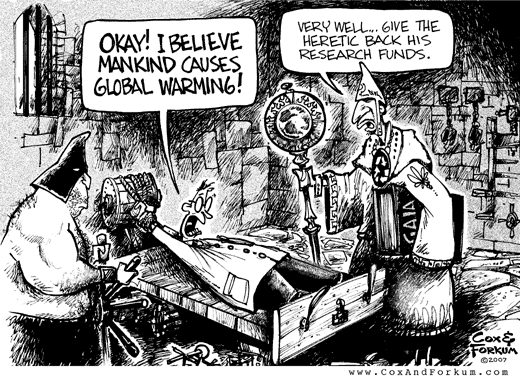
Cartoon by Cox and Forkum.


Richard Lindzen is a professor of meteorology at Massachusetts Institute of Technology who thinks that man-caused global warming is real, but will hardly cause any change at all. The NY Times has an interesting article on him: A Climate Change Dissenter Who Has Left His Mark on U.S. Policy. Here are some choice excerpts:
 [...] [Lindzen argues that] the answer that emerges from most climate models is wrong because they assume the Earth's clouds and water will amplify the rising heat. According to Lindzen's calculations, the clouds should have the opposite effect, minimizing the warming effect.

In his paper, Rahmstorf added a "Personal Postscript": "Can Lindzen seriously believe that a vast conspiracy of thousands of climatologists worldwide is misleading the public for personal gain? All this seems completely out of touch with the world of climate science as I know it and, to be frank, simply ludicrous." In a reply, Lindzen skewered Rahmstorf in a footnote, arguing that the German scientist was "addicted to the use of words like 'entirely,' 'fact,' 'irrefutable,' etc. Such words are inappropriate to a primitive and immature science -- which is what climate science is at present."

Richard Goody, 90, who taught meteorology to Lindzen at Harvard, says the critics of his former pupil are "focusing on his propensity to debate. He [Lindzen] loves debating. He absorbs an enormous amount of information, and he loves arguing with you about it. Since he's so well-informed and so smart, he usually wins. This doesn't endear you to a lot of people." [...] Goody is quick to add: "But science is not about gentility. It's about discussing the facts. He's just doing what he should do." [...] "This machine turns out a number for something that will happen 100 years in the future. Science doesn't usually work that way. There's not much evidence about the behavior of these climate models," he said.

[...] Roger Pielke Jr., a political scientist at the University of Colorado, specializes in studying the scientific process. He sees the rough-and-tumble of the climate debate as an unstable brew of science and politics. "If we were to view science as a field where a lot of conflicts happen, then Lindzen is an expected part of the scenery. But if science is a community where there is only one acceptable view, then Lindzen stands out." Pielke blames environmental groups for making climate a two-sided debate.

[...] In a paper he wrote earlier this year, he managed to lash out at his scientific critics, bureaucrats, politicians -- including former Vice President Al Gore -- and environmental groups before training his rhetoric on the public. "And finally, there are the numerous well-meaning individuals who have allowed propagandists to convince them that in accepting the alarmist view of anthropogenic climate change, they are displaying intelligence and virtue. For them, their psychic welfare is at stake," he wrote.

The paper gives the essence of his argument, which is that, while man-caused warming certainly exists, by itself it is small. It was roughly 0.7 degree Celsius in the 20th century. If the amount of carbon dioxide in the atmosphere doubles, which many scientists predict that it will by the end of this century, that will increase global mean temperatures by a little more than 1 degree, he thinks. "A hundred years from now, I don't really know, but I don't think it [the climate] will be radically different. The climate is always changing. It's natural variability," he said in an interview.

[...] "Now we're seeing a doubling down, a desperate movement among professional [scientific] societies that have committed themselves to the issue," he said. Asserting that groups such as the National Academy of Sciences or the American Meteorological Society are wrong about climate projections and proposed government responses doesn't endear Lindzen to the nation's science establishment. But he doesn't stop there. He proposes to cut off most government funding because it rewards what he calls "alarmist" studies about climate change and discourages dissenting views. "There has to be a return to non-government support of science," he told the Cato group. [A Climate Change Dissenter Who Has Left His Mark on U.S. Policy]


How Ben Bernake Using The Power of the FED Triggered The Great Recession

Another great op-ed in Forbes by Richard Salsman on How Bernanke’s Fed Triggered the Great Recession:
[...] in 2008-2009 Bernanke did nearly let “it” happen again — a banking collapse, a depression, deflation — by bringing the U.S. financial system to its knees by roughly the same Fed policy adopted in the 1930s, followed by his blizzard of paper-money printing that has caused a dollar debasement unprecedented in U.S. history. The result has been a huge destruction of wealth, spreading fiscal chaos and stagflation as far as the eye can see.

How did Bernanke create this horrible morass? First, in 2006-2007 he deliberately inverted the Treasury yield curve, even while knowing it would cause a recession and credit-financial crisis. Second, he imposed on the reeling economy a $1.7 trillion flood of “quantitative easing” (QE), euphemistic for the hazardous policy of money-printing. His first policy caused economic stagnation, his second policy caused monetary inflation, and combined, his policies have generated “stagflation” — the corrosive mix last seen in the 1970s. It’s the direct opposite of the supply-side polices (pro-growth, sound-money) that made the 1980s and 1990s so prosperous.

How can we hold Bernanke accountable for this widespread mess? Consider first the economic stagnation. By training, Bernanke knew full well (and still knows) that an inverted Treasury yield curve — wherein the Fed deliberately keeps short-term interest rates above longer-term Treasury bond yields — invariably causes recessions and crises in the modern (fiat paper money) era.

He knows that an inverted yield curve severely and nearly instantly renders unprofitable most financial intermediation, which is the process of “borrowing short to lend long.” The normal case is for short-term borrowing yields to trade below long-term investment yields (an upward-sloped yield curve), which is profitable for credit intermediaries, given the positive yield margin. In contrast, the rarer case is for short-term rates to trade above long-term rates (an “inverted,” or downward-sloped yield curve), which is far less profitable or an outright loser for lenders, due to the negative yield margin.

Read the rest.

John Allison on Job Destruction: Rule of Regulators vs a Rule of Law

Writes John Allison in Unshackle The Job Creators - Investors.com:
[...] As a longtime banking CEO, I know first-hand and with certainty how jobs are created — and it's not by government bureaucrats waving magic wands. Jobs are created by private businesses, from the large multinational corporation down to the sole proprietor who mows grass and spreads mulch.

[...] In today's economy, entrepreneurs and business leaders are eager to ramp up production, launch new products, open new branches and create new jobs. But what's standing in the way of translating that eagerness into paychecks? Government policies that undermine the rule of law, create destructive boom-and-bust cycles, and generate massive deficits.

Under the rule of law, the legal system specifically defines unlawful behavior and gives fair warning of the punishment for wrongdoing. Instead, we suffer under the rule of regulators.

Every year, Congress and state legislatures concoct new schemes to clamp down on business freedom. Using real wrongdoers as a pretext, they declare the entire business world guilty without a trial and pass a sentence of perpetual supervision by an army of bureaucrats who halt progress until they get around to doling out licenses, permits, inspections and new rules.

The result is that businessmen live in perpetual fear of government reprisals.

Read the rest...

Books: Freedom and School Choice in American Education

Freedom and School Choice in American Education has just been released. In the book, leading intellectual figures in the school reform movement, all of them favoring approaches centered around the value of competition and choice, outline different visions for the goal of choice-oriented educational reform and the best means for achieving it. This volume takes the reader inside the movement to empower parents with choice, airing the more interesting debates that the reformers have with one another over the direction and strategy of their movement.Features an important and somewhat controversial essay by C. Bradley Thompson on "Do Children Have a Right to an Education?" 

The Philosophy of the New Left

Writes C. Bradley Thompson: "In 1958 Mike Wallace interviewed the Marxist social theorist, Erich Fromm (author of "The Sane Society"). If you want to understand the philosophy behind the New Left and the world in which we live today, I recommend that you watch it. [...] Watching the Fromm interview helps us to understand why the Dustin Hoffman film, The Graduate, was such a hit in 1967. The culture had been prepared by Fromm, Marcuse, et. al. The famous line uttered by Mr. McGuire to Benjamin is straight out of Fromm: 'I just want to say one word to you. Just one word. . . Are you listening? . . . Plastics.' "Watch the Erich Fromm Interview

Republicans Going to War without a Weapon: The Budget Debate

Over at Forbes Yaron Brook and Don Watkins have penned a poignant op-ed on What’s Missing From The Budget Debate:
House Budget Committee Chairman Paul Ryan’s budget has come under severe attack for daring to curtail some elements of the entitlement state. Although we are certainly not defenders of the plan’s details — it doesn’t even cut spendingwhat’s striking is how easily its supporters have been put on the moral defensive, and to how devastating an effect. In a column typical of the attacks on the Ryan budget, New York Times columnist Paul Krugman called the plan “cruel,” “heartless” and “mean-spirited.” Ryan “has talked a good game about taking care of those in need,” but that can’t be reconciled with cutting the welfare state.

It was nothing new: Every attempt to cut entitlements has been denounced as unethical and immoral. But this time there was a new twist. The real motive behind the plan, critics say, is a philosophic opposition to entitlements — an opposition fueled by the ideas of the controversial philosopher Ayn Rand.

Rand of course was both an uncompromising critic of the entitlement state and a preeminent champion of laissez-faire. But whatever influence Rand might have had on Ryan’s goal — he credits her with inspiring him to go into politics — one thing is for sure: Her arguments have been conspicuously absent in the budget debate. Frankly, that’s like going to war without a weapon. Rand's ideas are indispensable in the struggle to limit government: they provide the key to answering the moral argument for the entitlement state.

Read the rest...

Wilders on His Aquittal

Writes Wilders in  In Defense of 'Hurtful' Speech:
[...] Yesterday, the Dutch people learned that political debate has not been stifled in their country. They learned that they are still allowed to speak critically about Islam and that resistance against Islamization is not a crime.

I was brought to trial despite being an elected politician and the leader of the third-largest party in the Dutch parliament. I was not prosecuted for anything I did, but for what I had said. My view on Islam is that it is not so much a religion as a totalitarian political ideology with religious elements. While there are many moderate Muslims, Islam’s political ideology is radical and has global ambitions. I expressed these views in newspaper interviews, op-ed articles and in my 2008 documentary, “Fitna.”

I was dragged to court by leftist and Islamic organizations that were bent not only on silencing me but on stifling public debate. My accusers claimed that I deliberately “insulted” and “incited discrimination and hatred” against Muslims.

[...] That’s why I was taken to court, despite the fact that the public prosecutor saw no reason to prosecute me. “Freedom of expression fulfills an essential role in public debate in a democratic society,” the prosecutors repeatedly said during my trial. “That comments are hurtful and offensive for a large number of Muslims does not mean that they are punishable.”

[...] Though I am obviously relieved by yesterday’s decision, my thoughts go to people such as Danish journalist Lars Hedegaard, Austrian human-rights activist Elisabeth Sabaditsch-Wolff and others who have recently been convicted for criticizing Islam. They have not been as fortunate as I. In far too many Western countries, it is still impossible to have a debate about the nature of Islam.

[...] Citizens should never allow themselves to be silenced. I have spoken, I speak and I shall continue to speak.
Read the rest of In Defense of 'Hurtful' Speech.

Geert Wilders Acquitted of all Charges

This morning the Court of Amsterdam has acquitted Geert Wilders of all charges.“I am delighted with this ruling,” says Geert Wilders. “It is a victory, not only for me but for all the Dutch people. Today is a victory for freedom of speech. The Dutch are still allowed to speak critically about islam, and resistance against islamisation is not a crime. I have spoken, I speak and I shall continue to speak.”
A victory for free speech and a great blow against the religion of violence and intolerance.

Obama The Luddite

Writes economist Richard Salsman over at Forbes in Obama The Luddite: Friend To Labor Unions, Enemy Of Job Creators:
Before citing the many ways Washington’s policies impede job creation, let’s first consider Obama’s pet theory, which is centuries old and as fallacious as ever. Believe it or not, he blames high joblessness on automation, technology and efficiency. In a recent interview with NBC News, the president, asked why the U.S. jobless rate remained so high, answered:
There are some structural issues with our economy where a lot of businesses have learned to become much more efficient with a lot fewer workers. You see it when you go to a bank and you use an ATM, you don’t go to a bank teller, or you go to the airport and you’re using a kiosk instead of checking in at the gate.
So Obama prefers that humans again perform such automated tasks?

The economic illiteracy exposed by Obama’s resort to this ancient, bogus claim is truly astounding. Citizens should be shocked to find their political leader (and his advisors?) spouting such junk — and worse, pushing labor policies that embody the idiocy. The myth that automation or technology kills an economy’s job growth has been refuted by political economists (and empirical history) at least since the 16th century. Indeed, the Industrial Revolution itself (since 1750) entails the near-incessant introduction of new machines, factories, technologies, energies and transportation-communication systems — all of which saved physical labor and made skilled labor more productive (thus better paid), and coincided with massive growth in all kinds of jobs, including in services, intellectual fields and in the invention, design and creation of new technologies.

When it comes to genuine, pro-capitalist job-creation, Obama is a saboteur, in the original meaning of the word. Its root is sabot, which is French for “wooden shoe,” and it was such shoes (clogs) that insecure, ignorant Dutch workers threw into the gears of new machines centuries ago, hoping to impede output gains and prevent job losses among colleagues. To sabotage something means to purposely weaken or destroy it through subversion, obstruction and disruption. That’s what public policy does today to those who might hire labor.

Similarly, the “Luddites” were a gang of disgruntled British textile artisans in the 19th century (headed by a stupid thug named Ned Ludd) that tried to prevent the entry of more productive and mechanized looms by destroying them. The Luddites were applauded by village idiots who thought the destruction would “save” jobs. Obama is a current-day Luddite who obstructs industrial development and obsesses about such old-fashioned things as windmills, solar power and “shovel-ready” projects.

If economic activity is to be rational, profitable and thus beneficial to human well-being, the aim must be not more work or jobs for the mere sake of it, but to become wealthier and improve one’s living standards, through greater productivity. That goal often entails working less and devoting more time to leisure, perhaps even by reducing the number of workers per household, if it’s affordable.


Capitalists On Strike

Writes Richard Salsman over at Forbes on How The Demand-Siders Ruined The U.S. Economy:
Both [Keynesianism and Monetarism] schools, while posing as academic rivals, in fact have far more in common than they admit. Both obsess about mere spending and consumption — the economy’s “demand-side” — to the neglect and harm of its all-important supply-side. What always drives a robust economy is not “consumers” per se but savers, investors, innovators and producers.

Whereas Keynesians claim a free economy is at risk of “over-producing” and under-consuming, Monetarists claim it is at risk of “deflation” due to insufficient money supplies. The Keynesians are always eager to boost what they call “insufficient aggregate demand,” typically by means of government deficit-spending, a policy they tout as “stimulus.”

Likewise, the Monetarists are ever-eager to counter imagined threats to demand allegedly posed by insufficient money-creation, and if necessary they’d resort to helicopters to dispense the needed money from above, a policy they call “quantitative easing.” Yet these demand-side schemes – Keynesian deficit-spending and Monetarist money-printing alike — only erode entrepreneurial and productive prowess. For example, today’s dangerously long duration of unemployment (39 weeks) reflects repeated extensions of jobless benefits, which Keynesians demand as a way to stoke more consumption, not extra jobs or output.

In truth, and contra-Keynesianism, mere consumption is the effect of production, not its cause; to consume is equivalent to using up or destroying wealth, not creating it anew. Likewise, and contra-Monetarism, the mere creation of fiat paper money (or bank reserves) by a monopoly central bank isn’t the same as creating real wealth; indeed, more often than not the effect — inflation — only undermines the wealth-production process, by distorting price signals, while simultaneously robbing unsuspecting money-holders of purchasing power.

Sadly, U.S. policymakers seem to be aping the crazy policies adopted by their Japanese counterparts starting two decades ago: gargantuan deficit-spending and money-printing. Keynesian and Monetarist policies can easily cross borders, much like viruses. Japan’s economy has stagnated during this time, not “in spite of” its demand-side schemes but because of them. Its government debt is now 200% of GDP, double what it was in 1996, and at the same time the Bank of Japan boosted the money supply by 158%. What good did any of this do? Japan’s NIKKEI today is half what it was in 1996, while its industrial output is higher by only 1%.

In this century so far America also has suffered a “lost decade” of sorts, due to the anti-prosperity schemes of both Keynesians and Monetarists; they’ve depressed the economic growth rate and saddled both current and future generations with massive and unparalleled deficit-spending and debt monetization. Together with a burgeoning mass of regulations, demand-side policies suffocate private-sector incentives to save, produce, invest and hire. Thus capitalists are on strike — and rightly so, since they face political assaults from both sides.

Bake More Pies

From When It Comes to Wealth Creation, There Is No Pie over at Forbes:
One implication of the pie metaphor is that wealth is a zero-sum game: there is a fixed amount of houses, cars, medicines, etc. to go around, and the more Steve Jobs gets the less is left for the rest of us. That may have had some plausibility 250 years ago when most wealth was in the form of land. But today, when an iPhone 3G verges on outdated technology, it’s impossible to miss the fact that wealth grows. Roberts puts the point this way: “[T]he pie is not constant. So your well-being can grow even when your share of the pie falls if the pie is getting sufficiently larger.”

Wealth grows. True. But the pie metaphor carries with it another implication, which Roberts doesn’t challenge. It treats wealth as owned by society. We happen to find ourselves in possession of a pie. How did it get here? That’s never made too clear, but it’s here, and now we have to decide how to divide it up fairly.

In accepting the pie metaphor, we concede a moral point that should not be conceded. Wealth does not arise from an amorphous social process; “society” owns no pie.

Wealth is created by, and morally belongs to the individual creator. [...]
[Or by extension, if a group of individuals team up together to bake a pie then the pie belongs to them and not "society."]
[...] As Rand observes, since “man has to sustain his life by his own effort, the man who has no right to the product of his effort has no means to sustain his life. The man who produces while others dispose of his product, is a slave.”

LA Times Writer Shows His Confusion About The Gold Standard

Writes Nathaniel Popper over at the LA Times:

The ultimate goal is to return the nation to the gold standard, in which every dollar would be backed by a fixed amount of the precious metal. Economists of all stripes say the plan would be ruinous, but that view is of scant concern to Pitts.

"Quite frankly, I think that economists from universities are thinking within the confines of their own little world," Pitts said. "They don't deal with the real issues." Proponents of the laws believe that returning America to the gold standard would force the government to live within its means, curtailing runaway spending and inflation.

[...]

The United States and most of the rest of the world operated on a full gold standard until the Great Depression. Economists generally agree that the policy helped cause the depression and earlier severe downturns by limiting the amount of money the government could create, constraining its ability to stimulate the economy. Scholars say moving to a gold standard now would be likely to slow the economy's already meager growth. [Gold Standard | U.S. monetary policy and gold standard: Pushing for a return to the gold standard - Los Angeles Times]
Contrast this view to that of Alan Greenspan (when he was a defender of capitalism):
“The irony was that since 1913, we had been, not on a gold standard, but on what may be termed "a mixed gold standard"; yet it is gold that took the blame.” [Capitalism: The Unknown Ideal]
The article falsely claims that economists "of all stripes" are against a gold standard. The truth is that any pro-capitalist economist would support a proper gold standard based on pro-capitalist principles over the FED mess we have now.


Audio: Was the creation of the Federal Reserve in 1913 has been a boon or a bust for the U.S. economy?

George Selgin, of the University of Georgia, talks with EconTalk host Russ Roberts about whether the creation of the Federal Reserve in 1913 has been a boon or a bust for the U.S. economy. Drawing on a recent paper with William Lastrapes and Lawrence White recently released by the Cato Institute, "Has the Fed Been a Failure?" Selgin argues that the Fed has done poorly at two missions often deemed to justify a Central Bank: lender of last resort and smoother of the business cycle. Selgin makes the case that avoiding bank runs and bank panics does not require a central bank and that contrary to received wisdom, it is hard to argue that the Fed has smoothed the business cycle. Additional topics discussed include whether the Fed has the information to do its jobs well, the role of the Fed in moral hazard, and the potential for the gold standard to outperform the Fed.

Listen to George Selgin talk on the Fed over at the EconTalk: Library of Economics and Liberty.

Voice of Capitalism

Capitalism news delivered every Monday to your email inbox.

Subscribed. Check your email box for confirmation.

Pin It on Pinterest