From FoxNews: Ahmadinejad's Mideast Solution: Destroy Israel.
Iranian President Mahmoud Ahmadinejad said Thursday the solution to the Middle East crisis was to destroy Israel, state-media reported.
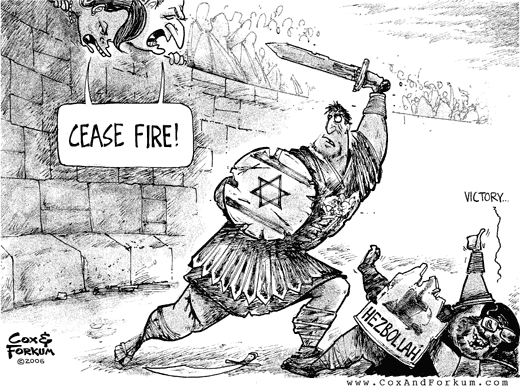
In a speech during an emergency meeting of Muslim leaders in Malaysia, Ahmadinejad also called for an immediate cease-fire to end the fighting between Israel and the Iranian-backed group Hezbollah.
"Although the main solution is for the elimination of the Zionist regime, at this stage an immediate cease-fire must be implemented," Ahmadinejad said, according to state-run television in a report posted on its Web site Thursday.
Israeli Foreign Ministry spokesman Mark Regev accused Ahmadinejad of trying to rally the region to support Iranian-backed Hezbollah.
"Our operation in Lebanon is designed to neutralize one of the long arms of Iran, Hezbollah," Regev said. "Hezbollah is their proxy, being used as an instrument of Teheran to advance their extremist agenda and the blow to Hezbollah is a blow to Iranian interests and a blow to all extremist Jihadist forces in the region.
From CNN: Hezbollah threatens to strike Tel Aviv.
On the diplomatic front, France circulated a revised draft resolution for the United Nations Security Council on Thursday calling for an immediate halt to Israeli-Hezbollah fighting and spelling out conditions for a permanent cease-fire in Lebanon.
The U.S. State Department said it hoped for a cease-fire resolution by Friday, but U.S. diplomats were prepared to work into the weekend to achieve a deal.
A sticking point has been the timing of a cease-fire. France and other European countries support Lebanon's call for an immediate cease-fire. The United States and Britain have said an immediate cease-fire would not eliminate the long-term threat that Hezbollah imposes on Israel.
In TIA Daily, Robert Tracinski has been providing excellent coverage and analysis of the big picture in the Hezbollah vs. Israel war. These are a couple of his must-read articles:
From RealClearPolitics: Iran's Strategy Is Crudely Obvious--So Why Can't We Fight It?.
The new Lebanon War, like much of the War on Terrorism, has a strange character. It is a war in which everyone knows the enemy's strategy, in which it is child's play to see through all of his ruses and propaganda tricks--and yet our leaders, rather than devising their own counter-strategy, fall for every ruse and play along with the enemy's game. ...
Everyone knows that Iran is using Hezbollah's war in Lebanon to distract attention from its nuclear weapons program. ...
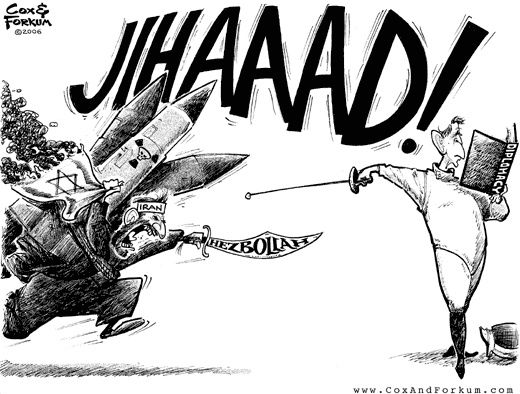
The Iranian strategy to buy time is utterly transparent and not especially clever. It is simple to defeat: declare that Hezbollah's aggression against Israel is proof of Iran's evil intentions and that we don't require any further diplomatic justification to bomb Iran's nuclear sites and bring down its regime.
Instead, Western leaders fell for the Iranian strategy, and the Iranians have pretty much gotten what they wanted. ...
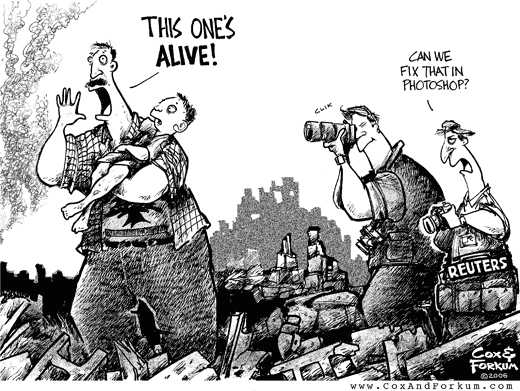
Secretary Rice has a reputation as an intelligent, hard-charging woman who doesn't scare easily. Over the past few months, she has blown that reputation, caving in to Iran and its European sympathizers--and now allowing herself to be panicked into appeasement by predictable images of Lebanese civilian casualties. The Iranians have not been playing a sophisticated diplomatic game--yet they have consistently outplayed Secretary Rice.
Just as obvious as the strategy of the Iranian Axis are the destructive consequences of America's diplomatic retreat in the face of Hezbollah's war.
Also by Tracinski at RealClearPolitics: What Part of 'War' Don't We Understand?.
Part of the reason America hesitates to act is because generations of Pragmatists have tried to turn our brains into bags full of knots--making it harder for us to see the big picture and the bold strokes that are actually necessary to defeat our enemies.
Just as powerful is the warped logic of the "suicide bomb morality" of altruism, which identifies self-sacrifice as the essence of virtue. In any conflict, the good guys are expected to prove that they are good by backing down and sacrificing their interests--while nothing is expected of the bad guys, precisely because they are evil. That's why a Los Angeles Times op-ed demanded that Israel "has to be the most responsible party" by declaring an immediate ceasefire. Why should Israel be the first to back down from the fight? The author answers: "What, after all, can we expect from Hamas or Hezbollah?"
Notice the warped psychology this fosters: the onus is always on the good guys to turn the other check and submit to evil. This is a moral outlook that empowers the evil because they are evil and restrains the good because they are good. Should we then be surprised to see the evil emboldened to greater acts of destruction?
There is no longer any doubt what is driving the conflict in the Middle East: it is the Syrian-Iranian strategy of using proxies to strike at the US and extend Iran's fanatical influence over the region. The only question is whether we can stop tying our brains into knots and stop turning the other cheek long enough to strike back and topple these two regimes.
"Changement de Rythme" (or "Broken Time") is a fencing term meaning "a sudden change in the tempo of one fencer's actions, used to fool the opponent into responding at the wrong time." Or perhaps in the wrong way, as in the case of the cartoon.
From the Jerusalem Post: As Ahmadinejad watches by Caroline Glick. (via Regime Change Iran)
Iranian President Mahmoud Ahmadinejad is the man to watch these days. And yet it would seem that those in positions of power are paying him little heed. ...
This week the UN Security Council is supposed to pass a resolution giving Iran until August 31 to end its nuclear programs. The obvious meaning of the new deadline is that until then, in spite of Iran's direction of Hizbullah's war against Israel - a state which Iran daily threatens to destroy - no action will be taken against Teheran.
Indeed, in all the talk of Security Council resolutions regarding the war that Iran's proxy force Hizbullah is waging against Israel, no one has mentioned the possibility of condemning Iran, or Syria, for their sponsorship of Hizbullah.
AS THE STAKES of the war against Israel rise by the day, we find the international community, led by the US, and willingly followed by the Olmert government, scope-locked on a diplomatic agenda that is irrelevant to the imminent dangers Israel and the world now face in the midst of this Iranian sponsored jihad.
Aug 2, 2006 | Dollars & Crosses
From Cox and Forum:
From CNN: Castro's illness sparks speculation, rumors.Celebration in the streets of Little Havana gave way Tuesday to speculation about the state of Fidel Castro's health and what would happen in Cuba if he were to die, while county officials activated a rumor control hot line.
Castro remained out of sight Tuesday after undergoing intestinal surgery and temporarily turning over power to his brother Raul. Some in Florida speculated that the leader who has defied the United States for nearly half a century already could be dead.
"When a man has been in power for so long, they don't tell people at first. I am afraid that when people begin to realize that he is dead, the real fight for power will begin," said Eric Hernandez, 33, a writer for Telemundo who said he had canceled plans to return to Cuba on Friday to visit his father for the first time in five years.
South Florida's Cuban-American community of about 800,000 is the largest segment of the state's fast-growing Hispanic community and its influence is felt across Florida. Cheering crowds waving Cuban flags celebrated the news of Castro's illness late Monday and into early Tuesday.
One group had dressed as migrants wearing life jackets, pretending to paddle a cardboard boat down Little Havana's Calle Ocho in Miami -- recalling the desperate journey many exiles have taken across the Florida Straits.
"This is a celebration of people of hope returning to their home country, something that is 40-something years in the making," said Joe Martinez, chairman of Miami-Dade County commissioners, who was born in Cuba.
UPDATE: From CNN: Cuban TV: Castro says health 'stable'.Fidel Castro's health situation is "stable" and he is in "good spirits," according to a message attributed to him and read on Cuban television Tuesday evening.
The message provided little detail about the medical condition that prompted Castro to temporarily cede power to his brother, Raul, on Monday.
Blaming intestinal surgery, Cuban television reported the handover Monday night, the first time Castro has ceded control of the island nation in 47 years.
From CBS News: Chavez, The Future Of Communism?. (hat tip Chris Byers)Cuba is the isolated Communist island that has never squeezed itself out from under the thumb of the West, focusing most of its energy on weathering the U.S. trade embargo. Though Castro survived U.S. attempts on his life, like the CIA's famous exploding seashell, his famous tumble down the stairs in old age was a metaphor for his regime. Cuba became the floating prison from which thousands of influential American immigrant businesspeople, politicians, etc., hailed, and never has ceased to be the island from which citizens risk life and limb to escape. Whereas Castro envisioned that his Communist utopia would set the gold standard for the world, he has been handily upstaged by dissidents and exiles who have, over the decades, become poster children for the fundamental thirst for liberty.