Jan 20, 2021 | Politics
From "Opinion | How Will President Biden Govern?":
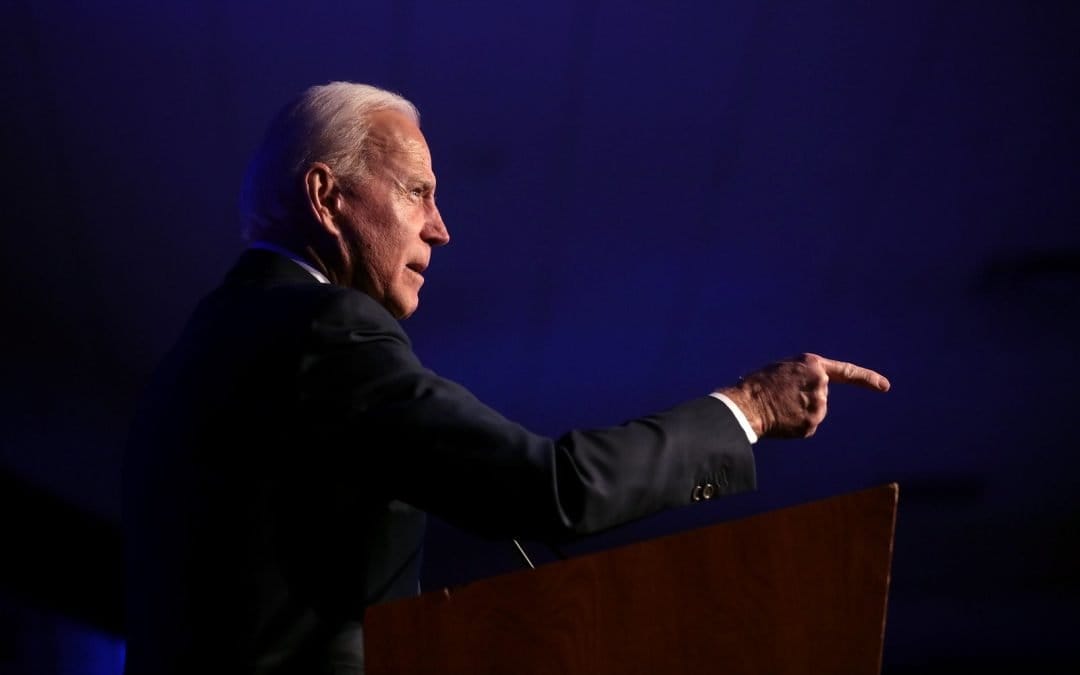
Left to his own political instincts, Mr. Biden could be the man for this moment. He is a moderate liberal with sympathy for the working class who is inclined to reach across the political aisle. With a 50-50 Senate and a narrow House majority, he also has good practical reason to do so. At 78 years old, he realizes he is likely to serve only one term and could create an admirable legacy as the man who calmed the Trump-era furies. That, at least, is our hopeful case for the Biden years.***
Yet Mr. Biden also comes to power with a Democratic Party whose ascendant progressives have other ideas. Their goal is to use the federal government as a battering ram to drive economic and cultural “transformation.” Progressives in the House and Senate, urged on by the Democratic media complex and Silicon Valley, view the defeat of Donald Trump as the opening to assert a new level of government control over the economy and cultural dominance over American society.[...]Mr. Biden’s rhetoric in particular has been more condemning than unifying. He was right to blame Mr. Trump for contributing to the Jan. 6 Capitol riot, but comparing Sens. Josh Hawley and Ted Cruz to Joseph Goebbels is Trump-like excess. His speech writers seem infused with woke ideology, as they cast the riot and most other events in the language of identity politics. Mr. Biden’s early legislative priorities also seem odd given that he has no great election mandate and a narrowly divided Congress. Ron Klain, his new White House chief of staff, described the top priorities as addressing four “overlapping and compounding crises”—Covid, the economy, climate and racial justice. The rhetoric of “crisis” is the familiar progressive trope to scare the public into accepting radical change...
Photo Credit: Gage Skidmore.
Jan 13, 2021 | Politics
Twitter removing Tweets at its fancy is not censorship if Twitter is doing so of its own free-will.No one has the right to Tweet, it is a privilege. The right to determine what goes on the Twitter website belongs to the owners of Twitter. If someone (like a government bureaucrat) is forcing Twitter to remove certain Tweets, or forcing them to display certain Tweets, then they are censoring Twitter.If Twitter bans a user from "speaking" on their platform they are free to speak elsewhere or create their own platform. Their right to freedom of speech remains unabridged.How is this possible? It is because individual rights form a unity. There is only one right - the right to life - which is the freedom to take those actions necessary to preserve one's life and pursue one's happiness so long as one does not violate the rights of others.All other rights (right to property, right to freedom of speech, etc.) are derivatives of the fundamental right to life and when properly defined do not contradict each other. Thus Twitter's right to use and dispose of its property does not contradict one's right to speak freely free from the initiation of physical force (such as threats of imprisonment or threats of physical violence).Not so with the collectivist notion of "rights" which holds that a property owner does not have an inalienable right to their property, but may only use their property by permission of the collective, the "people", the state. Ayn Rand brilliantly demonstrates the contradictions inherent in the collectivist notion of "censorship" when she notes:"For years, the collectivists have been propagating the notion that a private individual’s refusal to finance an opponent is a violation of the opponent’s right of free speech and an act of “censorship.”"It is “censorship,” they claim, if a newspaper refuses to employ or publish writers whose ideas are diametrically opposed to its policy."It is “censorship,” they claim, if businessmen refuse to advertise in a magazine that denounces, insults and smears them . . . . [“Man’s Rights” The Virtue of Selfishness, 98]
Or: It is censorship if Twitter refuses to display a Tweet on its website that it disagrees with.Such a confused notion of censorship turns the meaning of censorship on its head:
"[This collectivist notion] means that the ability to provide the material tools for the expression of ideas deprives a man of the right to hold any ideas. It means that a publisher has to publish books he considers worthless, false or evil — that a TV sponsor has to finance commentators who choose to affront his convictions — that the owner of a newspaper must turn his editorial pages over to any young hooligan who clamors for the enslavement of the press. It means that one group of men acquires the “right” to unlimited license — while another group is reduced to helpless irresponsibility." [“Man’s Rights” The Virtue of Selfishness, 98]
Jan 13, 2021 | Politics
Vivek Ramaswamy and Jed Rubenfeld write in the WSJ on "Save the Constitution From Big Tech":"Facebook and Twitter banned President Trump and numerous supporters after last week’s disgraceful Capitol riot, and Google, Apple and Amazon blocked Twitter alternative Parler—all based on claims of “incitement to violence” and “hate speech.” Silicon Valley titans cite their ever-changing “terms of service,” but their selective enforcement suggests political motives."
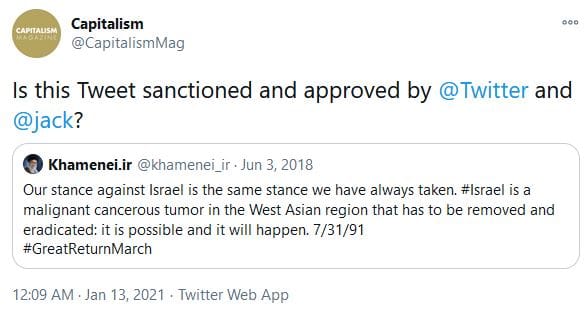
As an example take this Tweet that apparently meets the criteria of safe content that presumably is not an “incitement to violence” or “hate speech.”: This Tweet has been up for several years.Regulatory threats are the modus operandi of fascism
Continuing from the WSJ article:"Conventional wisdom holds that technology companies are free to regulate content because they are private, and the First Amendment protects only against government censorship."
This is and remains true - as long as those companies are private not just in name (de jure) but in practice (de facto). But what happens when those companies have been co-opted by government officials?"Google, Facebook and Twitter should be treated as state actors under existing legal doctrines. Using a combination of statutory inducements and regulatory threats, Congress has co-opted Silicon Valley to do through the back door what government cannot directly accomplish under the Constitution."
"Using a combination of statutory inducements and regulatory threats" is the modus operandi or operating method of fascism.Writes Ayn Rand on the essential characteristic of fascism:"The main characteristic of socialism (and of communism) is public ownership of the means of production, and, therefore, the abolition of private property. The right to property is the right of use and disposal. Under fascism, men retain the semblance or pretense of private property, but the government holds total power over its use and disposal.The dictionary definition of fascism is: “a governmental system with strong centralized power, permitting no opposition or criticism, controlling all affairs of the nation (industrial, commercial, etc.), emphasizing an aggressive nationalism . . .” [The American College Dictionary, New York: Random House, 1957.]
"Under fascism, citizens retain the responsibilities of owning property, without freedom to act and without any of the advantages of ownership. [“The Fascist New Frontier,” The Ayn Rand Column, 98.]
The Carrot and The Stick
The authors of the WSJ opinion piece then go on to discuss Section 230 of the 1996 Communications Decency Act, which allows website owners to remove user-posted content from their websites (what the authors falsely claim as censoring speech) while not being held liable for content posted by users that remain."It is “axiomatic,” the Supreme Court held in Norwood v. Harrison (1973), that the government “may not induce, encourage or promote private persons to accomplish what it is constitutionally forbidden to accomplish.” That’s what Congress did by enacting Section 230 of the 1996 Communications Decency Act, which not only permits tech companies to censor constitutionally protected speech but immunizes them from liability if they do so."The justices have long held that the provision of such immunity can turn private action into state action. In Railway Employees’ Department v. Hanson (1956), they found state action in private union-employer closed-shop agreements—which force all employees to join the union—because Congress had passed a statute immunizing such agreements from liability under state law. In Skinner v. Railway Labor Executives Association(1989), the court again found state action in private-party conduct—drug tests for company employees—because federal regulations immunized railroads from liability if they conducted those tests. In both cases, as with Section 230, the federal government didn’t mandate anything; it merely pre-empted state law, protecting certain private parties from lawsuits if they engaged in the conduct Congress was promoting.""Section 230 is the carrot, and there’s also a stick: Congressional Democrats have repeatedly made explicit threats to social-media giants if they failed to censor speech those lawmakers disfavored. In April 2019, Louisiana Rep. Cedric Richmond warned Facebook and Google that they had “better” restrict what he and his colleagues saw as harmful content or face regulation: 'We’re going to make it swift, we’re going to make it strong, and we’re going to hold them very accountable.' New York Rep. Jerrold Nadler added: 'Let’s see what happens by just pressuring them.' "
"Such threats have worked. ...It’s no accident that big tech took its most aggressive steps against Mr. Trump just as Democrats were poised to take control of the White House and Senate. Prominent Democrats promptly voiced approval of big tech’s actions, which Connecticut Sen. Richard Blumenthal expressly attributed to 'a shift in the political winds.' "
"Censorship, in its old-fashioned meaning, is a government edict that forbids the discussion of some specific subjects or ideas — such, for instance, as sex, religion or criticism of government officials — an edict enforced by the government’s scrutiny of all forms of communication prior to their public release. But for stifling the freedom of men’s minds the modern method is much more potent; it rests on the power of nonobjective law; it neither forbids nor permits anything; it never defines or specifies; it merely delivers men’s lives, fortunes, careers, ambitions into the arbitrary power of a bureaucrat who can reward or punish at whim. It spares the bureaucrat the troublesome necessity of committing himself to rigid rules — and it places upon the victims the burden of discovering how to please him, with a fluid unknowable as their only guide.""No, a federal commissioner may never utter a single word for or against any program. But what do you suppose will happen if and when, with or without his knowledge, a third-assistant or a second cousin or just a nameless friend from Washington whispers to a television executive that the commissioner does not like producer X or does not approve of writer Y or takes a great interest in the career of starlet Z or is anxious to advance the cause of the United Nations?" [“Have Gun, Will Nudge” The Objectivist Newsletter, March, 1962]
Or in this case, signaling out and canceling a private company - Parler - which at the time of its cancellation was the most popular and most downloaded app on the internet - that provided an outlet that provides serious competition to the established "progressive" far-left tech and political orthodoxy.What makes this all the more ominous is that the CEOs of social media tech companies are calling out for further regulation to violate their rights, which they find preferable to the pressure of continuous, arbitrary government "pressure" and threats.What these Big-Tech CEOs do not realize is that when the door is fully opened for the government to partially violate the rights of tech-Companies through regulations, the threats will only become greater, until they only own their companies in name, with the actual company board decisions being made by Congress and the actual CEOs becoming government bureaucrats in another alphabet government agency, so that they become little more than public utilities.