Oct 4, 2004 | Dollars & Crosses
From Daniel Pipes:
...There's been a hue and cry about releasing the prisoners at Guantánamo Bay, Cuba, so this is now taking place. But two recent developments concerning former inmates should prompt the U.S. government to rethink this incautious policy:- Abdul Ghaffar, an Afghan, returned to Afghanistan and rejoined the Taliban as a commander. He was killed in a raid by Afghan security forces on Sept. 25 in Uruzgan.
- Slimane Hadj Abderahmane, a Dane, 31, announced on Danish television on Sept. 29 that he plans to hide from the Danish authorities until he can get to Chechnya where he will fight the Russians in the jihad there. As for the agreement he signed with the U.S. authorities promising not to engage in terrorist activity, he said, "This document is toilet paper for the Americans if they want it."
Oct 3, 2004 | Dollars & Crosses
From Cox and Forkum:

FoxNews reports: U.S., Iraqi Forces Mop Up Samarra.U.S. commanders have praised the performance of Iraqi security forces in the offensive in Samarra, 60 miles northwest of Baghdad, calling the assault a successful first step in a major push to wrest key areas from insurgents before January elections.
Oct 2, 2004 | Dollars & Crosses
From an interview with Lisa Von Damme:
Schools today commit flagrant violations of hierarchy. At a high school in my area, the freshman social studies program begins with a study of the nature and value of the U.N. (before the students have even a rudimentary knowledge of history); the science curriculum begins with DNA replication (before students know about Mendel and Darwin and basic genetic theory); English classes begin with subtleties of literary style (before students have a basic understanding of plot and theme). Education needs to be totally reconceived with the principle of hierarchy in mind.
In my opinion, what is offered to students in today's schools bears little resemblance to education. If education is a study of the core subjects with the goal of providing students with that abstract knowledge which is essential to a mature mind, then education was abandoned by the schools long ago. The integrated, essentialized study of history, with its sweeping generalizations about man, has been rejected in favor of the disintegrated, concrete-bound subject of "social studies." The classics of literature, with their timeless themes and penetrating insights into man and the nature of the universe, have been replaced by whatever contemporary works happen to be in political favor. The world is in desperate need of an educational renaissance.
You can read the entire interview here.
Oct 2, 2004 | Dollars & Crosses
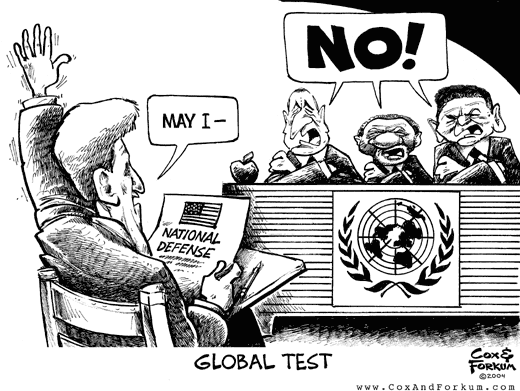
From Cox and Forkum:

The "Global Test" cartoon has an update that touches on America's right to use preemptive force. This cartoon and post elaborate the issue further.
In the past, Senator Kerry has condemned the Iraq invasion as a "war of choice," saying that President Bush's use of preemptive force was wrong because there was no imminent threat from Iraq. In the debate, he emphasized this by pointing out that Iraq had not attacked America on 9/11, Osama bin Laden had.
Kerry acknowledged America's right to use preemptive force (*see below), and that's consistent with his previously stated imminent-threat threshold. But unlike Bush, Kerry didn't make it clear that he would ever choose to use preemptive force to prevent a growing threat. An imminent attack obviously demands an immediate response by its very nature. Only a pacifist would advocate sitting still in the face of an impending attack. And there's no reason to doubt that Kerry would, as he declared at the Democrat convention, meet an attack "with a swift and certain response."
However, the question of using preemptive force is one of preventing attacks before they are imminent, as in Iraq. Nothing I've heard from Kerry indicates he would do so. Worse still, he seems to have purposefully obfuscated the issue while at the same time making it a central argument against the invasion of Iraq.
(Another cartoon on the topic: "Detour of Duty".)
*Kerry from the presidential debate transcript:The president always has the right, and always has had the right, for preemptive strike. That was a great doctrine throughout the Cold War. And it was always one of the things we argued about with respect to arms control.
No president, through all of American history, has ever ceded, and nor would I, the right to preempt in any way necessary to protect the United States of America.
But if and when you do it, ... you have to do it in a way that passes the test, that passes the global test where your countrymen, your people understand fully why you're doing what you're doing and you can prove to the world that you did it for legitimate reasons. [...]
How many leaders in the world today would respond to us, as a result of what we've done [in Iraq], in that way? So what is at test here is the credibility of the United States of America and how we lead the world. And Iran and Iraq are now more dangerous -- Iran and North Korea are now more dangerous.
Now, whether preemption is ultimately what has to happen, I don't know yet.
Oct 1, 2004 | Dollars & Crosses
From Cox and Forkum:
In the last night's presidential debate, Senator Kerry criticized President Bush's decision to invade Iraq for not passing a "global test." Kerry stressed the need for more international assistance in Iraq, stating repeatedly that we're suffering 90% of the casualties and shouldering 90% financial burden. However, Charles Johnson quoted a relevant Financial Times article from earlier this week: No French or German turn on Iraq:French and German government officials say they will not significantly increase military assistance in Iraq even if John Kerry, the Democratic presidential challenger, is elected on November 2.
Mr Kerry, who has attacked President George W. Bush for failing to broaden the US-led alliance in Iraq, has pledged to improve relations with European allies and increase international military assistance in Iraq.
"I cannot imagine that there will be any change in our decision not to send troops, whoever becomes president," Gert Weisskirchen, member of parliament and foreign policy expert for Germany's ruling Social Democratic Party, said in an interview. [...]
Michel Barnier, the French foreign minister, said last week that France, which has tense relations with interim prime minister Iyad Allawi, had no plans to send troops "either now or later."
In the debate, Bush responded appropriately to Kerry's "global test" comment:"I'm not exactly sure what you mean, 'passes the global test,' you take pre-emptive action if you pass a global test. My attitude is you take pre-emptive action in order to protect the American people, that you act in order to make this country secure."
From AP: Bush: Kerry would let France control US military. (Via Little Green Footballs)"The use of troops to defend America must never be subject to a veto by countries like France," Bush told supporters a day after Kerry said the United States ought to pass a "global test" before launching a preemptive war.
Kerry spokesman David Wade accused the president of taking Kerry's words out of context and brushed off the attack as a desperate ploy, saying: "They want to run against a straw man. Instead, they have to run against John Kerry."
"Out of context"? In the context of his "pass the global test" comment, Kerry said that in using the preemptive strike option, a president not only has to make sure his countrymen understand why, but he also has to "prove to the world that [he] did it for legitimate reasons." The obvious implication of this is that if a president can't satisfactorily "prove to the world that [he] did it for legitimate reasons," then he doesn't have a right to use preemptive force. Kerry's use of "legitimate reasons" is very broad and, I think, intentionally vague, but it's clear that he considers our sovereign right to launch a war of self-defense somehow subject to whether or not "the world" (whatever that means) approves of our evidence, motives and goals. If that's not making the use of troops to defend America "subject to a veto by countries like France," I don't know what is.
Speaking of France, reader Barry Rab directed us to this New York Post op-ed by Amire Taheri, in which he writes:Add to this the recent bizarre phrase from French Prime Minister Jean-Pierre Raffarin. The head of the Figaro press group went to see him about the kidnapping of two French journalists in Iraq; Raffarin assured him they would soon be freed, reportedly saying, "The Iraqi insurgents are our best allies."
In plain language, this means that, in the struggle in Iraq, Raffarin does not see France on the side of its NATO allies -- the U.S., Britain, Italy and Denmark among others -- but on the side of the "insurgents."
UPDATE October 6: From The Washington Times: Kerry says Franco-German troops unlikely.Democratic presidential nominee Sen. John Kerry conceded yesterday that he probably will not be able to convince France and Germany to contribute troops to Iraq if he is elected president. The Massachusetts senator has made broadening the coalition trying to stabilize Iraq a centerpiece of his campaign, but at a town hall meeting yesterday, he said he knows other countries won't trade their soldiers' lives for those of U.S. troops.
The real Global Test? The Washington Times reports: U.N. panel to frame guidelines on legality of pre-emptive strike. (Via Little Green Footballs)Members of an international panel studying United Nations' operations say the group hopes to lay down clear rules declaring when it is legal for a nation to use pre-emptive military force in its own defense.
The issue grows out of the international controversy over the Bush administration's decision to invade Iraq without a final U.N. Security Council resolution explicitly authorizing the war, said panel member Gareth Evans, a former foreign minister of Australia.
"I expect the panel to be giving close consideration to what those rules are and how they should be applied and whether an effort should be made to identify generally agreed criteria for the legitimate use of force, whatever the context," Mr. Evans said during a recent appearance at the Woodrow Wilson International Center for Scholars in Washington.
He made his remarks before last week's presidential debate in which Democratic nominee Sen. John Kerry's call for a "global test" on when pre-emptive action is justified became a campaign issue.
Sep 29, 2004 | Dollars & Crosses
The St. John's College Objectivist Club will present a live talk: Ayn Rand's Epistemology is a Moral Matter by Craig Biddle on Tuesday, October 5, at 7:30 p.m. in the FSK Auditorium.
Epistemology is the study of how knowledge is acquired and validated; it identifies what a person should and should not do with his mind if he wants to keep his thinking tied to reality. But good thinking is not an end in itself; one does not strive to think well for the sake of being rational. The ultimate reason to think well is to live well; good thinking is for good living. Epistemology is, in this respect, a moral matter; it is the science of the selfish, life-promoting way to use one's mind. This talk explores the moral nature of epistemology, the principles involved in this integration, and their implications in daily life.
Craig Biddle is the author of Loving Life: The Morality of Self-Interest and the Facts that Support It and of the forthcoming Good Thinking for Good Living: The Science of Being Selfish. This event is free and open to the public. Donations are welcome, but not required. For more information, contact club president Daniel Schwartz at dschwartz@sjca.edu.