Jul 31, 2005 | Dollars & Crosses
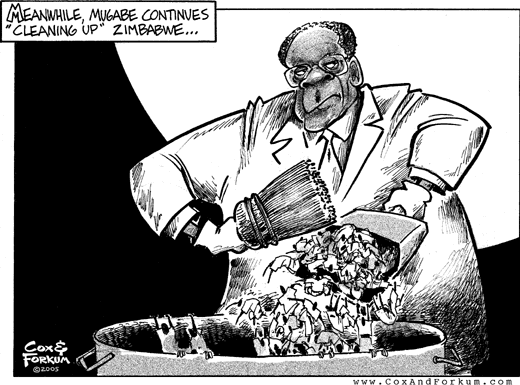
Yahoo News on "Slum clearance" in Zimbabwe:
Zimbabwe's destruction of urban slums is a "disastrous venture" that has left 700,000 people without homes or jobs, violated international law and created a grave humanitarian crisis, a harshly worded U.N. report said Friday. [...] The report detailed the devastating extent of Operation Murambatsvina, or Drive Out Trash, for the first time. It said a further 2.4 million people have been affected by the countrywide campaign that began with little warning on May 19 and has seen thousands of shantytowns, ramshackle markets and makeshift homes demolished. "While purporting to target illegal dwellings and structures and to clamp down on alleged illicit activities, (the operation) was carried out in an indiscriminate and unjustified manner, with indifference to human suffering," the report said.
[...] Annan urged Zimbabwe to stop the destruction and sought to shift the attention from blame to rebuilding. "Criticism, while fully justified, is not enough," Annan said in a statement. "We have a duty to help those in need."
[...] The state-owned Herald quoted the country's U.N. representative, Boniface Chidyausiku, as saying: "The President will make a comment at the appropriate time. Zimbabwe is not under any inquisition to warrant 48 hours of responding." He demanded the international community raise funds so Zimbabwe can provide cheaper housing for its people. "One would call upon Britain and the European Union to stop their campaign to vilify our economy. Were it not for their sanctions, our economy wouldn't be where it is today." [...]
[Opposition legislator Trudy Stevenson of the Movement for Democratic Change] welcomed Tibaijuka's description of the evictions as a breach of international law, recalling they left at least 20,000 of her constituents without shelter in the midwinter cold. The sick and elderly had died and children had been left orphaned, she said. "So let's get them (the government) in the international courts," Stevenson said. Stevenson's MDC alleged that "Operation Murambatsvina" aimed to victimize those who voted for the opposition in March 31 parliamentary elections and drive them back to rural areas, where they could be intimidated by blocking their access to relief food.
[...] U.N. agencies estimate 4 million Zimbabweans need relief following the seizure of 5,000 white-owned farms and the collapse of the agricultural-based economy.
[...] African nations on the 15-member Security Council have so far kept the crisis in Zimbabwe off the council's agenda. But several U.N. diplomats said they are hoping to get Tibaijuka to brief members on the report next week.
From Cox and Forkum:
Jul 29, 2005 | Dollars & Crosses
Gary Hull, long-time speaker for the Ayn Rand Institute, will present a lecture on his recently released book, "The Abolition of Antitrust," on Book-TV C-SPAN 2. The show will air this Sunday, July 31, at 5:30 AM, Eastern time. Here is an edited version of Book-TV s description of the show:
Gary Hull, editor of the book "The Abolition of Antitrust," argues that antitrust laws are harmful. Mr. Hull and other contributing writers assert that these laws are based on bad economics and the misinterpretation of American business history. Gary Hull is joined by Yaron Brook, president of the Ayn Rand Institute in Irvine, California, to examine several antitrust cases, including General Electric, Visa/MasterCard, and Kellogg/General Mills. [Hat Tip: HBL]
Jul 22, 2005 | Dollars & Crosses
IRVINE, CA--Some say President Bush's $50,000 aid offer to hurricane-ravaged Cuba is an insultingly trivial amount. Dr. Andrew Bernstein, senior writer for the Ayn Rand Institute, says offering any aid to Castro is aiding and abetting terrorism.
"Not a penny of aid should be granted to Castro's regime under any circumstances," Bernstein says, "because he is a bloody-handed dictator who oppresses his own people and is a sworn enemy of the United States. Castro's forces have executed thousands of individuals who oppose his regime, forced tens of thousands of political prisoners into slave labor, and murdered countless victims for the 'crime' of attempting to defect.
"Both logic and history show," said Dr. Bernstein, "that dictators use aid for natural-disasters, whether public or private, for their own nefarious purposes."
Bernstein points to Castro's past and current crimes. "De-classified Soviet documents, as well as Nikita Khruschev's own memoirs, reveal that Castro implored the Soviets to launch a pre-emptive nuclear strike against America during the Cuban missile crisis. Currently, Castro provides moral and material support to the Iranian mullahs in their holy war against America. He has declared that, 'War against the United States is my true destiny.'
"Rather than aid Castro's war against us, President Bush should seek to end it. He should morally denounce Castro and his regime, encourage and aid defectors, support dissidents, and pressure other free nations to do the same. Our goal should be a free Cuba and the removal of the 'terrorist next door.'"Jul 11, 2005 | Dollars & Crosses
From Cox and Forkum:
The terrorists who committed the atrocities were not terrorists, they were simply "misguided criminals" according to the BBC's John Simpson:
Now that the bombs have exploded, and thousands of newspaper pages and entire days of air time have been devoted to the horror of it all, and to the poor, decent people who are dead and missing, and to the misguided criminals responsible, perhaps we can stand back from it all and catch our breath.["London bombs need calm response"]
Terrorism apparently is only to be used to describe Israel's efforts to defend itself.Jul 10, 2005 | Dollars & Crosses
African Economics Expert James Shikwati speaks in the German Magazine, DER SPIEGEL (27/2005 - July 4, 2005 ) on how aid to Africa does more harm than good. He advocates that Africa could solve its own problems if it adopts a free-market.
On the West's intentions want to eliminate hunger and poverty through government aid:
Such intentions have been damaging our continent for the past 40 years. If the industrial nations really want to help the Africans, they should finally terminate this awful aid. The countries that have collected the most development aid are also the ones that are in the worst shape. Despite the billions that have poured in to Africa, the continent remains poor. [...] Huge bureaucracies are financed (with the aid money), corruption and complacency are promoted, Africans are taught to be beggars and not to be independent. In addition, development aid weakens the local markets everywhere and dampens the spirit of entrepreneurship that we so desperately need. As absurd as it may sound: Development aid is one of the reasons for Africa's problems. If the West were to cancel these payments, normal Africans wouldn't even notice. Only the functionaries would be hard hit. Which is why they maintain that the world would stop turning without this development aid.
On starvation in Kenya, and how the UN Food Program subsidizes corruption by eliminating free-markets in favor of corrupt bureaucratic ones:
When there's a drought in a region of Kenya, our corrupt politicians reflexively cry out for more help. This call then reaches the United Nations World Food Program -- which is a massive agency of apparatchiks who are in the absurd situation of, on the one hand, being dedicated to the fight against hunger while, on the other hand, being faced with unemployment were hunger actually eliminated. [...] and at some point, this corn ends up in the harbor of Mombasa. A portion of the corn often goes directly into the hands of unscrupulous politicians who then pass it on to their own tribe to boost their next election campaign. Another portion of the shipment ends up on the black market where the corn is dumped at extremely low prices. Local farmers may as well put down their hoes right away; no one can compete with the UN's World Food Program. And because the farmers go under in the face of this pressure, Kenya would have no reserves to draw on if there actually were a famine next year. It's a simple but fatal cycle. [...] Hunger should not be a problem in most of the countries south of the Sahara. In addition, there are vast natural resources: oil, gold, diamonds. Africa is always only portrayed as a continent of suffering, but most figures are vastly exaggerated.
On how AIDS in Africa is exaggerated and how malaria is downplayed:
If one were to believe all the horrorifying reports, then all Kenyans should actually be dead by now. But now, tests are being carried out everywhere, and it turns out that the figures were vastly exaggerated. It's not three million Kenyans that are infected. All of the sudden, it's only about one million. Malaria is just as much of a problem, but people rarely talk about that. [...] AIDS is big business, maybe Africa's biggest business. There's nothing else that can generate as much aid money as shocking figures on AIDS. AIDS is a political disease here [...] Millions of dollars earmarked for the fight against AIDS are still stashed away in Kenyan bank accounts and have not been spent. Our politicians were overwhelmed with money, and they try to siphon off as much as possible.
On donations of clothes to Africans and how they destroy local markets:
[...] and they flood our markets with that stuff. We can buy these donated clothes cheaply at our so-called Mitumba markets. There are Germans who spend a few dollars to get used Bayern Munich or Werder Bremen jerseys, in other words, clothes that that some German kids sent to Africa for a good cause. After buying these jerseys, they auction them off at Ebay and send them back to Germany -- for three times the price. That's insanity [...]
Why do we get these mountains of clothes? No one is freezing here. Instead, our tailors lose their livelihoods. They're in the same position as our farmers. No one in the low-wage world of Africa can be cost-efficient enough to keep pace with donated products. In 1997, 137,000 workers were employed in Nigeria's textile industry. By 2003, the figure had dropped to 57,000. The results are the same in all other areas where overwhelming helpfulness and fragile African markets collide.
Jul 3, 2005 | Dollars & Crosses
Here is what they should have been saying during Live 8: "Capitalism Is the Cure for Africa's Problems."