Apr 15, 2003 | Dollars & Crosses
Iran's former president expressed support Saturday for holding a referendum on restoring ties with the United States, marking a significant shift as his fellow hard-liners nervously watch U.S.-led forces take control of neighboring Iraq. Hashemi Rafsanjani has openly sided with hard-liners since stepping down as president in 1997 and still heads a powerful body advising Iran's supreme leader, Ayatollah Ali Khamenei....The mere mention of a referendum represents a marked shift by Rafsanjani. [Associated Press, 4/12/03]
Apr 15, 2003 | Dollars & Crosses
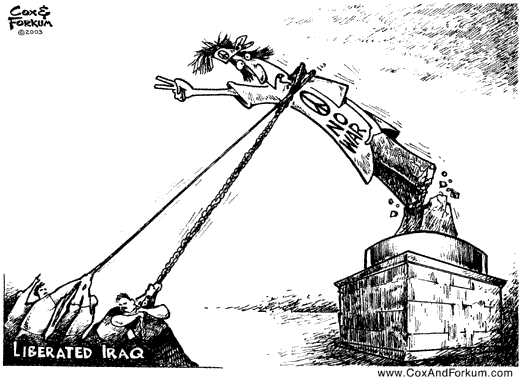
From Cox and Forkum:
Apr 14, 2003 | Dollars & Crosses
Today I went on an architectural walking tour of Newspaper Row and Manhattan's civic center; the tour was conducted by the New York Sun's Francis Morrone, in honor of the paper's first anniversary. (Morrone writes the Sun's "Abroad in New York" column.) He made a few observations that I thought would be worth posting.
City Hall Park goes back to the 17th century; before City Hall was there, it was known as the Commons. On July 9, 1776 the Declaration of Independence was publicly read there; here's what happened:
On July 9, 1776, upon hearing the Declaration of Independence, an enraged crowd marched down Broadway to Bowling Green where stood a large lead statue of King George III astride a horse.... Ropes were thrown around the Romanized icon and the body was pulled down.
As Morrone said, "The history of the world can be read in its toppled statues." (Or something to that effect.)
Morrone also called attention to St. Paul's Church, where George Washington worshipped and where his memorial was held when he died. He mentioned how the church survived the Great Fire of 1776 when everything around it was destroyed:
Did you know that St. Paul's is the oldest extant building in New York, give or take a few farmhouses? It was finished in 1766, which means it survived the Revolution and British occupation, the Great Fire of 1776, when a third of the town was destroyed, the Great Fire of 1835, when almost 700 downtown buildings were destroyed on a freezing December night, and everything since. This city is a great churning engine of destruction and creation, with the past, until only a generation or so ago, dispatched with a wanton ferocity, yet the dark, ruddy St. Paul's remains. [Matthew Wills, Notes from Brooklyn, 11/9/01]
Recently St. Paul's Church survived once again--the World Trade Center was just across the street but the church remained unharmed. Morrone suggested that instead of some hideous modern sculpture the most fitting memorial to September 11 would be the church itself.Apr 14, 2003 | Dollars & Crosses
I don't believe the major music labels deserve to have their music stolen by downloads from the Internet. That said, to my knowledge the record industry is not a business that has conducted itself with much integrity. So it's good to see that profits are being made by those who refuse to pander to the lowest common denominator:While executives at [the five mega-majors: Sony Music Entertainment Inc., Universal Music Group, BMG Entertainment, EMI Group, and Warner Music Group] wail about the industry's imminent collapse, indie labels and artists are singing a much happier tune. Profits are up--in some cases by 50 to 100 percent. That's in contrast to overall album sales, which dropped about 11 percent in 2002. You won't hear many of these labels' artists on pop radio--and ironically, that's one of the secrets to their success. By avoiding the major expenses associated with getting a tune on the air--which can cost upwards of $400,000 or $500,000 per song--independent labels are able to turn a profit far more quickly, and share more of those profits with their artists. Another secret of their success is that the labels target consumers--namely, adults--who are still willing to pay for their music, rather than download it for free...At a major label, most artists are unlikely to earn anything unless they sell at least 1 million albums, and even then, they could wind up in debt. Everything from studio time to limo rides are charged against their royalties, which might be only $1 per disc sold. That compares with an indie artist, who can sell a disc for $15 at a concert. If they make $5 profit a disc on 5,000 discs, they pocket $25,000. [Christian Science Monitor, 4/11/03]
Apr 14, 2003 | Dollars & Crosses
From Cox and Forkum:

Writes Allen Forkum:And now for something completely different ... Sports Illustrated recently reported on the protests at the Augusta National Golf Club during the Masters Tournament. Feminist Martha Burk has been making a stink for months about the private club excluding women (as if it's any of her business) and organized a protest. Female golf fans are siding with the club, and at least a few people planned to counter protest. But one group in particular caught our eye, and though they decided not to protest, they get lots of credit for their name: Protesters Against Ridiculous Protests. Sports Illustrated's John Donovan has a humorous review of today's Augusta protests -- Mixed Message: Masters protest drowns in a sea of silliness.
Recommended: If you have enjoyed Cox and Forkum's work displayed at Capitalism Magazine don't forget to get their paperback collection of their cartoons available at the Cox and Forkum website.
Apr 13, 2003 | Dollars & Crosses
"The idea that Iraq's population would have welcomed American forces entering the country after a terrifying aerial bombardment was always utterly implausible. That this became one of the lynchpins of US policy is evidence of the rubbish fed to the Administration (many of whose members were out of touch with their country as well as keen on promoting their postwar careers by persuading the Americans of how easy an invasion would be.)"--Edward Said, tenured professor at Columbia University