Apr 25, 2003 | Dollars & Crosses
From Cox and Forkum:

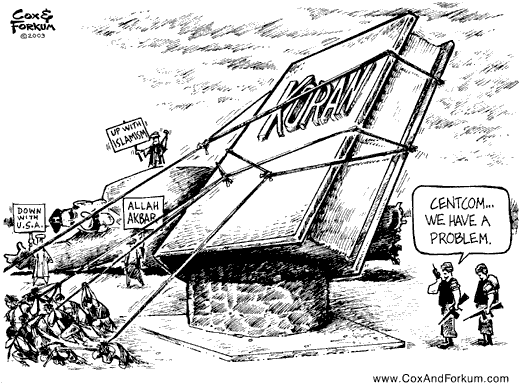
Comments Allen Forkum:Fox News reports: Iraqi Shiite Pilgrims Criticize U.S. and White House Eyeing Iranian Influence Among Iraqi Shiites. Excerpt from latter article: [White House Press Secretary Ari Fleischer] said Bush doesn't have a problem with Iraq being an Islamic state as long as it is a democratic and tolerant one. Officials point to the model of Turkey, a democratic nation run by an elected Islamic party that allows religious freedom. The United States opposes an Islamic dictatorship in Iraq, similar to that seen in Tehran, Fleischer said.
But a "democratic" state is not necessarily a "tolerant" one. Here are two good editorials about the type of government that should be established in Iraq:
The first is by Robert Tracinski of the Ayn Rand Institute: 'Iraqi Freedom' Requires Individual Rights. Excerpt: "The greatest threat to good government in Iraq is precisely that each tribal and religious faction will demand special favors, that the Shiites in the south will want a Khomeini-style theocracy, or that the Kurds will make a grab for control of the northern oil fields. This kind of political gang warfare between opposing factions is inevitable--so long as the government has the power to dispense such privileges. That is why it is crucial, for example, that the new Iraqi government enforce, not a balance of power between Sunnis and Shiites, but a separation of church and state."
The second editorial is from InterMarket Forecasting's Richard Salsman: Turning Iraq Into Another Iran. Excerpt: "The problem [of democracy] in Iraq is that 60% of the population consists of Shiite Muslims. They are more religious and more anti-American than the other two tribes (Kurd and Sunni) that comprise the population. The Shiites in Iraq are similar to those who run the dictatorial, terror-sponsoring theocracy in Iran. By deposing the Shah of Iran in 1979, the U.S. helped terrorist Shiites take hold of Iran. Will the U.S. now do the same thing in Iraq? It certainly will if it concedes to 'one-man, one-vote' in that country -- with no constitution protecting individual rights. If that is the result, the U.S. will have wasted its war effort, by allowing an Iran-style government to develop next to Iran."
Apr 25, 2003 | Dollars & Crosses
I've seen public displays of airheadedness before, but this pretty much takes the cake:
The three women of country music band the Dixie Chicks posed nude for the cover of a weekly showbiz magazine in a defiant response to the backlash over their opposition to the war in Iraq. [Reuters, 4/24/03]
There's defiance for you. The headline reads "Dixie Chicks Pose Nude in Answer to Critics"--a particularly intellectual sort of response, dealing decisively with the issues, wouldn't you say?
"We don't want people to think that we are trying to be provocative...."
I guess they don't want people to think they're particularly intelligent, either--or honest, given that last comment.
"It's not about the nakedness," band member Martie Maguire said in an accompanying interview with the magazine. "It's about clothes getting in the way of labels."
Oh. I see. Now it all makes sense. (Or maybe was it about labels getting in the way of clothes? ...or something.) To top it all off, they're just not all that attractive, even with their clothes off.
Related articles: Country Fried Dixie Chicks.--Ed
Apr 25, 2003 | Dollars & Crosses
Protests against the US presence in Iraq have been staged by Shias in the central city of Karbala at the climax of a pilgrimage that has attracted up to one million people....However the BBC's Damien Grammaticas in Karbala says the anti-US demonstrations were small-scale, involving only a few hundred people. [BBC News, 4/23/03]
Needless to say, the second sentence is buried deep in the article, whose headline is "Shias stage anti-US protest." And here's from the bottom of another article:
The Doctors Without Borders (MSF) group said that Baghdad hospitals are in dire straits, but that there was no large-scale health crisis in the country. "MSF has not found any reason to justify a major humanitarian medical programme in Iraq," said MSF international president Morten Rostrup. [Agence France Presse, 4/24/03]
This admission is all the more remarkable as, according to a mail I received from someone recently in southern Iraq, the more the aid agencies create stories of humanitarian crises, the more money they get--and the media often goes along unquestioningly.Apr 24, 2003 | Dollars & Crosses
An excellent editorial in today's New York Sun details the government's unconstitutional seizures of private property in New York:The [New York] Times worked out a deal under which the Empire State Development Corporation would condemn an entire city block, razing 10 properties and a parking lot. A number of residences... and more than 30 thriving businesses... will be swept away to accommodate the Times. The Times will be paying about $62 per square foot for its acquisition, according to the report, as opposed to $130 per square foot paid in a comparable private transaction for a nearby parcel....
The New York Stock Exchange, in lower Manhattan, wanted a location to build a new headquarters. It decided on a site across the street from its current location. Unfortunately for the NYSE, however, the location was occupied by residential and commercial properties. Instead of letting that get it down, however, the NYSE decided to threaten the city with leaving Manhattan altogether if it didn't help in the acquisition of the properties. The New York City Economic Development Corporation complied and began the process of condemning the apartment building at 45 Wall Street.The tenants' association fought the move, but a state appeals court sided with the city. The court cited that the project would have a public benefit, would increase tax revenues, and would aid economic development. Judged by such criteria, it's hard to see why a government use of eminent domain would ever be denied... [New York Sun, 4/23/03]
The rest of the editorial is worth reading too; these examples come from a report by the Castle Coalition, a project of the Institute for Justice. The Constitution says that private property shall not be taken for public use without just compensation; in these cases "public use" is stretched to benefit private individuals in the name of "economic development" and the compensation is anything but just. This is to say nothing of the fact that in justice, no private property should ever be taken for public use, barring emergencies.
Apr 24, 2003 | Dollars & Crosses
It's nice to see a defense of objectivity in reporting, even if it's only in passing:As the American forces quickly advanced on Baghdad, the BBC offered viewers live feeds of the briefings given by Iraq's information minister. As those sessions began to look more and more like "Saturday Night Live" skits, the BBC continued to treat them at face value and continued to give them equal billing to briefings from the Americans in Qatar.
Even more troubling, the network rarely chose to make any effort to establish the objective facts. When the two sides disagreed about who controlled the Baghdad Airport, the BBC could have noted that American journalists, embedded with American troops, were standing on the runways, but it did not. That kind of credulous evenhandedness is not a service to viewers; it is an abdication of journalistic responsibility. [Joshua Gerstein, New York Sun, 4/23/03]
Several paragraphs later, however, Gerstein (a reporter for ABC News) completely undercuts his defense of objectivity. With full knowledge of the CNN scandal, he defends the BBC for staying in Baghdad: "Imagine the journalists and news outlets we would have had to rely on had the BBC pulled out of Baghdad as most American television outlets did. But Iraqi censorship is no excuse for the network's failure to have its correspondents outside Iraq, who were not under the thumb of Saddam's goons, report on the true nature of the Iraqi power structure." The utter failure to think in principle is exasperating. Isn't it clear by now how little value there was in reports from Baghdad?
From Cox and Forkum:

Apr 24, 2003 | Dollars & Crosses
Today's my day to be exasperated with conservatives. The New York Sun today takes on Martin Indyk's plan, mentioned yesterday, to have an American-led trusteeship rule parts of the West Bank and Gaza:
The first [problem]... is that "Egypt, Saudi Arabia, and Jordan" would provide "training of the Palestinian security services." This, according to Mr. Indyk, "would ensure that Western methods were effectively adapted to Arab culture." There, in one chilling clause, is encapsulated the entire patronizing, condescending attitude of American peace processors. As if "Arab culture" somehow had a special need to be policed by security forces with the Egyptian or Saudi government's disregard for human rights, democracy, freedom, and rule of law....
The other problem we see with the Indyk plan is perhaps even graver. It is that final-status negotiations between Israel and the Palestinian Arabs would go forward even while the trusteeship... was in charge of rooting out terrorism and eliminating anti-Israel incitement from the Palestinian public schools and controlled press. Queried on which Palestinian Arabs would be doing the negotiating, Mr. Indyk mentioned the same PLO henchmen who have been doing the negotiating for Yasser Arafat for a decade. In other words, people with no true democratic mandate and no proven track record of fighting terrorism, delivering security to Israel, or providing freedom or honest, representative government to the Palestinian Arabs. There may be an argument for America and its allies invading the West Bank and Gaza to root out terrorism and help build a free democracy there. But asking Israel to simultaneously negotiate a deal to give a state to the same gang of terrorists who America and its allies are invading to kick out strikes us as befogged. [New York Sun, 4/23/03]
Now these are good points as far as they go. But nowhere does the article mention the fundamental issue: that this plan requires that America sacrifice its own interests for the sake of "peace" in the Middle East. It's sophisticated pragmatism, but it's still pragmatism--as usual conservatives know what our interests are, but are unwilling to defend our moral right to pursue them, as a matter of principle.