Jul 23, 2003 | Dollars & Crosses
Opps! California Democrats Caught in the Act! From the SF Gate:Unaware that a live microphone was broadcasting their words around the Capitol, Assembly Democrats meeting behind closed doors debated prolonging California's budget crisis for political gain.
Members of the coalition of liberal Democrats talked about slowing progress on the budget as a means of increasing pressure on Republicans.
A microphone had been left on during the closed meeting Monday, and the conversation was transmitted to about 500 "squawk boxes" that enable staff members, lobbyists and reporters to listen in on legislative meetings.
Some members of the group, including Assemblywoman Jackie Goldberg, said if the budget crisis were extended, it could improve chances for a ballot initiative that would make it easier for the Democrats to raise taxes by lowering the threshold for passage from two-thirds to 55 percent. ["Open microphone catches California Democrats talking about prolonging budget crisis", July 22, 2003]
[Tip: J. Imhoff]
Jul 22, 2003 | Dollars & Crosses
From Cox and Forkum:
Further reading:
Bush's Compassionate Conservatism Will Undermine the Republicans and Capitalism
What once distinguished Republicans was their commitment to limited government. The politics of "compassion," however, is the politics of liberalism and statism. If Republicans want to secure both their future and the future of freedom in America, they must learn to stop being afraid to take a firm stand for capitalism and individual rights.
A Leap Toward Socialized Medicine -- By One Vote
The President's latest compromise makes Bush the nation's foremost advocate of state-run health care -- which, for every American, means less choice, higher costs and one huge step toward socialized medicine.
Bush Abdicates Leadership on Prescription Drugs
Bush isn't just hurting his campaign -- he's hurting all of us by failing to take a stand against a growing government takeover of our health care.
Penny-Wise/Pound-Foolish: Bush Sanctions Democrat Spending Principles
What is the point, Republicans ask, of having control of the White House and Congress if it is just to enact Democrat big spending programs?
Jul 22, 2003 | Dollars & Crosses
In his book Time and Money, (a book on "Austiran macroecomics") economist Roger Garrison, takes the Von Mises approach to analyzing economic issues, and argues that deficits are more damaging to the economy than taxes because of the uncertainty they create which distorts the process of economic planning:In effect, the government is putting the private sector on notice: "We're taking $1.25 trillion in accordance with the established tax codes. And we're taking another $250 billion as well, but we're not saying just how, just when, or just whose." Taxes, complex and distasteful as they are to both the business community and the consuming public, are a known quantity. We make plans around them, we pay our accountants to minimize them, and we brace ourselves for them. But the deficit is a different story...
...No matter how certain a large deficit may be, there is no effective way for either business people or the rest of us to minimize it, plan around it, or hedge against it. It could hit us with high interest rates [if financed out of domestic savings], with inflation [if monetized by the Fed], with weak export markets [if financed by foreigners], with increased taxes, or with some combination...
...But until the government's fiscal strategy takes some definite form, the $250 billion of intent to appropriate funds in some yet-to-be-specified way looms large as a cloud of uncertainty over the private sector."
Hat Tip: Rob Tarr.
Jul 22, 2003 | Dollars & Crosses
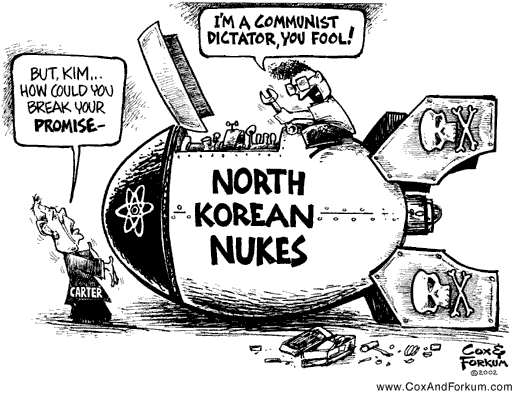
From David Holcberg of the Ayn Rand Institute:How did the "warmongers" at the White House react to North Korea's declaration that it had reprocessed enough nuclear fuel to make about six nuclear bombs? By insisting on a diplomatic solution through negotiations!
But it is precisely this wrongheaded approach that failed to prevent the current crisis-- and will ensure that North Korea becomes a nuclear power in the coming months.
Negotiations are moral--and practical--only between individuals who are open to reason, who respect each other's rights, and whose purpose is to exchange values for mutual benefit, without coercion. But the North Korean leadership is wildly irrational, has no respect for individual rights, and seeks, by threatening a nuclear attack, to blackmail the United States into surrendering its wealth.
The proper approach to eliminate this threat against the United States is not to negotiate with North Korea's thugs--but to kill them.
This classic cartoon from Cox and Forkum: summarizes the case against "Duplomacy":

Recommended Reading: Baby Kim Jong's Secret Weapon Against America
So why is it Baby Kim who is making the threats, and Uncle Sam who is doing the conceding? What does the baby have up his sleeve?
Jul 22, 2003 | Dollars & Crosses
How's this for nerve?While [U.S. Securities and Exchange Commission Chairman William] Donaldson said he supports the increased regulation and stepped-up enforcement that came from the Sarbanes-Oxley law, he said he was concerned that fear of the law was making companies less will to take risks and weighing down the U.S. economy. "Insofar as corporate managers are hesitant or reluctant to move ahead with business decisions because of a fear of conforming with Sarbanes-Oxley, I hope they will conform but I hope they will move on,'' Donaldson said in an interview in New York....
A year after the law's passage, it's time for companies to recognize its requirements are here to stay, Donaldson said. The law, signed by President George W. Bush last July, is not intended to "tie up American business in a regulatory regime that is counterproductive and expensive,'' Donaldson said.
"This isn't to say that to conform to Sarbanes isn't going to cost more money -- it is,'' Donaldson said. "There are going to have to be procedures put in to conform but that's a cost of doing business, a cost of what has happened, but I think people have to move on now.'' [Bloomberg]
Jul 22, 2003 | Dollars & Crosses
From today's New York Sun:When a group of Saudi women appeared on a TV discussion program to voice their grievances recently they got a mixed reception from viewers. Many applauded their boldness. Others complained that the participants in Saudi Women Speak Out had not gone far enough....
The application of an ultra-strict interpretation of Islam, historically alien to much of the country, technically prevents women from driving, traveling without being accompanied by a guardian, working alongside men or showing their faces in public. These rules are now starting to crumble as more women go out to work....
The religious police who not so long ago would have relished breaking up the fun are a demoralized bunch. Recently they turned up to remonstrate with some youths holding a party on the beach. As they trudged away after delivering their lecture the sound was turned back up....
The stifling conservatism of women's lives is a comparatively recent phenomenon. Women were the first to suffer the consequences of the failed uprising of Juhaiman al-Utaibi, a Muslim zealot and enemy of the al-Saud monarchy who with his followers took over the Holy Mosque in Mecca in November 1979. The rebels were crushed, and the 63 survivors publicly beheaded. The ruling family, though, was rattled and the religious police given free rein in an attempt to restore the government's Islamic credentials. "This sowed the seeds of a new religion," said Mrs.Fitaihi. "It had nothing to do with Islam. It was to do with power, using religion to control." ["An Opening for Saudi Women: Activists Seek Informal Loosening of Rules", The Daily Telegraph]