Jan 20, 2004 | Dollars & Crosses
From Cox and Forkum:
FoxNews reported Analysts Debate Costs of Bush Space Vision.
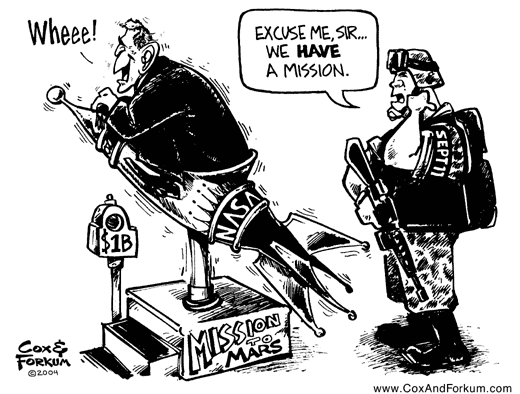
Now, I love the idea of space exploration as much as the next nerd. But there are at least two problems with President Bush's proposal to put men on Mars. The most important is, as the cartoon suggests, that the government is already charged with a crucial mission: the War on Terrorism. Just think how far $1 billion would go toward equipment and weapons that make our soldiers safer and more effective. This is not just a matter of quibbling over who should get government largess. It's a matter of what is appropriate for the government to do, and protecting us from our enemies should be its only priority -- particularly after 9/11.
The second problem with Bush's plan is that it is a basically socialism for space companies. A mission to Mars should be a private venture. If there are enough investors for such an idea, then it will not need government handouts. Certainly a private initiative would be more efficient than a government one. For an examination of how a private, capitalistic Mars venture might work, see Ron Pisaturo's op-ed Mars: Who Should Own It.It has often been said, even by vocal proponents of free enterprise who claim to hate government subsidies, that while private citizens are good at settling or homesteading, the government is good at exploring. They argue that we have always needed the government to do the exploring, to pave the way for the private settlers. My reply is: Recognize private property for exploring, and you will see that private citizens make better explorers than do government employees. [...]
As a capitalist and a lover of technology, I judge the Nasa space program and a Nasa mission to Mars to be morally a far better government expenditure than welfare-state programs such as Medicare, public housing projects, etc. At least NASA is creating something of value that benefits all Americans, instead of just taking money from producers and giving it away to non-producers. And I idolize American astronauts and NASA engineers for their heroic achievements. But we will never know what these same heroic achievers would have accomplished if NASA had been a private company with a chance to own the moon -- and if all the money the government spent on NASA had remained in the hands of private citizens and had been invested in other equally heroic ventures that we will never know about; we will never know about these other ventures because they were not allowed to happen -- because the money needed to finance them was taken from their rightful owners.
Jan 19, 2004 | Dollars & Crosses
Harry Binswanger has an excellent article criticizing David Frum and Richard Perle for their claim that foreign policy "hard-liners" are realists and pragmatists, while the "soft-liners" are ideologues:
Pragmatism is an anti-philosophy. It is the philosophic position that philosophy is hot air. It is concrete-boundedness, posing as philosophy.
Pragmatism holds--and has to hold, given its metaphysics and epistemology--that what was true yesterday may not be true today or tomorrow....
Pragmatism is not realism. Pragmatism is, in fact, inconsistent with realism. Realism (in the positive sense of that term) means acting in accordance with the facts of reality. To do that, one has to accept that facts are facts and to maintain a long-range, conceptual awareness of reality. That's the level of awareness that man requires if he is to act successfully in reality. It is only a grasp of principles, which Pragmatism scorns, that makes it possible to understand how and why "negotiating" with and "dialoguing" with dictatorships is doomed to failure.
The authors are right that the soft-liners evade the historical evidence of the failure of their approach. But that is not because the soft-liners are "ideologues," but because they are pragmatists.
Put it this way: the soft-liners are ideologues of pragmatism. They hold as their only absolute that there are no absolutes. They are rigidly fixated on the idea that everything is fluid and flexible.
They are dogmatically certain that there is no certainty.
I have always found it hard to understand why people would think that principles are impractical just because they hold that what's true is what works in reality. But recently I came across a greeting card that expresses the pragmatist's credo perfectly:
"No one can possibly know what is about to happen. It is happening each time, for the first time, for the only time."--James Baldwin
How does the pragmatist get from "what's true is what works" to "what's true today may not be true tomorrow"? Pragmatism is a doctrine that arose after philosophers rejected the law of causality and the validity of induction. For them, reality can only be a chaotic flux, because there is no basis in reality for making generalizations.
What justifies abstract ideas, then? Pragmatism holds that theoretical knowledge is true when it works "in practice"--which means: If your theory or principle leads to certain predictions, and those predictions turn out to be true in reality, then your theory is true.
But this is just the logical fallacy of affirming the consequent, or, as Dr. Binswanger puts it, the reversal of cause and effect. If your theory says P, and P implies Q, then just because you learn that Q is true doesn't mean that P is true--there could be many other reasons why Q is true.
That's why the pragmatist thinks that a theory is only "tentatively" true, and what's true today may not be true tomorrow. If one rejects the law of causality and the validity of induction, there is no way one can affirm the absolutism of principles.Jan 18, 2004 | Dollars & Crosses
Andrew Sullivan quotes Al Sharpton at the recent Democrats' debate:
"Oh, in the Federal Reserve Board, I would be looking for someone that would set standards in this country, in terms of our banking, our--in how government regulates the Federal Reserve as we see it under Greenspan, that we would not be protecting the big businesses; we would not be protecting banking interests in a way that would not, in my judgment, lead toward mass employment, mass development and mass production." - Revd. Al Sharpton , Democratic candidate for president, at the New Hampshire debate. Please send in any new incoherent, uninformed, ill-phrased nonsense from a man the Democrats keep pretending to take seriously.
Jan 17, 2004 | Dollars & Crosses
A heart wrenching article "Girls for Sale" at the NYTimes discusses the lives of two prostitute slaves in Cambodia:
One thinks of slavery as an evil confined to musty sepia photographs. But there are 21st-century versions of slaves as well, girls like Srey Neth. I met Srey Neth, a lovely, giggly wisp of a teenager, here in the wild smuggling town of Poipet in northwestern Cambodia. Girls here are bought and sold, but there is an important difference compared with the 19th century: many of these modern slaves will be dead of AIDS by their 20's.
...Srey Neth claimed to be 18 but looked several years younger. She insisted at first (through my Khmer interpreter) that she was free and not controlled by the guesthouse. But soon she told her real story: a female cousin had arranged her sale and taken her to the guesthouse. Now she was sharing a room with three other prostitutes, and they were all pimped to guests.
...Why not try to escape at night? "They would get me back, and something bad would happen. Maybe a beating. I heard that when a group of girls tried to escape, they locked them in the rooms and beat them up." "What about the police?" I asked. "Couldn't you call out to the police for help?" "The police wouldn't help me because they get bribes from the brothel owners," Srey Neth said, adding that senior police officials had come to the guesthouse for sex with her.
I asked Srey Neth how much it would cost to buy her freedom. She named an amount equivalent to $150. "Do you really want to leave?" I asked. "Are you sure you wouldn't come back to this?" She had been watching TV and listlessly answering my questions. Now she turned abruptly and snorted. "This is a hell," she said sharply, speaking with passion for the first time. "You think I want to do this?"
Read the full article here.Jan 16, 2004 | Dollars & Crosses
The New York Sun's editorial asks the sensible question: "What is the city government doing regulating the number of taxis in the city?" ["Medallion Madness," January 2, 2004]. Limiting the number of cabs was probably intended to protect cabbies' incomes from competition -- so now a large proportion of fares instead goes toward paying off mortgages on medallions.
This is progress?
And why should someone who wants to drive a cab be forbidden from doing so just to fatten someone else's wallet? True, ending restrictions on cabs might crowd city streets -- but the appropriate response would be to remove restrictions on private vans and buses as well. Then we could avoid wasting billions on the Second Avenue Subway sinkhole.Jan 16, 2004 | Dollars & Crosses
Writes David Holcberg of the Ayn Rand Institute:
The United States should demand that the new Afghan constitution include an explicit separation of state and religion. It makes no sense to have gone to war to overthrow one tyrannical Islamic theocracy just to replace it with another one. But to do that would require the current administration to identify Islamic fundamentalism as our ideological enemy and to recognize that the separation of state and religion is a crucial requirement of freedom not only in Afghanistan, but also here in America.
Recommended Reading: