May 31, 2004 | Dollars & Crosses
From the International Herald Tribune on the E.U.'s legislature's "well-oiled system of perks and privileges":
...which might make a corporate president smile in recognition: chauffeured cars; daily and monthly stipends that can add tens of thousands of euros to basic salaries; jobs for relatives paid out of a E150,000 (about $180,000) a year secretarial allowance; free health care; pensions that, as one legislator put it, can put "gin on the terrace"; and, most stunningly, a travel expense procedure that reimburses legislators for as much as 10 times the amount of their airfare ticket prices. According to payroll and expense records obtained by the International Herald Tribune and The New York Times, a legislator can add well over E100,000 to a base salary when all the tax-free benefits are calculated...
...Budgeted at nearly E100 million in the aggregate, European deputies' benefits easily top those for members of any EU-member national parliament. (The U.S. Congress, in which members of the House receive million-dollar budgets to finance sizable staffs is another story, but nepotism in hiring is barred there and reimbursement is generally tied to actual costs incurred.) ["Perks at EU Parliament: A system out of control?"]
May 27, 2004 | Dollars & Crosses
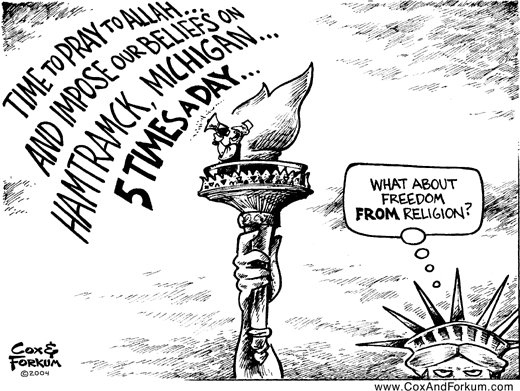
From Cox and Forkum:
AP reports: Michigan Mosque Loudspeaker Issue on Ballot:HAMTRAMCK, Mich. - A noise-ordinance change that would allow mosques to broadcast calls to prayer on loudspeakers will be put to a citywide vote after opponents gathered hundreds of petition signatures. [...]
The council had voted unanimously last month to allow the Bangladeshi Al-Islah Mosque to broadcast the call to prayer five times a day. [...]
The Al-Islah mosque plans to begin broadcasting the calls on Friday. Abdul Motlib, head of the mosque, said he was confident the measure would win a citywide vote. "Hamtramck has 23,000 people. If 500 or 600 people go against us, we're not losing nothing."
May 26, 2004 | Dollars & Crosses
From Cox and Forkum:
CNN reported this weekend: Moore's 'Fahrenheit 9/11' wins Cannes award."Fahrenheit 9/11" was the first documentary to win Cannes' prestigious Palme d'Or since Jacques Cousteau's "The Silent World" in 1956.
Michael Moore's far left politics are bad enough, but the fact that his political films continue to win major awards as documentaries is absurd.
The American Heritage Dictionary defines documentary as: "Presenting facts objectively without editorializing or inserting fictional material, as in a book or film." Editorialize is defined as: "To present an opinion in the guise of an objective report."
Moore proudly notes on his web site regarding his Cannes award: "It is the first time in nearly 50 years a documentary has won the Palme d'Or (the Golden Palm)." [Emphasis added]
Yet in a 2003 interview (viewable here and on DVD), Evan Coyne Maloney pointed out to Moore that his films are more like video editorials. Moore responded:"Yeah, it's like an op-ed piece in the newspaper. These are my opinions. I'm very up front about them. I don't try and disguise them. I don't try to present them as objective news. They're not. They're very subjective."
Even when Moore himself admits to editorializing (which is likely his justifications for the distortions and fabrications that taint his work), he still wins awards for his "documentaries." Perhaps there needs to be a new category for what Moore creates; there's already one word that comes close: advertorial.
Of course, Moore is free to express and market his political opinion. But passing them off as documentaries and accepting awards for them as documentaries is artistic fraud.
Evan Coyne Maloney points out how Moore's Fahrenheit 9/11 will function as a Democrat-promoted political advertisement that skirts the campaign finance reform laws: The Michael Moore Loophole.
And in Michael Moore and Me, Fred Barnes, executive editor of The Weekly Standard, describes how Michael Moore lied about him.May 25, 2004 | Dollars & Crosses
From the UK Independent:
Teenage rape victims fleeing war in the Democratic Republic of Congo are being sexually exploited by the United Nations peace-keeping troops sent to the stop their suffering. The Independent has found that mothers as young as 13 -- the victims of multiple rape by militiamen -- can only secure enough food to survive in the sprawling refugee camp by routinely sleeping with UN peace-keepers.
May 25, 2004 | Dollars & Crosses
From Cox and Forkum:
James Taranto has a number of good links regarding leftward media bias (and even one about the rightward bias). The lead entry is an op-ed by Michael Barone, who states:[T]oday's press works to put the worst possible face on the war. ... Hence the endless dwelling on the abuses in the Abu Ghraib prison and the breathless speculation that it would drive Defense Secretary Donald Rumsfeld from office. Instead, an ABC/Washington Post poll showed the public 69 percent to 20 percent against Rumsfeld's resignation. Hence the much lesser coverage given to the murder of Nick Berg. Hence the microscopic coverage of the finding of the deadly poison sarin in an improvised explosive device -- mustn't give credence to the possibility that Saddam was conducting (as inspector David Kay said) weapons of mass destruction programs.
Taranto also notes that the latest Pew survey of media professionals and the public found:55% of national journalists say they think the press is "not critical enough" of President Bush; only 24% of the public agrees. Thirty-four percent of the public thinks the press is "too critical," vs. a mere 8% of the national press. Thirty-five percent of both groups characterize coverage of the president as "fair."
After detailing a few more statistics indicating a port-side list in the media, Taranto concludes:All this suggests that journalists not only are considerably more liberal than the general public but also wish their own coverage were more liberal than it is.
Glenn Reynolds also has some relevant comments and links. Steven Den Beste has a number of great links and comments on media bias and Bush's speech. He also points to an op-ed by Michael Moran that attempts to blunt criticism of the media."Call [criticism the media for biased coverage] a fallback strategy: the media lost the war," says Tom Rosenstiel, a former Los Angeles Times correspondent who now runs the non-profit Project for Excellence in Journalism. "It's very convenient politically for an administration that's under fire for its war policy to blame the messenger. [...]"
So if things go badly in Iraq, the theory goes, then "war supporters" will use the media as a scapegoat. This is a straw man constructed to divert attention away from legitimate criticism. Obviously the media could not single-handedly lose (or win) the war. There are many factors. But it's preposterous to dismiss the impact of war coverage that emphasizes negative news instead of objectively reporting the full context.May 24, 2004 | Dollars & Crosses
Writes John Lott on FoxNews:
Crime did not fall in England after handguns were banned in January 1997. Quite the contrary, crime rose sharply. Yet, serious violent crime rates from 1997 to 2002 averaged 29 percent higher than 1996; robbery was 24 percent higher; murders 27 percent higher. Before the law, armed robberies had fallen by 50 percent from 1993 to 1997, but as soon as handguns were banned, the robbery rate shot back up, almost back to their 1993 levels. Australia has also seen its violent crime rates soar after its Port Arthur gun control measures in late 1996. Violent crime rates averaged 32 per cent higher in the six years after the law was passed (from 1997 to 2002) than they did the year before the law in 1996. The same comparisons for armed robbery rates showed increases of 45 percent. The 2000 International Crime Victimization Survey, the most recent survey done, shows that the violent crime rate in England and Australia was twice the rate in the US.