Oct 31, 2004 | Dollars & Crosses
From MEMRI's "Arab and Iranian Media on the U.S. Presidential Election" [10/29/04]:
"In contrast, former Iranian foreign minister and exiled leader of the Iranian Freedom Movement opposition group Dr. Ibrahim Yazdi expressed his explicit support for Senator Kerry, saying that as president he would benefit Iran more. In an article in the reformist daily Sharq, Yazdi wrote that Bush was the Jews' "New Messiah" and that if he was reelected the U.S. would continue in its unilateral Middle East and Iranian policy. Bush, who would not be reelected again for a third term, would be able to implement his policy with greater determination, whereas if Kerry won the election, said Yazdi, he would seek cooperation with and consideration of the European Union countries, and even cooperation with Japan, China, and Russia. As a result of this policy of cooperation, the U.S. and Europe would change their policy in favor of Iran's nuclear program." [Sharq (Iran), September 11, 2004.]
See also: Endorsements for President Bush by John Lewis, Ph.D.Oct 31, 2004 | Dollars & Crosses
Reports that Martha Stewart is making her own food in prison illustrate the heroic actions of an unbreakable person. Prison will not get her down. Prison cannot tear her apart from her core value to make life more pleasant, no matter what the circumstances. This attitude is profoundly inspiring, completely American and eminently healthy.
Those who wanted to see Martha Stewart go to jail not over alleged violations of the law so much as to "cut her down a notch" will take no comfort in these reports. A woman who can find ways to brighten up even a prison term deserves not mockery or sneers, but the highest form of admiration one can muster.
In a world where so many demand something for nothing, it's beyond refreshing to see Martha Stewart make something out of nothing.Oct 29, 2004 | Dollars & Crosses
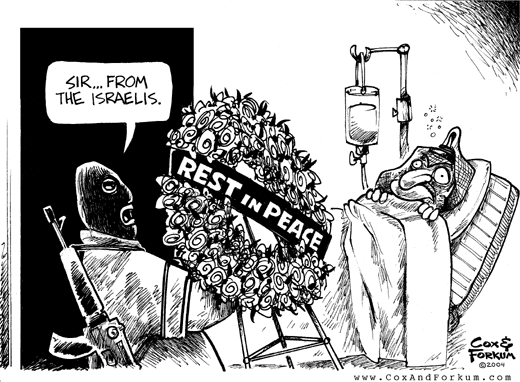
From Cox and Forkum:
CNN reports: Doctor: Arafat has blood platelet deficiency.Oct 29, 2004 | Dollars & Crosses
IRVINE, CA--The recent controversial decision by Interior Secretary Gale Norton to open up to oil and gas exploration 2.6 million acres in Utah, previously off limits as a potential "wilderness areas," is morally correct, says Dr. Andrew Bernstein, senior writer for the Ayn Rand Institute.
The conflicting values at the heart of this and most other environmental controversies are very clear, says Dr. Bernstein: "the value of human survival vs. the preservation of birds, snakes, insects, trees and rocks.
"Environmentalists allege that wildlife and ‘pristine' wilderness have value in and of themselves, apart from any use they have for man. Consequently, even when human prosperity requires industrial development of a wild area, they oppose it because of the ‘intrinsic value' of nature.
"To be a champion of human life on earth, one must uphold as a moral absolute the requirements of human life and well-being. No other consideration is relevant, certainly not the pseudo-rights of animals and vegetation."
Bernstein concludes that "industrial development, including that of oil and natural gas in America's western states, is an enormous boon to human living standards and life expectancies. Consequently, Secretary Norton's decision in this case to protect the rights of men to promote human life on earth is the only moral choice possible."Oct 28, 2004 | Dollars & Crosses
IRVINE, CA—"If the majority of Americans voted for a Christian democracy or a Jewish democracy or an Islamic democracy, i.e., a theocracy, in this country, would you accept it?" asks Dr. Andrew Bernstein, a senior writer for the Ayn Rand Institute.
The answer to Dr. Bernstein's question is not just a choice between unlimited majority rule and the First Amendment's prohibition against the establishment of religion. "Those who advocate unlimited majority rule," says Bernstein, "not only endanger the First Amendment, they threaten all our freedoms and the very foundations on which this country is built.
"America is not a democracy, i.e., an unlimited majority rule system; it is a constitutionally limited republic. And the primary limiter is individual rights. All of our freedoms, such as freedom of speech, freedom of religion and freedom of the press, are necessary conditions required to exercise our inalienable rights to life, liberty and the pursuit of happiness. It does not matter what the majority wants, individual rights come first; the majority, no matter its number or religion, may not vote to ignore, take away or violate anyone's individual rights."Oct 28, 2004 | Dollars & Crosses
Writes blogger James Lileks on the U.N.'s Favorite Terrorist:
All you need to know about Arafat was that he insisted on wearing a pistol when he addressed the UN General Assembly. And all you need to know about the UN, I suppose, is that they let him.
Just in case you need to know more...
Arafat's Despotism: Innocent Palestinians are Better Under Israeli Rule by Yaron Brook
Remember the mayor of a Palestinian village, Zuhir Hamdan, who publicly stated that his villagers preferred to live, not under Arafat, but Israel?
UN Declaration of Rights Destroys Rights by Glenn Woiceshyn
The concept of rights is older than the United Nations but relatively new in human history -- a predominantly savage and bloody history of war, murder, slavery, rape and looting committed by humans against humans. Such is "life" when people regard each other as sacrificial fodder for their needs, desires or superstitions.Oct 28, 2004 | Dollars & Crosses
Some of you may remember receiving the message below from me 4 years ago about how the record labels could protect property rights to music in cyberspace by using decoy files.
For anyone looking to defend property rights and make money at the same time, here's an interesting business model I discovered:
The Tabloids, an Oakland-based rock band... recently launched stopnapster.com, urging people to sabotage Napster by mislabeling songs posted to the site. Music entrepreneurs and Internet saboteurs have already started circulating fake versions of popular songs on Napster.
Stopnapster.com also calls for releasing songs into Napster that have anti-piracy speeches inserted randomly into the music. For instance, you may be listening to Eminem when suddenly Charlton Heston begins reading a public interest message opposing song theft... "We're looking at the big picture here. Intellectual property is intellectual freedom," says Michael Robinson, the band's leader, a freelance writer and a marketing consultant. "The U.S. Constitution and the Internet are on a collision course. We don't want our rights ripped off," he adds. The Tabloids seek government regulation of technologies like Napster's. (From Digital Music Weekly,
You could probably get this funded as an Internet business model. Get permission from bands to use their songs, and thirty seconds in start mixing in voiceovers of interviews with the band, etc. Then create all kinds of bogus music servers and spam the hell out of Napster, Gnutella, etc. with the fake mp3s. (Actually, I hear the Nettwerk label just did this with the new Barenaked Ladies single.)
The band gets advertising and fights theft, you make a little money selling the ads, and the Net gets clogged with so much music spam that it gets difficult and costly to find intact pirated tracks. If Napster raises technical barriers, you have a financial incentive to overcome them. And the pirates can't very well call on the law to protect them, can they?
Personally, I find something deliciously satisfying in the image of some young thug, smugly expecting to marinate his brain in the latest Eminem tirade he's swiped off the net, getting an earful of Charlton Heston. [Spamming for Freedom, July 4, 2004]
A report in the paper today indicates it's finally catching on:
The music industry may finally be winning its game of music piracy whack-a-mole, thanks to the use of increasingly effective technological hammers....And while the RIAA has been smacking downloaders with lawsuits, individual record labels have contracted technological mercenaries to make using the peer-to-peer networks where people go to illegally download music more difficult.
"The whole idea is to increase the frustration and take away the fun quotient of these networks," said an executive from one company that provides such services, Marc Morgenstern. His company, Overpeer, protects 70,000 music, video, and software titles from piracy by flooding the most popular networks — Kazaa, Grokster, and eDonkey, among others — with thousands of garbage data files bearing the titles of popular songs. The decoys appear at the top of user searches for the title. On searches for the most popular songs, fake files sometimes constitute 95% of the results. ["Music Industry Foils Pirates By Seeding Networks With Fake Files", NYSun]
Oct 28, 2004 | Dollars & Crosses
From Cox and Forkum:
Oct 27, 2004 | Dollars & Crosses
From Cox and Forkum:
From the International Herald Tribure: Vote in U.S. inflames Europeans.Judging from opinion polls, media reports and conversation on this side of the Atlantic, the overwhelming sentiment on what would be bad for Europe is another four years with President George W. Bush. In Britain, France, Germany, Spain and the Netherlands, Europeans appear to be united by an overwhelming antipathy toward Bush. ...
European media are sending correspondents all over the United States in an effort to delve into the American psyche. "We want to understand why so many people are still on Bush's side; it's a kind of mystery to us," said Peter Frey, Berlin bureau chief for ZDF television in Germany. "We are asking the American people, 'Why are you voting for Bush?' We want to understand why he has this support." ...
For many Europeans, it is not what Kerry would do as president that matters, it is the way they think he would do it.
"The fact that Kerry has an attitude in which he feels he wants to consult the allies and is less arrogant in his relationship with allies, puts him in a much more positive light here," said Nathalie La Balme, program officer at the Paris office of the German Marshall Fund. "I don't know whether if Kerry gets elected anything will change. But in terms of attitude and perception and words, it would make a big difference."
Oct 27, 2004 | Dollars & Crosses
The Stolen Honor is available online for free at http://www.stolenhonor.com/documentary/watch-video.asp
From the site:
Stolen Honor investigates how John Kerry's actions during the Vietnam era impacted the treatment of American soldiers and POWs. Using John Kerry's own words, the documentary juxtaposes John Kerry's actions with the words of veterans who were still in Vietnam when John Kerry was leading the anti-war movement.
Oct 26, 2004 | Dollars & Crosses
From the WSJ:A study suggests that U.S. senators possess stock-picking skills that even the most seasoned money manager would envy. During the boom years of the 1990s, senators' stock picks beat the market by 12 percentage points a year on average, according to the study. Corporate insiders, meanwhile, beat the market by about six percentage points a year, while U.S. households underperformed the market by 1.4 percentage points a year on average, according to separate studies. The final details of the study will be published in the December issue of the Journal of Financial and Quantitative Analysis. ...
Looking at the timing of cumulative returns, the senators also appeared to know exactly when to buy or sell their holdings. Senators would buy stocks just before the shares suddenly would outperform the market by more than 25%. Conversely, senators would sell stocks that had been beating the market by about 25% for the past year just when the shares would fall back in line with the market's performance.
I wonder how many government officials made money off ImClone using the same "inside information" that sent Sam Waksal to jail?
The researchers say senators' uncanny ability to know when to buy or sell their shares seems to stem from having access to information that other investors wouldn't have. "I don't think you need much of an imagination to realize that they're in the know," says Alan Ziobrowski, a business professor at Georgia State University in Atlanta and one of the four authors of the study.
Senators, for example, are likely to know which tax legislation is apt to pass and which companies might benefit. Or a senator who sits on a certain committee might find out that a particular company soon will be awarded a government contract or that a certain drug might get regulatory approval, says Prof. Ziobrowski.
Oct 26, 2004 | Dollars & Crosses
From Cox and Forkum:
A controversy over whether or not Iraqi stockpiles of RDX and HMX explosives went missing before or after U.S. forces arrived has effectively defused yesterday's "breaking" story as an immediate threat to Bush's campaign. By midday the story was already off CNN's main page as a separate news item (FoxNews, however, still has it front and center). FoxNews reports: When Did Missing Explosives Disappear?.The mystery over tons of missing explosives in Iraq turned Tuesday from a question of what happened to them to when they disappeared.
The United Nations' nuclear department, the International Atomic Energy Agency, warned Monday that insurgents may have stolen the 380 tons of conventional explosives -- the kind used in the car bombing attacks that have killed many soldiers and bystanders in Iraq.
But senior Defense Department officials told FOX News they're not sure whether looters made off with the explosives or whether Saddam moved them before the war began. NBC News reported Monday night that one of its reporters was embedded with the 101st Airborne. She watched the troops conduct what can be described as a "cursory search" of the premises on April 10, and found a great deal of conventional ordnance, but no RDX or HMX.
Such questions haven't stopped Kerry from trying to exploit the issue: Kerry Blasts Bush on Missing Ammo.Kerry accused President Bush on Tuesday of trying to cover up bad decisions relating to the execution of the war in Iraq and alluded to the possibility that more bad news has yet to be uncovered.
"Mr. President, what else are you being silent about? What else are you keeping from the American people?" Kerry said during a speech in Green Bay, referring to the estimated 380 tons of highly explosive material that have gone missing from an arms depot in Iraq.
Although Kerry and the Democrats are blaming the Bush administration for losing the ammo, calling it "one of the great blunders" of the Iraq war, recent reports by NBC and further details given by the Pentagon and International Atomic Energy Agency on Tuesday suggest that the material may have been missing before the 101st Airborne Division rolled into the Al-Qaqaa facility as Saddam Hussein was being deposed in nearby Baghdad in April 2003.
Vice President Dick Cheney responded for Bush from Florida, saying, "It is not at all clear that those explosives were even at the weapons facility when our troops arrived in the area of Baghdad."
Also today, Kerry released a campaign commercial that capitalizes on the story. Apparently they did a quick edit on another commercial and inserted the new claims. (Via Little Green Footballs)
James Taranto has more: The Times Spoils CBS's Surprise.
Update October 27: This story is more complex than yesterday's reports indicated. Belmont Club has more about who saw what when and where: The RDX Problem Resolves Itself. And The Wall Street Journal ponders the political aspects of the story: Munitions Overkill.
Looks like the fuse is still smoldering after all. The story is back on CNN's main page: Missing Iraqi explosives fuel campaign rhetoric.Oct 26, 2004 | Dollars & Crosses
Excellent reasons to avoid the barbaric religious practice of circumcision:
If physicians would simply leave the newborn's penis alone, as Dr. Benjamin Spock recommends in the latest edition of Baby and Child Care, the foreskin would be left to fulfill its several functions. In infancy, the foreskin protects the glans from irritation and from fecal material. In adulthood, the function of the foreskin may at first seem obscure. The shaft and the glans of an intact (uncircumcised) man's penis are covered by skin. Retracting the foreskin reveals the glans and makes the skin on the shaft somewhat loose. Of what use is this redundant skin? During erection, the penile shaft elongates, becoming about 50% longer. The foreskin covers this lengthened shaft. It is designed to accommodate an organ that is capable of a marked increase in diameter, as well as length.
In addition, the foreskin is the most sensitive part of the penis and can enhance the quality of sexual intercourse. Anatomical studies demonstrate that the foreskin has a greater concentration of complex nerve endings than the glans. If there were any possibility that the foreskin could contribute significantly to sexual enjoyment, is that not a cogent reason for rethinking our motives for this ritual procedure?
History shows that the arguments in favor of circumcison are questionable. At the beginning of this century, one of the reasons given for circumcision was to decrease masturbation, which was thought to lead to insanity and other "morbid" conditions. We now know that circumcision does not prevent masturbation, nor does masturbation lead to insanity. More recently, circumcision was promoted as a means of preventing cervical cancer in the man's sexual partners; this notion has been proved incorrect. The current excuses are that failure to remove the foreskin may contribute to urinary tract infections and penile cancer, but neither of these contentions has been proved. Even if either were correct, the risk of urinary tract infection in an uncircumcised infant is only one in one hundred. Performing 100 mutilative surgeries to possibly prevent one treatable urinary tract infection is not valid preventive medicine - it is just another excuse. Penile cancer occurs in older men at the rate of approximately 1 in 100,000. The idea of performing 100,000 mutilating (by definition) procedures on newborns to possibly prevent cancer in one elderly man is absurd. Applying this type of reasoning to women would lead to the conclusion that removing all breasts at puberty should be done to prevent breast cancer. ["Unnecessary Circumcision", George C. Denniston, M.D., M.P.H.]
For more information visit doctorsopposingcircumcision.orgOct 26, 2004 | Dollars & Crosses
Writes Stephen Morris on the meaning of John Kerry's election:
Kerry's 34-year record in public life indicates that he never understood what the Cold War was about and that he does not understand the nature of the US's rogue-state or Islamist terrorist enemies now....Kerry thinks that the war on terror is like "the war against organised crime". Both, he insists, are examples of forces of chaos. Really? Since when did organised crime want to create chaos? Have you noticed the Mafia engaged in suicide bombing? Flying planes into buildings? When did any mob consider poisoning the nation's water supply? Have you heard that they are trying to acquire nuclear weapons? And is organised crime anywhere trying to convert Christian infidels to the Muslim religion? ["Stephen Morris, "Danger man John Kerry", October 25, 2004]
On Kerry holding the U.N. above the U.S.:
...As The Washington Post recalled last week, discussing the possibility of US troops being killed in Bosnia in 1994, he said: "If you mean dying in the course of the United Nations effort, yes, it is worth that. If you mean dying American troops unilaterally going in with some false presumption that we can affect the outcome, the answer is unequivocally no."
On Kerry the "moral relativist":
...Unlike many American liberals, Kerry has often expressed his discomfort with the US criticising other nations for their repressive domestic policies. Thus a Kerry administration will be one that not only does not promote democracy, it will be one in which gross human rights abroad are given little attention.
On Kerry's "soft spot" for dictators:
In 1990, in a rare act of post-Cold War political unity, the UN Security Council approved a plan to end the war in Cambodia with a UN temporary administration to organise elections in the country...Kerry opposed it. Instead, he wanted the Vietnamese-installed Hun Sen, formerly of the Khmer Rouge, to organise elections. It seems that Kerry's preference for a UN role in conflict resolution is mainly to shackle American power, but not the power of his favourite little dictatorships.
...Kerry's soft spot for the dictators of Third World countries was not confined to Vietnam and Cambodia. During the Cold War Kerry was opposed to using force against all adversaries. This was especially so in the case of Nicaragua, where Kerry began his diplomatic showboating with the Sandinistas in 1985, but also in Grenada and the 1991 Gulf War to evict Saddam from Kuwait. Kerry's benign attitude towards dictators will affect one of the US's two greatest contemporary security threats: the nuclear arming of North Korea and Iran.
Read Dr. Harry Binswanger's article for more analysis on the 2004 elections.Oct 26, 2004 | Dollars & Crosses
What a culture of submissiveness means--and how it is enforced:
On August 26, Qatar TV aired a panel discussion that included Dr. Ibrahim Elias, and the Director of The Women's Development Society, Imam Bibars, who discussed a study she performed in the Arab world: "I'd like to say that I found something that took me by surprise. I call it 'a culture of the electricity cable.' The men in the study did not know one another, but they all used to beat their wives with electricity cables. These cables are large and they would beat their wives." In defense of beatings, Dr. Elias, a lawyer, explained, "If you beat your wife and it's only light beatings in order to set things straight -- that's it...We tell him, 'They are not considered an assault, but discipline.'" Responding to the question, "What do you mean by light beatings?" he gave an example of when a man should be beat his wife: "For example, a man comes home from work and finds his wife watching TV. She doesn't even get up to make him food. He tells her once, twice, and asks again. If only once he would raise his voice and beat her, she would get up to prepare food for him and by the next day she'd be obedient. This will last for a week and when she forgets, he will remind her." ["Arab TV Instructs On Wife-Beating", NYSun, October 20, 2004]
The whole article is worth reading.Oct 25, 2004 | Dollars & Crosses
From Our Oldest Enemy: A History of America's Disastrous Relationship with France by John J. Miller and Mark Molesky:
...The tale of Franco-American harmony is a long-standing and pernicious myth. The French attitude toward the United States consistently has been one of cultural suspicion and dislike, bordering at times on raw hatred, as well as diplomatic friction that occasionally has erupted into violent hostility. France is not America's oldest ally, but its oldest enemy.
The true story of Franco-American relations begins many years before the American Revolution, during the French and Indian Wars. Lasting nearly a century, these conflicts pitted the French and their Indian comrades against seventeenth- and eighteenth-century American colonists. French military officers used massacres as weapons of imperial terror against the hardy men, women, and children who settled on the frontier. At the age of twenty-two, George Washington nearly fell victim to one of these brutal onslaughts and was reviled in France as a murderous villain for many years (an opinion sustained by French propaganda and reversed only when the American Revolution made it politically necessary). Amid this tumult, the first articulations of a recognizably American national consciousness came into being. Indeed, America's first authentic sense of self was born not in a revolt against Britain, but in a struggle with France.
Although the French provided American colonial rebels with crucial assistance during their bid for independence, direct French military intervention came only after the Americans had achieved a decisive victory on their own at Saratoga. The French crown regarded the principles of the Declaration of Independence as abhorrent and frightening. French aristocrats viewed Lafayette with contempt and branded him a criminal for traveling to America against King Louis XVI's explicit command. The king and his government overcame their revulsion to the young republic only because they sniffed an opportunity to weaken their ancient rival Britain. To be sure, France did become an ally to the colonists for a few years in the late 1770s and early 1780s when American sovereignty served French geopolitical aims. But then the French believed that double-dealing against their erstwhile friends after Yorktown served their interests as well. During the peace talks, France sought to limit American gains because it feared the new nation might become too powerful. If the French had achieved all of their objectives in the Treaty of Paris in 1783, the United States today might be confined to a slender band of territory along the eastern seaboard, like a North American version of Chile...
Oct 24, 2004 | Dollars & Crosses
From Cox and Forkum:
AP reports: Kerry: Bush Allowed Bin Laden to Escape. (Via Little Green Footballs)"Can you imagine trusting them [Afghan warlords] when you have your 10th Mountain Division, the United States Marine Corps, when you had all the power and ability of the best-trained military in the world?" Kerry told a rally at the University of Nevada-Reno. "I would have used our military and we would have gone after and captured or killed Osama bin Laden. That's tough." ...
"You want to talk about the war on terror, Mr. President? Let's talk about it," Kerry yelled while his supporters cheered him on. "Let's talk about what happened when you let Osama bin Laden escape in Afghanistan.
"Let's talk about what happened when we had the world's number one terrorist, number one criminal, cornered in the mountains of Tora Bora. What did the president do? Do you know what he did? He outsourced the job of capturing him, just like he outsourced a lot of American jobs. He gave it to Afghan warlords who only one week earlier were fighting against us."
Fortunately retired General Tommy Franks -- who, unlike Kerry, was actually involved with the operations around Tora Bora -- put these charges to rest last week in The New York Times: War of Words.As commander of the allied forces in the Middle East, I was responsible for the operation at Tora Bora, and I can tell you that the senator's understanding of events doesn't square with reality.
First, take Mr. Kerry's contention that we "had an opportunity to capture or kill Osama bin Laden" and that "we had him surrounded." We don't know to this day whether Mr. bin Laden was at Tora Bora in December 2001. Some intelligence sources said he was; others indicated he was in Pakistan at the time; still others suggested he was in Kashmir. Tora Bora was teeming with Taliban and Qaeda operatives, many of whom were killed or captured, but Mr. bin Laden was never within our grasp.
Second, we did not "outsource" military action. We did rely heavily on Afghans because they knew Tora Bora, a mountainous, geographically difficult region on the border of Afghanistan and Pakistan. It is where Afghan mujahedeen holed up for years, keeping alive their resistance to the Soviet Union. Killing and capturing Taliban and Qaeda fighters was best done by the Afghan fighters who already knew the caves and tunnels.
Third, the Afghans weren't left to do the job alone. Special forces from the United States and several other countries were there, providing tactical leadership and calling in air strikes. Pakistani troops also provided significant help - as many as 100,000 sealed the border and rounded up hundreds of Qaeda and Taliban fighters.
Contrary to Senator Kerry, President Bush never "took his eye off the ball" when it came to Osama bin Laden. The war on terrorism has a global focus. It cannot be divided into separate and unrelated wars, one in Afghanistan and another in Iraq. Both are part of the same effort to capture and kill terrorists before they are able to strike America again, potentially with weapons of mass destruction. Terrorist cells are operating in some 60 countries, and the United States, in coordination with dozens of allies, is waging this war on many fronts.
As we planned for potential military action in Iraq and conducted counterterrorist operations in several other countries in the region, Afghanistan remained a center of focus. Neither attention nor manpower was diverted from Afghanistan to Iraq. When we started Operation Iraqi Freedom we had about 9,500 troops in Afghanistan, and by the time we finished major combat operations in Iraq last May we had more than 10,000 troops in Afghanistan.
Kerry could have learned similar information from Melanie Kirkpatrick of The Wall Street Journal who over a week ago wrote: Tora Bora Baloney. Kirkpatrick, like Kerry, wasn't involved in the military operations Tora Bora either. But unlike Kerry, she at least listens to people who were, such as Gen. Tommy Franks and his deputy, Lt. Gen. Michael "Rifle" DeLong:Getting the Tora Bora story right is important because Mr. Kerry's accusation goes to the heart of his broader charge against Mr. Bush -- that he bungled the war in Afghanistan. It's hard to be convincing on this point, when, less than three years later, 10 million Afghans have just gone to the polls in the first free election in their 5,000-year-old history. It's even harder to see how sending in thousands of U.S. troops to secure Tora Bora would have helped win that war faster -- even if it had resulted in bin Laden's death or capture. Mr. Kerry's criticism of the Tora Bora campaign also belies his promise to rely more on allies if he were commander-in-chief.
Oct 23, 2004 | Dollars & Crosses
From Cox and Forkum:
This cartoon is from the run-up to the 2002 congressional elections. Unfortunately, it's still relevant. AFP reports: Kerry campaign deploys army of lawyers in Florida. (Via Little Green Footballs)Still reeling from the 2000 election debacle in Florida, Democrats have deployed an army of lawyers in the battleground state that gave George W. Bush the presidency after five weeks of recounts and legal wrangling.
Less than two weeks from the November 2 presidential election, the legal team of Democratic contender John Kerry, as well as activist groups, have already filed a number of voting-related lawsuits in the state.
Many Democrats claim the Republicans stole the 2000 election after the Supreme Court halted 36 days of recounts and legal battles in Florida, leaving Bush with a 537-vote lead in the state that delivered him the presidency.
While both sides expect some trouble this time around, analysts generally doubt it will descend to the level of the last election, when lawyers, party leaders and state officials battled over hanging chads, butterfly ballots and other electoral oddities that turned Florida into an international laughing stock.