
Claus for Alarm
From Cox and Forkum:
Quote of the Day: “If capitalists are as evil as you say they are…”
Ayn Rand writing to John Hospers,"...if capitalists are as evil as you say they are, what magic faculty endows a politician with virtue? If men who deal with others by means of voluntary trade are selfish monsters--how does the possession of a gun, with the right to force others, transform a man into a selfless public servant.?"
Time and Again
From Cox and Forkum:
From The San Francisco Chronicle: President Bush named Time's Person of 2004 'for reshaping the rules of politics'.
President George W. Bush again holds the title of Time magazine's "Person of the Year" -- beating out Michael Moore, Mel Gibson and even his political adviser, Karl Rove. After a grueling campaign and a second election win behind him, Bush remains a polarizing figure in America and around the world, and that's part of the reason the magazine selected him, said Managing Editor Jim Kelly. "Many, many Americans deeply wish he had not won," Kelly said. "And yet he did." Bush, tapped in 2000 by Time, joins six other presidents who have twice been named the magazine's Person of the Year: Harry Truman, Dwight Eisenhower (first as a general), Lyndon Johnson, Richard Nixon, Ronald Reagan and Bill Clinton. Franklin Roosevelt holds the record with three nods from the editors.
Extreme Makeover
From Cox and Forkum: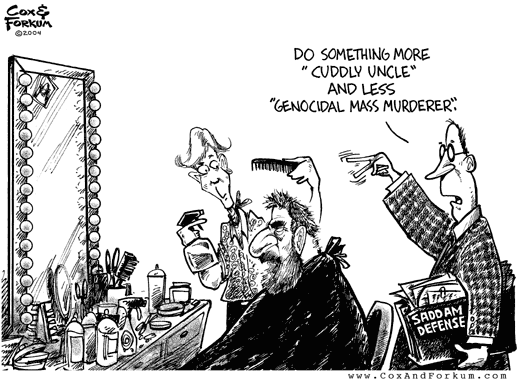
From his prison cell, ousted Iraqi President Saddam Hussein urged his compatriots to remain united against the U.S. occupation and warned of the potential dangers of the upcoming elections, his lawyers said Sunday. Iraqi lawyer Khalil al-Duleimi met with Saddam on Thursday, the first meeting since Saddam was captured a year ago. "Our representative in Iraq told us that the president warned the people of Iraq and the Arabs to beware of the American scheme aimed at splitting Iraq into sectarian and religious divisions and weakening the (Arab) nation," said Bushra Khalil, a Lebanese member of the defense team.This can only get worse.
At War
From Cox and Forkum: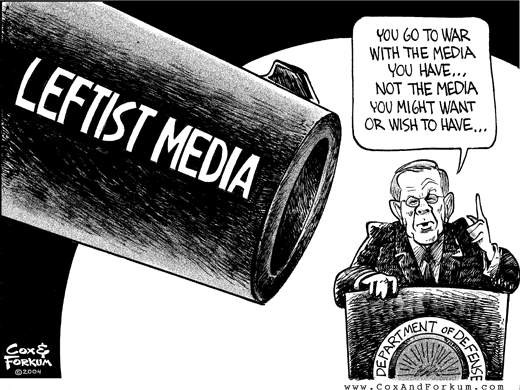
Nowhere was the media's irresponsibility on the Iraq conflict more acutely demonstrated than in the barrage of ugly news reports on Donald Rumsfeld's exchange in Kuwait with Spc. Thomas Wilson, an exchange that is still reverberating across the country. ... Virtually all the newspaper, magazine, radio, and TV accounts wildly misrepresented what happened next. As the Washington Post's Thomas Ricks "reported" -- and his piece was wholly representative of the media in general --" Rumsfeld replied: 'As you know, you go to war with the Army you have. They're not the Army you might want or wish to have at a later time." Rumsfeld, as the media would have it, was blowing off the deepest concerns of our men and women about to be placed in a deadly situation. ... But the official transcript of the Kuwaiti townhall meeting with the troops ... reveals an entirely different story. The first words out of Rumsfeld's mouth in response to Wilson were not what the media either said or implied or disclosed in film clips. They were, instead, words of encouragement. Rumsfeld dwelt at length on how much progress the military was making in solving the problem that began materializing a year ago August when the enemy started using explosives to blow up thin-skinned Army vehicles normally used in the rear of the combat zone. Nor was the secretary caught off guard by the question, as the media has suggested.The Wall Street Journal ran two good editorials on this subject this week: The first is by John R. Guardiano, an Arlington, Va.-based journalist who served in Iraq in 2003 as a field radio operator with the U.S. Marine Corps' Fourth Civil Affairs Group: Question Authority: What the media got wrong about Spc. Wilson and Secretary Rumsfeld.
To the media, it was a dramatic revelation of Bush administration hypocrisy and incompetence: A lowly American GI courageously speaks truth to power, thus showing that the emperor has no clothes. But to this Marine veteran of the Iraq war, the hullabaloo over Army Spc. Thomas J. Wilson's question reveals far more about media bias, prejudice and ignorance than it does about the U.S. military and Iraq. Spc. Wilson asked Defense Secretary Donald Rumsfeld why, nearly two years after the start of the war, his unit still has too few "up-armored" humvees. The media were surprised that an enlisted man would ask so direct and pointed a question of the Pentagon's highest official. I wasn't. I enlisted in the Marine Corps Reserve after Sept. 11, 2001, and served in Iraq in 2003. Throughout boot camp, combat training and subsequent preparation for war, my instructors always stressed the importance of independent thinking and initiative. Obviously, when you're in the middle of a firefight, you cannot -- and must not -- second-guess split-second command decisions. However, when preparing for war, thoughtful and considered questions are not only tolerated; they are encouraged -- even demanded, I found. As one of my combat instructors told us: "Marines, you're more likely to die from someone doing something stupid than because the enemy is skilled and ingenious. So make sure you've thought things through and that everyone's on the same page. Be polite. Be tactful. But don't be afraid to ask questions."The second WSJ editorial is by Brendan Miniter: Hunter's Gun Truck: One reason for the Iraq armor shortage: The military is too thorough.
Mr. Rumsfeld stirred up a hornet's nest last week by saying, "You go to war with the army you have. They're not the army you might want or wish to have." He's right. We cannot afford to make the mistake George McClellan did in the Civil War, endlessly preparing for war but not doggedly going after the enemy. Our soldiers deserve the best equipment and training money can buy. And that includes the best equipment they can use now, instead of waiting around for something better. Sometimes what's good enough today is better than what would be perfect sometime down the road.